I AM WHO I AM.
In the opening of Exodus, the narrative shifts from the favored status of Joseph’s family to the brutal enslavement of a nation. As the Israelites multiply despite Pharaoh's genocidal decrees, God prepares a deliverer, Moses, through a series of unlikely events: a royal upbringing, a self-imposed exile in Midian after a desperate act of violence, and a decades-long "waiting period" as a shepherd. The turning point occurs at the Burning Bush, where God reveals His eternal name, "I AM WHO I AM," and declares His intent to rescue His people. This begins a tense cycle of divine commission and human hesitation; Moses offers five distinct excuses for his inadequacy, all of which God answers with promises of His presence and miraculous signs. The initial attempt at deliverance seemingly fails when Pharaoh mocks God’s authority and intensifies the Israelites' labor, causing the people to turn against Moses. However, the section concludes with God's resolute promise to act with an "outstretched arm," shifting the focus from Moses' weakness to God's sovereign power to fulfill His ancient covenant. The Gospel Coalition Course on Exodus
- Exodus 1: Oppression in Egypt
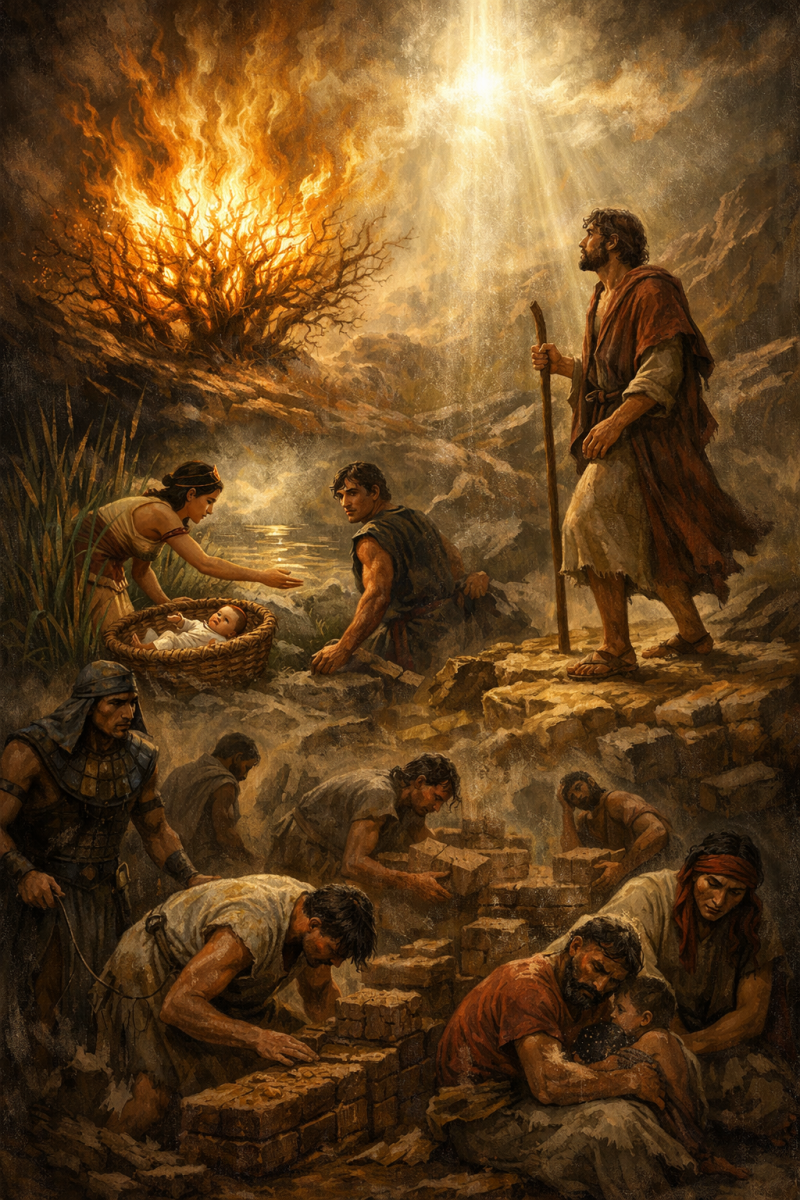
The generation of Joseph passes away, and a new Pharaoh rises who does not know Joseph. Fearing the rapid growth of the Israelites, he subjects them to forced labor and eventually orders the Hebrew midwives, Shiphrah and Puah, to kill all newborn boys. When the midwives fear God and refuse, Pharaoh commands that every Hebrew boy be thrown into the Nile River. - Exodus 2: The Birth and Flight of Moses
A Levite woman hides her newborn son for three months before placing him in a basket among the reeds of the Nile. He is found and adopted by Pharaoh’s daughter, who names him Moses. As an adult, Moses kills an Egyptian taskmaster for beating a Hebrew and flees to Midian to escape Pharaoh’s wrath. He settles there, marries Zipporah, and has a son named Gershom. - Exodus 3: The Burning Bush
While tending sheep at Mount Horeb, Moses encounters a bush that burns but is not consumed. God speaks from the bush, identifying Himself as the God of Abraham, Isaac, and Jacob. He commissions Moses to return to Egypt and lead the Israelites out of slavery to a "land flowing with milk and honey. " God reveals His name as "I AM WHO I AM" (YHWH). - Exodus 4: Signs and Return to Egypt
Moses expresses doubt about his ability, so God provides three miraculous signs: his staff turning into a snake, his hand becoming leprous and then healed, and water from the Nile turning to blood. Because Moses is "slow of speech," God appoints his brother Aaron to serve as his spokesperson. Moses returns to Egypt, and the elders of Israel believe him after seeing the signs. - Exodus 5: First Encounter with Pharaoh
Moses and Aaron requested that Pharaoh let the Israelites go into the wilderness to hold a festival for the Lord. Pharaoh refuses, famously asking, "Who is the Lord, that I should obey him?" He increases the people's workload by requiring them to gather their straw while maintaining the same quota of bricks. The Israelites turn against Moses in their increased suffering. - Exodus 6: God’s Promise of Deliverance
God reassures a discouraged Moses by reaffirming His covenant. He promises to redeem the Israelites with an "outstretched arm" and "mighty acts of judgment." This chapter also includes a partial genealogy of the houses of Reuben, Simeon, and Levi, specifically tracing the lineage of Moses and Aaron
As we browse the opening chapters of the book of Exodus, spanning from Exodus 1 to 6, we are presented with a narrative that not only recounts the Israelites' journey from bondage to freedom but also offers profound lessons for our lives. The passage highlights the theme of perseverance in the face of adversity. Despite being subjected to intense oppression and hardship by the Egyptians, the Israelites continued to grow in number and faith, demonstrating the power of resilience and trust in a higher power. Furthermore, the story of Moses' calling by God to lead the Israelites out of slavery serves as a testament to the idea that our past experiences and perceived shortcomings do not disqualify us from being used by God for significant purposes. Moses' initial reluctance and self-doubt are relatable, yet God's reassurance and empowerment of him underscore the concept that it is not our abilities but our willingness to obey and trust in God that ultimately matters. Additionally, the hardened heart of Pharaoh and the subsequent plagues that befell Egypt highlight the consequences of stubbornness and disobedience, reminding us of the importance of humility and receptivity to God's will. What I learned from Exodus 1-6 is that our faith journey is often marked by challenges and uncertainties, but it is in these moments that we are called to trust in God's sovereignty, to persevere, and to remain open to His leading, even when the path ahead seems unclear. By reflecting on these chapters, we are reminded that our lives are part of a larger narrative, one that is guided by God's redemptive plan, and that we, like the Israelites, can experience freedom, deliverance, and purpose when we surrender to His will.
Exodus 1-6 chronicles the pivotal early stages of God’s redemptive plan for the Israelites, transitioning them from oppression to freedom. The narrative opens with the Israelites, descendants of Jacob, flourishing in Egypt under Pharaoh’s growing suspicion, leading to their enslavement. The birth of Moses—spared from Pharaoh’s infanticide through divine providence—and his eventual flight after killing an Egyptian oppressor set the stage for his destined role. In Exodus 3, the iconic burning bush encounter reveals God’s call to Moses, commissioning him to confront Pharaoh and lead his people to the Promised Land. Acknowledging Moses’ reluctance and speech impediment, God appoints his brother Aaron as his spokesperson, underscoring themes of divine provision and human partnership. Despite Moses and Aaron’s initial pleas, Pharaoh hardens his heart, intensifying the Israelites’ suffering (Exodus 5). Yet, God reiterates His covenant to Abraham, Isaac, and Jacob in Exodus 6, affirming His faithfulness and the inevitability of deliverance. These chapters establish foundational themes of divine initiative, human frailty, and the unfolding of God’s promises, setting the spiritual and historical context for the Exodus to come.
When I sit down and reread Exodus 1‑6, I’m struck by how vividly the early chapters set the stage for one of the Bible’s most dramatic rescue stories. The Israelites are crushed under a new Egyptian king who fears their growing numbers, and yet God’s promise to Abraham is never abandoned—He is already weaving a plan of deliverance behind the scenes. What I learned here is that God’s faithfulness doesn’t depend on our circumstances; even in the darkest oppression, He is quietly at work.
The narrative of Moses’ birth, his rescue by Pharaoh’s daughter, and his later flight to Midian teaches me that God can use the most unlikely people for mighty purposes. I see a shy shepherd turned reluctant leader, and I’m reminded that leadership often begins in ordinary, even uncomfortable, places. When God finally calls Moses from the burning bush, the dialogue is strikingly human—“Who am I?” “What if they do not believe you?”—yet the answer is simple and powerful: “I will be with you.” This teaches me that divine partnership doesn’t erase my doubts, but it does promise presence through them.
The first signs of God's power—Moses' miraculous signs, the first plague of blood, and the promise that "the heart of the Egyptians will be hardened"—show that God cares about those who are suffering and is willing to fight against injustice. What I've learned is that while God's justice may take time to manifest, it is unavoidable, and my responsibility is to stand alongside those who endure hardship, believing that God is actively working towards their liberation. In short, Exodus 1‑6 reminds me to hold onto hope, to listen for God’s call even when I feel unqualified, and to believe that faithful obedience—however small—participates in God’s grand rescue plan.
REPLIES
Add comment
Comments