When the Voice Stilled the Wind
"Mount Sinai Experience," where the Lord moves from delivering Israel physically to organizing them spiritually through covenants and laws.
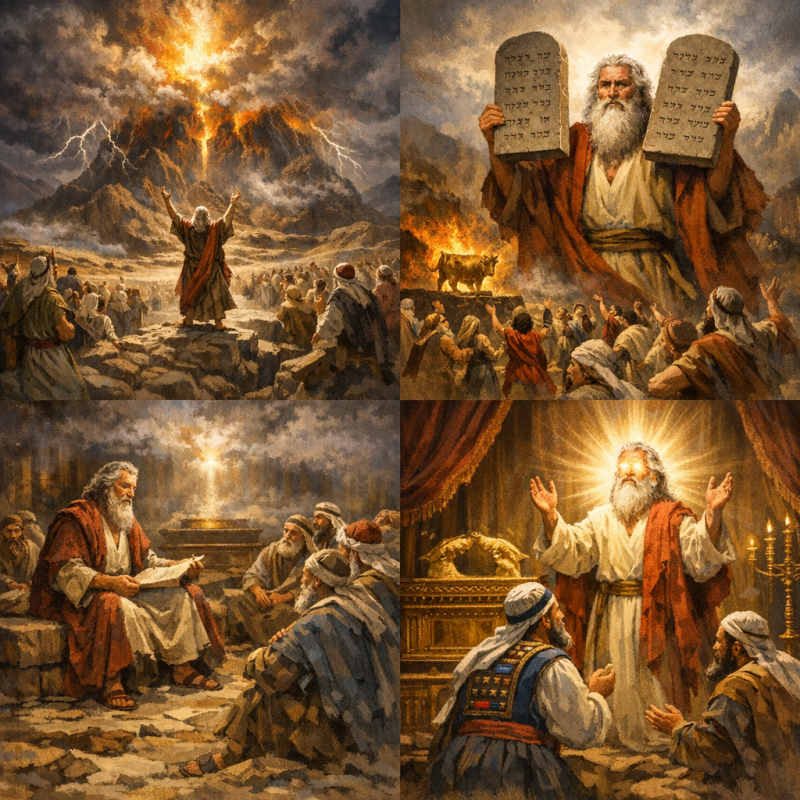
- The Covenant at Sinai (Exodus 19–20): The Lord offers to make Israel a "peculiar treasure" and a "kingdom of priests" if they obey His voice. He then speaks the Ten Commandments directly to the people amidst thunders and lightning, establishing the foundational moral law.
- The Ratification (Exodus 24): Moses, Aaron, and seventy elders of Israel see God. The people formally covenant to do "all the words which the Lord hath said."
- The Golden Calf (Exodus 31–32): While Moses is on the mount receiving the tablets and instructions for the Tabernacle (including the law of the Sabbath in chapter 31), the people grow impatient and fall into idolatry, worshipping a golden calf.
- The Second Tablets (Exodus 33–34): Because of their rebellion, the Lord takes away the "higher law" (Melchizedek Priesthood) and gives Moses a second set of tablets containing the "lower law" (the Law of Moses) to act as a "schoolmaster" to bring them to Christ.
Key Gospel Lessons
- Preparation for the Presence of God: In Exodus 19, the people had to "sanctify themselves" to meet the Lord. This teaches us that we must be spiritually prepared to enter holy places, like the Temple, today.
- The Danger of Impatience: The Israelites fell because Moses was "gone too long." When we feel God is silent or delayed in answering prayers, we are at our highest risk of seeking "worldly idols" for comfort.
- God’s Mercy in Restoration: Even after the Great Apostasy of the golden calf, the Lord did not abandon Israel. He provided a preparatory gospel (Exodus 34) to help them eventually return to Him.
Applying These Chapters Today
- The Sabbath as a Sign: Exodus 31:13 says the Sabbath is a "sign" between us and God. We apply this by treating the Sabbath not just as a day of rest, but as a weekly demonstration of our loyalty to Him.
- Avoiding Modern Idols: We likely don’t worship gold statues, but we might prioritize money, social status, or technology. These chapters challenge us to ask: "What 'calf' am I putting before the Lord?"
- The "Higher Law" vs. the "Lower Law": Just as Israel was offered the higher law, we are invited to live the Higher Law of the Gospel (introduced by Christ in the Sermon on the Mount). We shouldn't just check off "don'ts" (the Law of Moses style) but strive for a "change of heart" that the higher law requires.
When I first opened Exodus 19‑20, 24, 31‑34, I felt as if I’d been invited to sit at the foot of Mount Sinai and watch history unfold in real time. In chapter 19 the whole nation of Israel gathers “as a whole” at the foot of the mountain, trembling with anticipation while God prepares to reveal Himself in thunder, fire, and a thick cloud. The next day, in chapter 20, He delivers the Ten Commandments—simple, unforgettable statements that still shape our moral compass today. I love how the text balances awe‑inspiring grandeur with intimate, personal instruction: “You shall not murder,” “You shall not steal,” “Honor your father and mother” … each command feels like a friendly reminder from a neighbor who cares deeply about our well‑being.
Chapter 24 shows the covenant being sealed in a beautifully tangible way: the people, their leaders, and even the priests each take an oath, and the blood of the sacrifice is sprinkled on the altar and on the people, symbolising a binding promise. I’m always struck by the vivid image of Moses “sprinkling the blood” while the glory of the Lord settles like a cloud over the tent of meeting—an early picture of how community and divine presence become intertwined.
Finally, chapters 31‑34 bring a wonderful resolution after the chaos of the golden calf. God re‑affirms the Sabbath as a lasting sign—a weekly “gift” that reminds us to pause, rest, and reconnect with the Creator. When Moses returns with the new tablets, the scene is almost cinematic: the stone tablets gleam, the people’s hearts are softened, and the covenant is renewed “with all its terms.” Reading these passages, I’m reminded that the biblical story is not just about ancient laws but about a living relationship—one that invites us, even today, to listen for the thunder on the mountain, to honor the simple yet profound commandments, and to keep the Sabbath as a weekly invitation to rest in God’s faithful love.
Add comment
Comments