Heartbeat of the Divine: Following the Sacred Map to Home
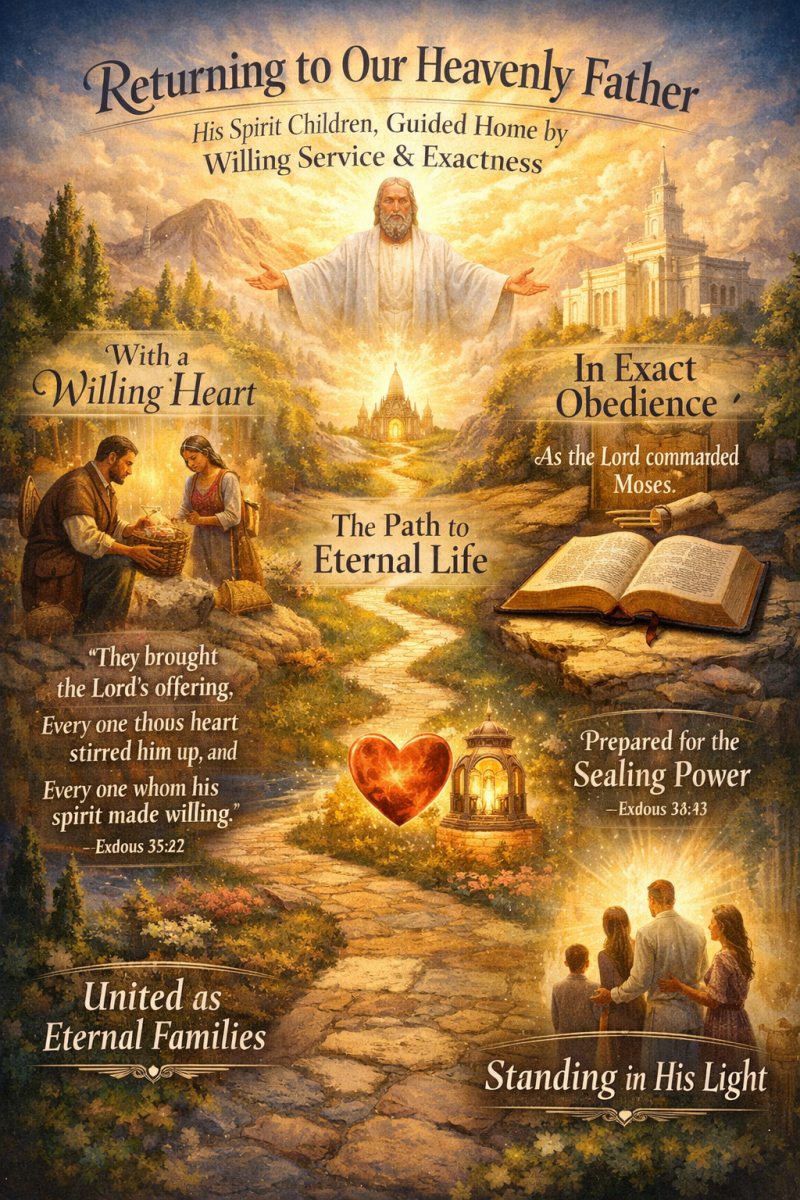
Think of our relationship with Heavenly Father as the heartbeat of why we are here. We aren't just creations; we are His literal spirit offspring, and His greatest desire is for us to return to His presence. He provided the scriptures to act as a clear, divine map to guide us home, and they teach us that the path is paved with two things: willing service and exactness. When we choose to serve others with a "willing heart," as the people did when they brought their offerings—for "every one whose heart stirred him up, and every one whom his spirit made willing, brought the Lord's offering" (Exodus 35:21)—we show that our love for Him is a sincere choice. Heavenly Father sees our willingness as deeply important because our exactness in following His word isn't about being perfect for the sake of rules; it’s about showing Him that we trust His wisdom completely. As the Israelites did, who made everything "as the Lord commanded Moses" (Exodus 39:43), this kind of disciplined devotion refines our character. It prepares us for the Sealing Power to bind our families together eternally, allowing us to stand in His light once again.
An Inspirational Reflection on Exodus 35‑40
When the Israelites camped at the foot of Mount Sinai, they stood at a crossroads between wandering and worship. After the thunder‑clap of the Ten Commandments, God shifted from proclamation to participation, inviting the people to become co‑creators of the sacred space that would house His presence. In Exodus 35‑40, the narrative bursts into a collaborative symphony of heart, hand, and holiness. The people respond to God’s call with generosity: gold, silver, bronze, fine linens, precious stones, and skilled artisans pour forth as freely given gifts. This outpouring is not merely a transaction; it is a tangible expression of gratitude, a communal prayer that says, “We belong to You, and we will honor You with our very best.” The scene reminds us that true worship begins not with grand architecture, but with the willingness to give what we have—time, talent, treasure—to a purpose larger than ourselves.
The construction of the Tabernacle becomes a divine workshop where every piece—whether a humble sandal strap or an exquisitely woven veil—carries a story of cooperation and reverence. Bezalel and Oholiab, filled with the Spirit of wisdom, skill, and knowledge, lead the effort, yet they are never isolated geniuses; they are surrounded by a community that supplies the raw materials and the prayers that sanctify each nail and thread. Their teamwork illustrates an enduring principle: greatness is achieved when individual gifts are woven together into a common tapestry. In our modern lives, where isolation can masquerade as independence, the Exodus account invites us to rediscover the power of shared purpose.
As the Tabernacle takes shape, the narrative pauses for a moment of divine inspection. God “fills the Tabernacle with His Glory,” and the cloud that guided the Israelites now rests upon the completed sanctuary. This moment is both climax and invitation. The cloud does not hover over a perfect building; it rests over a people who have poured their love into its creation. The glory that fills the holy place is a reminder that the divine meets us where we labor, where we rejoice, and where we dare to make something beautiful out of ordinary materials. It encourages us to see our own projects—whether a family, a career, or a creative endeavor—as potential vessels for something greater, provided we approach them with humility and wholehearted dedication.
The final verses of Exodus 40 reveal the cyclical rhythm of work and worship: as the Israelites set up the Tabernacle, the cloud lifts, and the people move forward; when the cloud descends, they pause, reverent, awaiting the next divine direction. This dance of motion and stillness models an inspirational balance for any life journey. It teaches us to celebrate our achievements, yet remain attuned to the still, small voice that guides the next step. The Tabernacle, therefore, is not merely a structure; it becomes a living metaphor for the soul’s pilgrimage—building, pausing, moving, and continually inviting God’s presence into every corner of our existence.
In reflecting on Exodus 35‑40, we discover an empowering invitation: to bring our gifts—big or small—to the work God is doing in the world, to collaborate with others in humility, and to trust that the very act of building, with honest effort and generous hearts, summons the divine glory into our lives. When we lift our hands to craft, to serve, to love, we become the very tabernacle in which God chooses to dwell.
The shift from the Tabernacle's glory to Leviticus is a move from building the house to inviting people inside. Heavenly Father calls to Moses out of the tabernacle, shifting the focus to how we, as His literal spirit offspring, can draw near to Him. In Leviticus 1, we are introduced to the burnt sacrifice—a voluntary act of devotion. This chapter reminds us that our journey back to His presence is paved with personal choice and a willingness to offer our very best. As the verse says, if a man bring an offering, "he shall offer it of his own voluntary will at the door of the tabernacle" (Leviticus 1:3). It is a beautiful reminder that our relationship with God the Father is never forced; it is a collaborative invitation to bring our lives into alignment with His holiness.
The details of the sacrifice—selecting an offering "without blemish"—become a divine workshop for the soul. The offering had to be the best, whether from the herd, flocks, or humble fowls. This teaches us an enduring principle: Heavenly Father values the sincerity of the heart over the size of the gift. In our modern lives, we may not bring livestock to an altar, but we bring our time, our talents, and our corrected mistakes. This process illustrates that greatness in His eyes is achieved through the exactness of our intent. When we approach our daily duties with this level of reverence, we are not just performing tasks; we are participating in a communal prayer of dedication.
As the smoke of the offering ascends, the narrative describes it as "a sweet savour unto the Lord" (Leviticus 1:9). This moment is both a climax and a promise. It suggests that when we dedicate our efforts—whether in building a family, a career, or a creative endeavor—with a wholehearted spirit, that effort is recognized and accepted. The "sweet savour" is a reminder that the divine meets us in our sincere attempts to be better. It encourages us to see our own sacrifices not as losses, but as potential vessels for something greater. It is through these small, exact acts of devotion that we prepare ourselves for the Sealing Power, which binds our efforts and our families to Him eternally.
The final rhythm of Leviticus 1 reveals a pattern of preparation and proximity. The priest lays the parts in order upon the wood, showing that there is a divine order to our spiritual progress. This models an inspirational balance for our life journey: we provide the "wood" and the "sacrifice" of our daily work, and Heavenly Father provides the sanctifying fire. The altar, therefore, is not a place of fear, but a living metaphor for the soul’s pilgrimage—a place where we pause to strip away the worldly and offer our true selves. It teaches us to celebrate the process of becoming, continually inviting the presence of God the Father into every corner of our existence.
In reflecting on Leviticus 1, we discover an empowering invitation: to bring our gifts—no matter how small—to the altar of our daily lives. We learn to trust that the very act of offering, with honest effort and a willing heart, summons a sense of peace and divine acceptance into our lives. When we lift our hands to serve and to sacrifice, we are following the map the scriptures provide to lead us back to the presence of our Heavenly Parents.
An Inspirational Reflection on Leviticus 2
As we move from the burnt offerings of the first chapter into Leviticus 2, we see God the Father expanding His invitation. While the first chapter dealt with the offering of life, this chapter focuses on the "meat offering"—which in the language of the King James Version refers to grain or meal. This represents the fruit of our daily labors, the literal bread earned by the sweat of our brow. It teaches us that our relationship with the divine is not just for special moments of sacrifice, but for the very substance of our everyday work. As Leviticus 2:1 states, "And when any will offer a meat offering unto the Lord, his offering shall be of fine flour; and he shall pour oil upon it, and put frankincense thereon."
The process of preparing this fine flour becomes a divine workshop for our character. Fine flour is not found in nature; it must be ground, sifted, and refined. This illustrates an enduring principle: Heavenly Father values the effort we put into refining our talents and tempers. Whether the offering was baken in an oven, fried in a pan, or cooked in a frying pan (Leviticus 2:4-7), it had to be prepared with exactness. In our modern lives, this reflects how we take our ordinary careers, our education, and our household tasks and "sift" them until they are worthy to be dedicated to a higher purpose. This teamwork between our hard work and His sanctification shows that greatness is achieved when we bring our best "flour" to the altar.
A critical detail in this chapter is the requirement of salt and the exclusion of leaven or honey. Leviticus 2:13 commands, "And every oblation of thy meat offering shalt thou season with salt; neither shalt thou suffer the salt of the covenant of thy God to be lacking." Salt preserves and purifies, acting as a symbol of the Sealing Power and the enduring nature of our covenants. The exclusion of leaven (which can represent pride or corruption) reminds us that when we offer our work to God the Father, we must do so with a humble and clean heart. This moment is both a climax and a promise; it suggests that even the simplest meal, when seasoned with the "salt of the covenant," becomes a "sweet savour" that invites His presence into our homes.
The final rhythm of Leviticus 2 reminds us of our accountability and the sacredness of what we produce. A portion of the offering was burnt as a memorial, while the remnant was given to the priests as something "most holy of the offerings of the Lord made by fire" (Leviticus 2:3). This models an inspirational balance for our life journey: we give back a portion to acknowledge Heavenly Father as the source of all our blessings, and the rest is sanctified for the support of the holy work. It teaches us to see our resources not just as our own, but as potential vessels for building a community where God chooses to dwell.
In reflecting on Leviticus 2, we discover an empowering invitation: to see our daily "grind" as a sacred act of worship. We learn to trust that when we pour the "oil" of the Spirit and the "frankincense" of prayer over our honest labors, they become holy. When we lift our hands to work with integrity and exactness, we are following the map the scriptures provide to lead us back to the presence of our Heavenly Parents.
An Inspirational Reflection on Leviticus 16
In the heart of the law, we find a day unlike any other—the Day of Atonement. After the tabernacle was prepared and the priests were consecrated, Leviticus 16 introduces the solemn ritual required to cleanse the sanctuary and the people. God the Father instructed Moses on how Aaron was to enter the "holy place within the vail" (Leviticus 16:2). This chapter reminds us that our journey back to His presence is paved with the necessity of cleansing and the profound reality of a Mediator. It is a beautiful study of how we, as His literal spirit offspring, must be reconciled to Him through a specific, divine pattern of holiness.
The details of the high priest’s preparation become a divine workshop for understanding our own spiritual needs. Before Aaron could perform the work for the nation, he had to wash his flesh in water and put on the "holy linen coat" and "linen breeches" (Leviticus 16:4). Whether he was offering for his own house or for the congregation, the requirement remained the same: he had to be clean. This teaches us an enduring principle: Heavenly Father values our personal preparation before we can effectively serve others. In our modern lives, this reflects the internal "washing" of repentance we must undergo to be worthy of the Sealing Power that binds our families together eternally.
A striking feature of this chapter is the ritual of the two goats. One was sacrificed as a sin offering, while the other—the "scapegoat"—had the sins of the people confessed over its head before being sent into the wilderness (Leviticus 16:21-22). This moment is both a climax and a promise; it illustrates the "fullness" of how our burdens can be entirely removed. The blood sprinkled on the mercy seat shows that justice is satisfied, while the goat led away into a "land not inhabited" shows that our mistakes are forgotten. It encourages us to see our own struggles not as permanent stains, but as things that can be carried away through the grace of God the Father.
The final rhythm of Leviticus 16 reveals a pattern of rest and reverence. The people were commanded to "afflict your souls" and do no work, for it was a "sabbath of rest unto you" (Leviticus 16:31). This models an inspirational balance for our life journey: we must pause our worldly labors to focus entirely on our reconciliation with the divine. This dance of stillness and spirit teaches us that true peace is achieved through exactness in our covenants. The sanctuary, therefore, is not just a building; it is a living metaphor for the soul’s pilgrimage—a place where we are made whole so that God’s presence can dwell in every corner of our existence.
In reflecting on Leviticus 16, we discover an empowering invitation: to trust in the cleansing power provided by Heavenly Father. We learn to appreciate that the very act of seeking forgiveness, with honest effort and a willing heart, summons a divine glory into our lives that washes away the past. When we lift our hands in prayer and our hearts in repentance, we are following the map the scriptures provide to lead us back to the presence of our Heavenly Parents.
An Inspirational Reflection on Leviticus 19
In the heart of the wilderness, Heavenly Father issued a call that transcends time and space, moving from the rituals of the altar to the character of the soul. In Leviticus 19, the narrative shifts from how we worship to how we live, inviting the people to mirror the very nature of the divine. As we read in Leviticus 19:2, "Speak unto all the congregation of the children of Israel, and say unto them, Ye shall be holy: for I the Lord your God am holy." This is not a demand for instant perfection, but a beautiful invitation for us, as His literal spirit offspring, to become co-creators of a holy community. It reminds us that our journey back to His presence is paved with the reality that holiness is found in the way we treat one another in the details of our daily lives.
The instructions that follow in this chapter become a divine workshop for the heart. From honoring parents to leaving the corners of the field for the poor, every commandment carries a story of cooperation and reverence. Whether it is the command to "not glean thy vineyard" (Leviticus 19:10) or to "not let thy cattle gender with a diverse kind" (Leviticus 19:19), the requirement remains the same: a willingness to bring our lives into exact alignment with His wisdom. This teaches us an enduring principle: God the Father sees our integrity in small things—honesty in business, kindness to the deaf, and justice for our neighbor—as the true measure of our devotion. In our modern lives, these acts of exactness are the raw materials we bring to build His kingdom.
As we navigate the social and moral landscape of this chapter, we find the climax of the law: "thou shalt love thy neighbour as thyself: I am the Lord" (Leviticus 19:18). This moment is both a challenge and an empowering promise. It suggests that the glory of the divine is most visible not just in a cloud over a tent, but in a person who chooses compassion over a grudge. The holiness that fills our lives is a reminder that Heavenly Father meets us in our labor to be fair and our rejoicing in being kind. It encourages us to see our own interactions—within our families, our careers, and our neighborhoods—as potential vessels for something greater, provided we approach them with humility and wholehearted dedication.
The final rhythm of Leviticus 19 reveals a pattern of remembrance and identity. Repeatedly, the Lord punctuates His instructions with the phrase, "I am the Lord your God." This models an inspirational balance for our life journey: we provide the effort to keep the "statutes and judgments," and He provides the identity and power that transforms us. This dance of obedience and grace teaches us to celebrate our progress toward the Sealing Power, which binds holy families together eternally. The law, therefore, is not a burden; it is a living metaphor for the soul’s pilgrimage—building a life of character that allows God’s presence to dwell in every corner of our existence.
In reflecting on Leviticus 19, we discover an empowering invitation: to bring our best selves to the work of loving our neighbor. We learn to trust that the very act of living with honest effort and a generous heart summons a divine sense of peace into our homes. When we lift our hands to serve, to speak truth, and to show mercy, we are following the map the scriptures provide to lead us back to the presence of our Heavenly Parents.
Add comment
Comments