When Life Doesn't Match the Dream:
We’ve all had those "Joseph moments." You receive a promise from the Lord—a Patriarchal Blessing, a spiritual prompting, or a dream for your future—only to watch your life head in the exact opposite direction.
Genesis 37–41 tells the story of a young man whose life was a series of pits, prisons, and broken promises. But as the Come, Follow Me manual reminds us, the recurring theme of Joseph's life wasn't the tragedy; it was the phrase "The Lord was with Joseph."
-
Genesis 37: Jacob's brothers envy his favored son, Joseph. They plot against him, sell him into slavery to Midianite traders, and deceive Jacob into believing Joseph is dead.
-
Genesis 38 (interlude)—The story of Judah and Tamar illustrates the continuation of the family line within the larger narrative.
-
Genesis 39 – In Egypt, Joseph serves in Potiphar’s house, is falsely accused by Potiphar’s wife, and is imprisoned. Even in jail, he gains trust, oversees the prison, and interprets the dreams of the cupbearer and baker.
-
Genesis 40 – Joseph accurately interprets the two officials’ dreams: the cupbearer will be restored to his position, and the baker will be executed. He asks the cupbearer to remember him, but the cupbearer forgets.
-
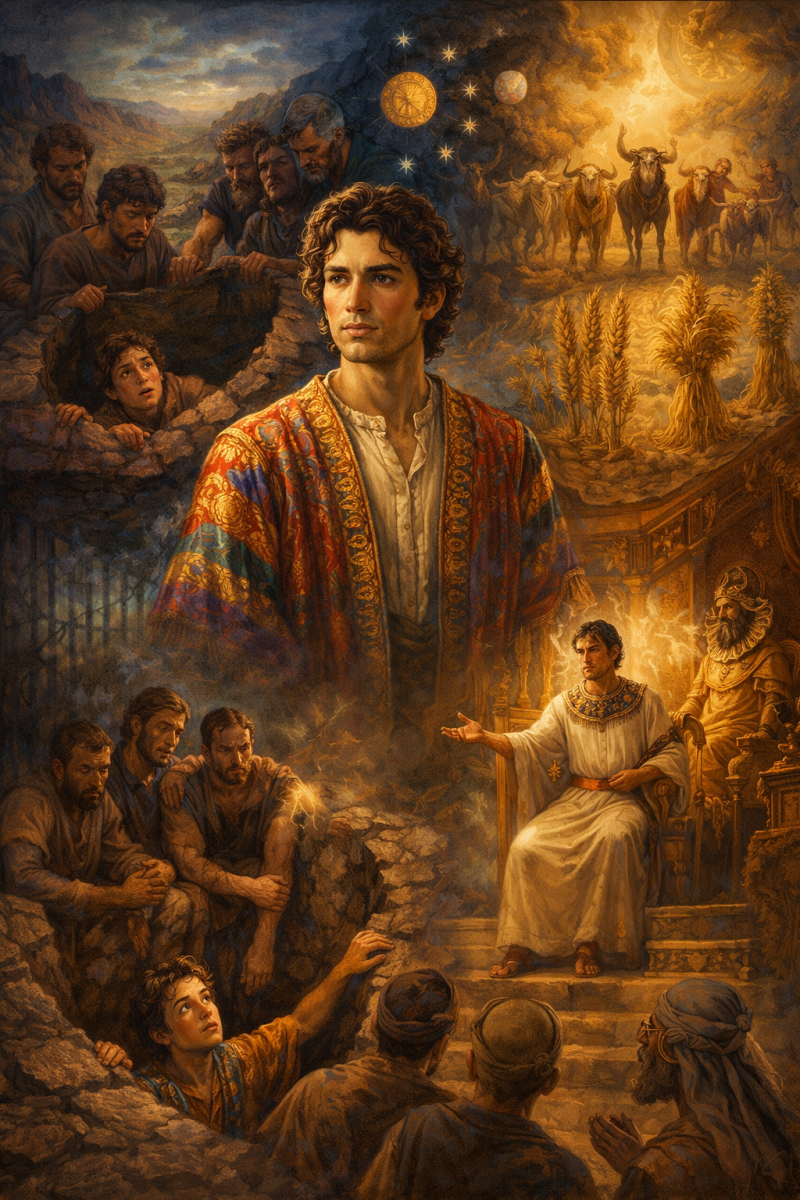
Genesis 41 – Two years later, Pharaoh has troubling dreams. The cupbearer recalls Joseph, who is summoned. Joseph interprets the dreams as seven years of plenty followed by seven years of famine and proposes a plan to store surplus grain. Impressed, Pharaoh appoints Joseph as second‑in‑command over Egypt, tasked with overseeing the grain storage and distribution during the forthcoming famine.
These chapters trace Joseph’s rise from favored son to slave, prisoner, and finally to a powerful administrator, setting the stage for the reunion of Jacob’s family in Egypt.
Joseph’s Journey: From Favoritism to Faithful Leadership
Joseph, the eleventh son of Jacob and firstborn to his beloved wife Rachel, stood at the center of a story marked by both divine promise and profound human conflict. Jacob’s clear favoritism, symbolized by the extravagant "coat of many colors," ignited resentment among Joseph’s older brothers, who viewed his prophetic dreams—of sheaves bowing and celestial bodies kneeling to him—as arrogant boasts of superiority. Their jealousy culminated in a traumatic betrayal: instead of killing him, they sold Joseph into slavery to Ishmaelite traders, fabricating a story about his death by wild beasts. As Genesis 37–41 unfolds, Joseph’s life becomes a harrowing odyssey of trials—thrown into a pit, enslaved in a foreign land, wrongfully imprisoned in Egypt—yet each hardship is met with the refrain that "the Lord was with Joseph," empowering him to navigate despair with resilience.
Joseph’s story, as the Come, Follow Me manual insightfully highlights, reminds us that divine favor does not insulate one from suffering. The "pit" of his early life—marked by family betrayal and unjust imprisonment—was not a sign of God’s absence but a crucible for his growth. His trials, far from being dead ends, became stepping stones to his eventual rise as Egypt’s second-in-command, entrusted with saving his family and nation from famine. Joseph’s journey teaches that God’s presence often works through suffering, transforming pain into purpose. His life challenges us to trust that even when circumstances feel unfair, faithfulness and divine companionship can turn the deepest pits into pathways to redemption.
The Prison: Integrity in the Dark
Joseph: A Journey of Faith, Fidelity, and Forensic Foresight
In Genesis 39, Joseph’s life takes a harrowing turn when Potiphar’s wife subjects him to relentless temptation—a “day by day” assault on his integrity. Rather than relying on sheer willpower to “stay strong,” Joseph makes a deliberate, active choice: he flees (Genesis 39:12). His refusal is rooted not merely in personal morality but in a profound spiritual conviction—he recognizes sin as a transgression against God Himself (v. 9). This spiritual clarity defines Joseph’s character. Even after being falsely accused, imprisoned, and stripped of his dignity, he does not succumb to bitterness. Instead, he continues to serve faithfully, trusting in divine purpose. His story reveals that godly living often demands bold action and unwavering reliance on personal revelation—the quiet, guiding presence of God that empowers integrity in darkness.
Years later, Joseph’s life pivots from prison to palace. Forgotten, he is suddenly thrust before Pharaoh to interpret dreams—a moment that tests his humility as much as his wisdom. “It is not in me; God shall give Pharaoh an answer of peace” (Genesis 41:16), he declares, embodying dependence on divine insight. His plan to store surplus grain during seven years of plenty exemplifies emergency preparedness and prophetic leadership, blending practical acumen with faith-driven foresight. What could have been a system of oppression becomes a lifeline for a famine-stricken world.
The most profound layer of Joseph’s narrative, however, lies in its shadowing of Christ. Both were beloved sons rejected by their own, sold for the price of a slave, and falsely accused while bearing the weight of others’ sins. Yet both emerged as saviors—Joseph providing physical bread, Christ the eternal “Bread of Life” (John 6:35). Joseph’s journey whispers a timeless truth: our “prisons” or “pits” may be God’s forge, shaping us for a “palace” where we can bless others. His legacy challenges believers to trust that faithfulness in affliction can yield fruitfulness beyond imagination, echoing his words: “God has made me fruitful in the land of my affliction” (Genesis 41:52). In Joseph’s story, we glimpse hope—that God can transform our trials into tools for His glory.
What I Learned from Genesis 37-41: Trusting God’s Plan in the Midst of Chaos
Reading through Genesis 37–41 reminded me how often God takes broken circumstances and weaves them into something beautiful. Joseph’s story—sold by his brothers, wrongfully imprisoned in Egypt, and seemingly forgotten—feels like a whirlwind of betrayal and hardship. Yet, what struck me most is how Joseph never let his circumstances erase his faith in God’s purpose. Even when his brothers hated him or Pharaoh’s cupbearer abandoned him, Joseph kept trusting that God was still at work.
I learned that God’s timing isn’t always linear. Joseph’s journey from slavery to second-in-command of Egypt didn’t happen overnight. It required patience, resilience, and humility. When Pharaoh had his troubling dreams, it was Joseph’s quiet faithfulness during years of waiting that prepared him to lead. It’s a reminder that our “seasons of waiting” aren’t wasted—they’re where God equips us for what’s next.
Most powerfully, I saw how forgiveness isn’t just a noble act but a choice to align with God’s bigger story. Years later, when Joseph finally reunites with his brothers, he declares, “You meant evil against me, but God meant it for good” (Genesis 50:20). That phrase has stuck with me. It’s easy to hold onto hurt, but Joseph chose to see God’s hand even in pain. His story teaches me to surrender my “why” to God, trusting that He can turn even the darkest chapters into a testament of His grace.
Joseph's life serves as a gentle reminder in a world that prioritizes control and quick fixes: God is still writing the story, and sometimes, our most challenging moments serve as the foundation for His greatest miracles.
REPLIES:
Add comment
Comments