A Testament to Faith, Hospitality, and Divine Promises
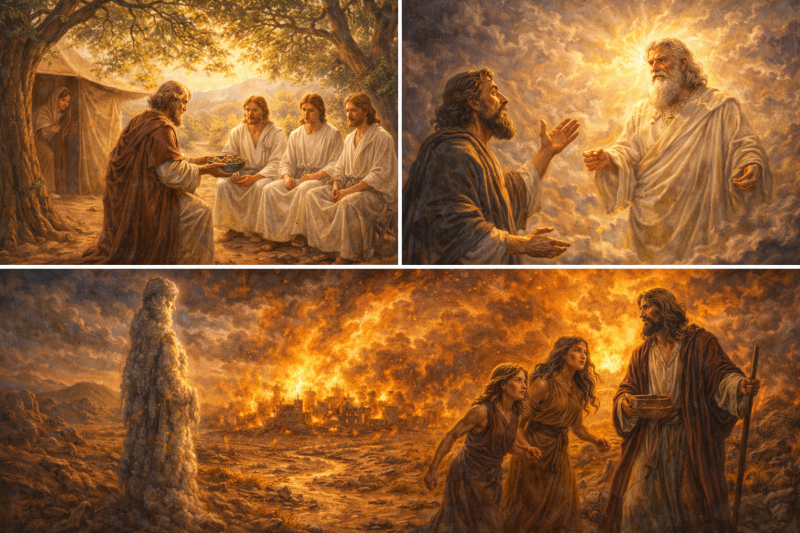
These chapters recount pivotal moments in the life of Abraham, beginning with the theophany at Mamre, where the Lord appears to Abraham and reaffirms the Abrahamic covenant—a promise of posterity, land, and spiritual blessings. Abraham’s intercession for Sodom (Genesis 18) teaches powerful lessons about compassion, justice, and the Lord’s willingness to spare the righteous. The destruction of Sodom and Gomorrah (Genesis 19) underscores the consequences of unrepentant wickedness while also highlighting God’s mercy in saving Lot and his family. In Genesis 20, Abraham’s interaction with Abimelech reminds us of the importance of truth and trust in divine protection. The birth of Isaac (Genesis 21) fulfills God’s long-promised blessing and symbolizes the miracle of covenant faithfulness.
The poignant account of Hagar and Ishmael reveals God’s care for all His children, even in exile. Finally, Genesis 22—the binding of Isaac—stands as a profound testament of Abraham’s unfailing faith and foreshadows the Atonement of Jesus Christ. The narrative concludes with the death of Sarah (Genesis 23), a matriarch of faith, and Abraham’s continued efforts to secure a promised burial place, reflecting his commitment to covenant obligations. As Latter-day Saints teach these chapters, they emphasize the enduring relevance of faith, obedience, and the sacred nature of covenants with God.
In Genesis 18, the narrative centers on a pivotal encounter between Abraham and the Lord, who appears to him in the form of three visitors near the oaks of Mamre. This chapter beautifully illustrates themes of hospitality, faith, and divine promise. Abraham's immediate and generous response—offering water, food, and rest—exemplifies the cultural and spiritual importance of welcoming strangers, a value deeply revered in the teachings of The Church of Jesus Christ of Latter-day Saints. As the visitors converse with Abraham, one of them, identified as the Lord, renews the covenant promise that Sarah will bear a son, Isaac, despite their advanced age. Sarah’s quiet laughter at the news, born of disbelief, is met with a gentle rebuke: “Is anything too hard for the Lord?” This moment invites reflection on the nature of faith and the necessity of trusting in God’s power and timing. The chapter also sets the stage for the impending judgment of Sodom, as Abraham begins his remarkable intercessory prayer, pleading for the righteous and revealing his deep concern for justice and mercy. For Latter-day Saints, Genesis 18 serves as a powerful testament to the importance of righteousness, compassionate hospitality, and the enduring reliability of God’s promises.
Genesis 18 offers profound insights into the interplay of divine justice, mercy, and human agency. In this chapter, Abraham’s role as a prophet and intercessor is central, reflecting core LDS teachings on faith, prayer, and the active relationship between humanity and God. This chapter emphasizes the narrative of Abraham pleading with the Lord to spare Sodom and Gomorrah if even a few righteous inhabitants could be found, illustrating the principle that prayerful intercession can influence divine actions. This aligns with the LDS knowledge of a God who is both just and compassionate, willing to delay judgment to afford repentance—a cornerstone of their theology centered on the Atonement of Jesus Christ.
Complementing the biblical account, the LDS canon includes the Book of Abraham (found in the Pearl of Great Price), which expands on Abraham’s spiritual experiences and teachings, reinforcing his role as a man of faith who sought divine guidance. LDS leaders often highlight Genesis 18 as a model of prophetic courage and the importance of seeking God’s will through prayer, mirroring the priesthood authority to intercede for others. The chapter also underscores a key LDS tenet: divine justice is tempered by grace, with God’s willingness to look beyond human wickedness and offer a path to redemption. Such themes resonate deeply within LDS teachings, which stress repentance, charity, and the unyielding love of a Heavenly Father who desires the salvation of all His children. Ultimately, Genesis 18 serves as a timeless reminder of humanity’s capacity to partner with God in extending mercy, reflecting the restored gospel’s message of hope and transformation.
Genesis 19 offers profound lessons on righteousness, obedience, and the consequences of sin, relevant to both ancient and modern audiences. The story recounts God’s judgment upon the cities of Sodom and Gomorrah, destroyed by fire and brimstone for their egregious wickedness (Genesis 19:24-25). President Howard W. Hunter once emphasized that these cities “exhibited such moral corruption that God had to destroy them” (Ensign, May 1994), underscoring the LDS teaching that divine justice cannot tolerate unrepentant sin. Central to the account is Lot, a “righteous man” (2 Peter 2:7-8) who resided among the wicked yet struggled to fully separate from their ways. His rescue by angels, with the urgent command, “Escape for thy life; look not behind thee” (Genesis 19:17), serves as a timeless emphasis on trusting and obeying divine guidance. LDS doctrine often highlights the cautionary tale of Lot’s wife, turned to a pillar of salt for looking back—a symbolic reminder of the perils of clinging to worldly attachments (see Doctrine and Covenants 136:32).
The lesson encourages modern disciples of Christ to avoid moral decay and prioritize spiritual preparedness, mirroring the urgency shown to Lot. It also reflects God’s mercy, as He preserved the righteous despite their imperfections—a theme echoed in President Henry B. Eyring’s teachings on the Lord’s patience with His children (Ensign, November 2020). Just as Lot and his daughters were saved from destruction, LDS members are called to “leave behind” unrepentant behaviors and distractions to inherit eternal life (see Alma 38:12). Ultimately, Genesis 19 challenges individuals to align with divine covenants, heed warnings, and place faith in God’s promises, even in a world increasingly distant from His truth.
Genesis 19: Lessons from Sodom and Gomorrah
In the Book of Genesis 19, the story of Sodom and Gomorrah serves as a powerful testament to divine justice and mercy; these cities were destroyed because of their pervasive wickedness—characterized by pride, selfishness, and disregard for the poor—which highlights the consequences of moral and spiritual decay. The narrative emphasizes the righteousness of Lot, a prophet who, like his uncle Abraham, called the people to repent, yet they stubbornly rejected his warnings. The destruction is not portrayed as a punishment for a single act but as a response to systemic iniquity, with additional context drawn from the Joseph Smith Translation (JST) of the Bible and the Book of Moses in the Pearl of Great Price.
These texts reveal that the men of Sodom sought to harm the angels visiting Lot, a detail clarified by the JST to underscore their lustful and violent intent. Yet, amidst the judgment, God’s mercy shines through the rescue of Lot and his family. However, their deliverance required complete faith and obedience; Lot’s wife, looking back at the doomed cities, was turned into a pillar of salt—a poignant reminder of the dangers of clinging to worldly attachments. Apply this story to modern life, urging adherence to prophetic counsel, humility, and the importance of charity. As a caution against spiritual complacency and greed, Sodom and Gomorrah remain a timeless example of the necessity to heed divine guidance and cultivate virtue over vice.
Genesis 20
The scriptural narrative in Genesis 20 offers profound lessons on faith, integrity, and divine providence, central themes emphasized in Latter-day Saint (LDS) teachings. In this account, Abraham, fearing for his life, again presents his wife Sarah as his sister to King Abimelech of Gerar. Though Abimelech takes Sarah into his household, God intervenes through a dream, revealing Sarah’s true identity and commanding him to return her. This story underscores the consequences of dishonesty and the power of truth, as Abraham’s lie creates a ripple effect of spiritual and relational trials. However, God’s mercy and protective covenant over His people are evident, as Sarah is miraculously safeguarded from harm—even as Abimelech, though initially unaware, is given an opportunity to repent and act righteously by returning her.
LDS doctrine highlights this episode as a reminder of the importance of relying on divine wisdom rather than human fear. Abraham’s repeated missteps in Egypt and Gerar illustrate the gradual learning process of trusting in God’s promises, a journey many modern-day disciples also navigate. Abimelech’s response—marked by humility, repentance, and restitution—serves as a model for addressing the consequences of others’ actions, reinforcing the LDS emphasis on accountability and reconciliation. Ultimately, Genesis 20 invites readers to reflect on their own choices: Will they cling to falsehoods to avoid risk, or embrace truth, knowing the Lord is faithful to protect and guide His children? Through this ancient story, we are reminded that the Atonement of Jesus Christ makes restoration and redemption possible, even when errors lead to unexpected challenges.
Genesis 21:
Genesis 21 is seen as a pivotal turning point in the Abrahamic covenant, illustrating how Heavenly Father fulfills promises through patient obedience. The birth of Isaac (“the child of promise”) after years of waiting confirms that God’s timing supersedes human expectation, a principle that undergirds the Restoration: the Prophet Joseph Smith taught that “the Lord works in the mysteries of His providence… to bring about the salvation of His people” (D&C 76:23). Isaac’s arrival is a tangible reminder that divine promises are sure, even when the surrounding circumstances seem impossible.
The chapter also provides a powerful lesson on the sanctity of families and the delicate balance between righteousness and compassion. Abraham’s willingness to obey God’s command to cast out Hagar and Ishmael (verses 8‑14) is tempered by God’s mercy—He promises that Ishmael will become a great nation (v. 18). Modern LDS teachings draw from this pattern: while the Church upholds the principle of eternal families and the sealing power of the temple, it also stresses that the Lord’s love extends to all of His children, regardless of lineage or circumstance (see 2 Nephi 2:25). This dual focus informs the Church’s humanitarian outreach and its doctrine of “broadening the circle of salvation.”
Genesis 21 further underscores the importance of covenant renewal through covenant‑making rituals. After the birth of Isaac, Abraham builds an altar and offers a sacrifice (v. 33), echoing the pattern that will later culminate in the temple ordinances of the New Dispensation. These acts of worship as precursors to the Abrahamic covenant being restored through modern priesthood authority, a restoration that enables individuals to receive personal revelation and make covenants that bind them to the Savior forever (see D&C 132). The altar becomes a symbolic link between ancient promises and contemporary temple worship, reminding members that every act of faithful obedience can be a step toward eternal progression.
Finally, the episode of the treaty between Abraham and Abimelech (verses 22–34) illustrates the Lord’s concern for righteous governance and the protection of personal property. LDS theology teaches that righteous leaders are those who honor divine law, a principle echoed in the political teachings of modern Church leaders who advocate for governments that protect religious liberty and moral standards. By highlighting Abraham’s reliance on God’s guidance in legal matters, Genesis 21 encourages Christians to seek divine counsel in civic affairs, reinforcing the belief that “the kingdom of God is not of this world” yet must be reflected in the righteousness of earthly institutions.
In sum, Genesis 21 resonates deeply within Christian thought: it affirms that God’s promises are immutable, teaches a compassionate view of all humanity, foreshadows temple covenants, and models the intertwining of divine instruction with temporal governance. Each of these themes continues to shape the faith, practice, and worldview of members today.
The Importance of Genesis 22 in Christian Faith and Scripture
The story of Abraham and Isaac in Genesis 22 stands as a cornerstone of Christian faith, illustrating profound themes of trust and obedience. When God commands Abraham to sacrifice his son Isaac, a child born of promise after decades of waiting, the narrative tests the depth of Abraham’s faith. Christians interpret this account not merely as a historical event but as a powerful metaphor for surrendering one’s most cherished possessions to divine will. Abraham’s unwavering compliance, despite the emotional and moral gravity of the request, serves as a model of devotion that resonates across generations. This story underscores the biblical principle that true faith is not passive belief but active submission to God’s purposes, even when the path ahead is unclear.
A central lesson from Genesis 22 is the concept of sacrificial obedience as a testament to one’s relationship with God. Abraham’s willingness to offer Isaac is considered an ultimate expression of trust in God’s sovereignty, acknowledging that all blessings come from the divine. This narrative parallels the Christian call to relinquish personal desires for a higher spiritual vocation. For instance, Jesus later emphasizes the value of such sacrificial love in His teachings, framing love for God as the foundation of righteousness. By choosing not to question God’s command but to follow it, Abraham becomes a symbol of faith that prioritizes divine will over human logic, inspiring believers to reflect on their own commitments.
The episode also highlights God’s provision and covenant faithfulness. At the last moment, God halts Abraham’s sacrifice and provides a ram as a substitute, sparing Isaac’s life. This divine intervention affirms that God’s tests are not about condemnation but about refining character and faith. In Christian theology, this moment often foreshadows God’s ultimate sacrifice of His Son, Jesus Christ, who serves as the perfect substitute for humanity’s sins. The ram in the thicket symbolizes God’s readiness to supply what humans cannot provide for themselves, reinforcing the idea that divine mercy is central to the covenant relationship. This provision becomes a precursor to the New Testament’s message that salvation is a gift of grace, not a result of human effort.
Genesis 22 further enriches Christian understanding of the cross and redemption. The New Testament explicitly draws parallels between Abraham’s experience and the sacrifice of Jesus. For example, in Hebrews 11, Abraham’s faith is celebrated as the cornerstone of spiritual legacy, with his willingness to sacrifice Isaac cited as an act of unwavering hope. Additionally, the Gospel of John 1:29 refers to Jesus as the “Lamb of God,” a phrase many Christians associate with the ram provided for Abraham. This imagery underscores the continuity between Old Testament foreshadowing and New Testament fulfillment, illustrating how God’s plan of redemption unfolds through history. By linking Abraham’s trial to Christ’s sacrifice, Genesis 22 becomes a lens through which Christians understand the depth of God’s love and the cost of atonement.
Ultimately, Genesis 22 remains a touchstone for Christian teachings on faith, obedience, and grace. The story challenges believers to reevaluate what they are willing to offer to God, emphasizing that true devotion is not measured by material possessions but by trust in divine provision. It also serves as a reminder that God’s tests are not about harm but about transformative growth. In sermons, prayers, and personal reflections, Christians often return to this narrative as a source of spiritual encouragement, finding in Abraham’s journey a blueprint for aligning their hearts with God’s purposes. Through its enduring lessons, Genesis 22 continues to shape the theological and ethical foundations of the Christian life.
The Significance of Genesis 23 for Christians who attend the Church of Jesus Christ of Latter-Day Saints
Genesis 23 records the death of Sarah, Abraham’s beloved wife, and the careful purchase of the field of Machpelah as a burial site. For Christians who attend the Church of Jesus Christ of Latter-day Saints, this narrative is a vivid illustration of how divine promises are secured through patient obedience and legal righteousness. Abraham’s respectful negotiation with the Hittites demonstrates that God’s covenantal blessings are often realized within the frameworks of existing societies, reinforcing the principle that faithful disciples should honor civil law while trusting in heavenly guidance.
The chapter also highlights the profound value placed on family and ancestry. By securing a permanent, owned piece of ground for Sarah’s burial, Abraham establishes a tangible link between past generations and future heirs. This tangible heritage mirrors the modern emphasis among believers on preserving sacred records, genealogical knowledge, and temple ordinances that bind families together across time. The act of burying a patriarch in a specific, consecrated place underscores the eternal nature of family bonds—a core tenet of the faith.
Furthermore, Genesis 23 foreshadows the doctrine of redemption through sacrifice. Sarah’s death, though a natural part of mortality, becomes a moment where Abraham demonstrates selfless love and humility before God. The willingness to part with personal wealth to honor a covenant reflects the later atoning sacrifice of the Savior, whose own burial and resurrection fulfill the promise of eternal life. The passage prompts believers to contemplate the transformation of personal loss into a chance to reinforce faith in divine promises.
Finally, the legal precision of the transaction—complete with witnesses, a written deed, and payment in full—offers a timeless lesson about integrity and accountability. Christians who attend the Church of Jesus Christ of Latter-day Saints view this episode as an early scriptural example of the law of tithing, stewardship, and honest commerce. It encourages members to conduct their affairs with transparency and reverence, knowing that righteous administration of temporal affairs prepares the heart for eternal blessings. In this way, Genesis 23 continues to inform both spiritual understanding and practical conduct among the faithful.
Share your thoughts, comments, and ideas in the comment area. I look forward to how this study has enriched you.
Did you know?
Ancient Barley Water: Abraham would have access to barley, dates, and honey to provide natural energy and hydration.
Ingredients:
-
1/2 cup hulled or pearl barley (Hulled is closer to the ancient version).
-
4–6 cups water.
-
Sweetener: 1 tbsp honey or a few chopped dried figs (for authentic Bronze Age sweetness).
-
Optional: A sprig of fresh mint or a squeeze of lemon (common in ancient Greek variations).

Add comment
Comments