A Narrative of Corruption, Judgment, and Divine Intervention
The biblical book of Genesis 6–11 recounts pivotal events in early human history, culminating in the Great Flood and the Tower of Babel. Genesis 6–8 introduces the Nephilim, descendants of the "sons of God" and "daughters of men" (Gen 6:1–4), which scholars often interpret as a union between spiritual beings (possibly angels or other divine figures) and humanity, resulting in a corrupt and violent generation. God, upset by how bad people are, decides to flood the world and save only Noah, his family, and pairs of animals in a huge ark. Post-flood narratives in Genesis 10–11 trace the repopulation of the earth and the infamous Tower of Babel, where humanity’s hubris in building a city to "make a name" for themselves leads God to confuse their languages and disperse them (Gen 11:1–9).
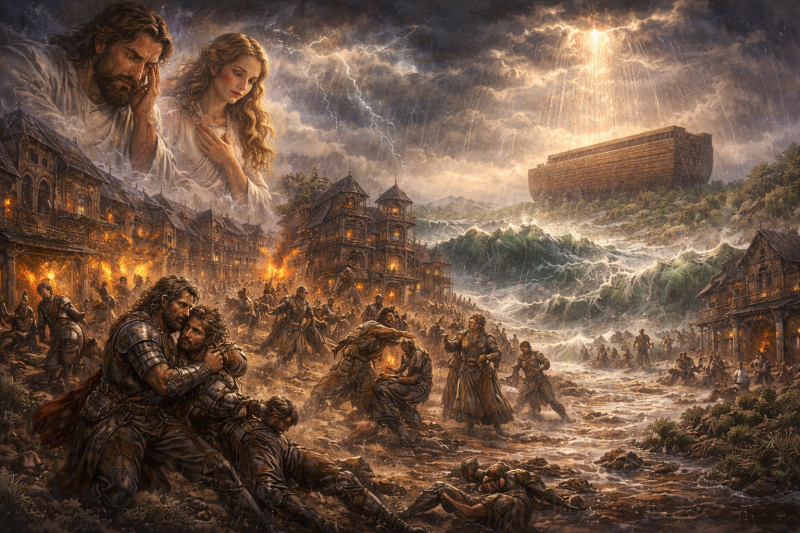
the wickedness of man
Genesis 6: God sees the wickedness of humanity and decides to send a flood to destroy the earth but saves Noah and his family, along with two of every kind of animal, in an ark.
Genesis 7: The flood comes, and Noah, his family, and the animals enter the ark, while the rest of humanity and animals are destroyed.
Genesis 8: The floodwaters recede, and Noah releases a dove, a raven, and a swallow to determine if the water has receded, and eventually release all the animals from the ark.
Genesis 9: God makes a covenant with Noah, promising never to destroy the earth with a flood again, and establishes the rainbow as a sign of this covenant.
Genesis 10: The genealogy of Noah's sons, Shem, Ham, and Japheth, is listed, showing the origins of the various nations of the world.
Genesis 11: Humanity attempts to build a tower to reach the heavens, but God confuses their language, causing them to scatter and preventing the completion of the tower, thus explaining the origin of different languages and cultures.
Moses 8: The Lord made covenants with Enoch, promising that Noah would be his descendant. Methuselah, Enoch's son, lived 969 years and prophesied that all kingdoms would come from Noah.
This narrative, influenced by apocryphal texts like the Book of Enoch, frames the Nephilim as giants and emphasizes the profound moral decay caused by the Watchers’ rebellion. The resulting violence and corruption that Adam witnesses justify God's decision to send the flood as a necessary judgment. While the LDS canon does not delve deeply into the Tower of Babel in this section, it aligns with Genesis in highlighting humanity’s struggle with pride and divine consequence. Together, these texts underscore themes of divine justice, human frailty, and the cyclical nature of moral failure leading to spiritual purification. The Book of Moses enriches the Genesis account by offering theological depth and a more direct narrative from Adam, bridging ancient scripture with LDS doctrine.
A Close Reading of Early Humanity’s Rise, Fall, and Hope
The biblical narrative of Genesis 6‑11 and the Latter‑day Saint account in Moses 8 belong to the same broad “primeval” segment of Scripture, yet each emphasizes different facets of the same divine drama. Genesis 6 opens with a terse assessment of humanity’s moral decline: “was immense in the earth” (6:5). In response, God initiates the only global judgment in the Old Testament—the Flood—preserving a remnant through Noah and a clean slate for the post‑deluge world (6:9‑9:29). The covenant sign of the rainbow (9:12‑17) establishes a promise that “never again shall all flesh be destroyed” by water, a motif of divine mercy that reverberates through the following chapters.
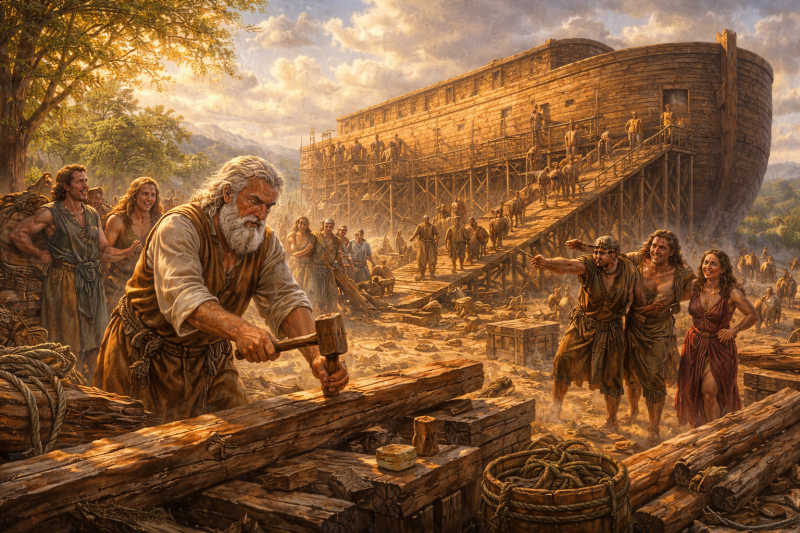
Moral decline
Genesis 10, the “Table of Nations,” records the descendants of Noah’s three sons, showing how the earth becomes populated and culturally diverse. This diversity reaches a climax in Genesis 11, where humanity, united by one language, attempts to “make a name for themselves” by building the Tower of Babel. God’s response—confounding their speech and scattering them—reinscribes the theme of divine sovereignty over human pride while simultaneously providing a theological explanation for linguistic and ethnic plurality.
Moses 8, a much later revelation in the Pearl of Great Price, zooms in on the immediate post‑creation generations that Genesis treats only cursorily. The chapter opens with the words, “And Adam went out of the garden of Eden, and dwelt in the east of Eden” (Moses 8:7), and proceeds to detail the birth of Seth, the naming of the land of Eden, and the early development of the human family. Notably, Moses 8 records that the “children of Adam … were instructed to keep the commandments of God” (8:19–23) and that “the Lord … gave them the law of the priesthood” (8:13–14). These details foreground the principle that divine instruction—rather than merely external punishment—was intended for humanity from the very beginning.
Reading the two accounts side by side reveals a complementary picture. Genesis stresses the catastrophic consequences of collective sin (the Flood, Babel) and the universal covenant promises that follow. Moses 8, on the other hand, shows the close, teaching relationship God had with the first families, pointing out that the blessings of the covenant were not just about punishment but were meant to be experienced through following God's rules, having priesthood authority, and receiving ongoing guidance Together they suggest that the early chapters of humanity’s story are not isolated tragedies but are woven into a larger, redemptive tapestry: God’s plan to restore, teach, and ultimately save a people who have repeatedly turned away from Him.
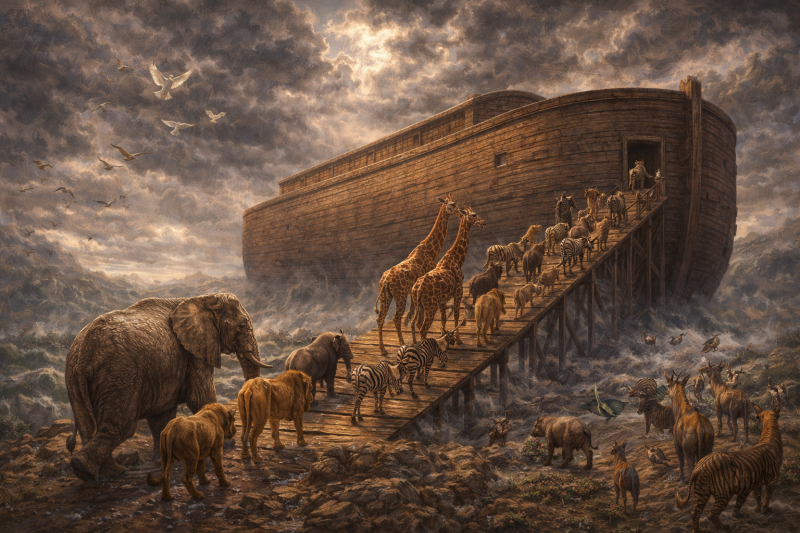
Catastrophic consequences
The story of the immediate post-creation generations, as told in Genesis 6:11, is pivotal in the biblical narrative. However, the reader often overlooks this story, leaving many details to their imagination. Fortunately, a much later revelation, as recorded in the Pearl of Great Price, provides a more in-depth look at this crucial period in human history. Specifically, Moses 8 offers a detailed account of the events that transpired after Adam and Eve were expelled from the Garden of Eden, shedding new light on the early development of the human family.
The chapter begins with the words, "And Adam went out of the garden of Eden, and dwelt in the east of Eden" (Moses 8:7), setting the stage for the story of the first family's life outside of the garden. According to the account, Adam and Eve had several children, including Seth, who is notable for being the son that replaced Abel, whom Cain had slain (Moses 8:9-11). The valley they lived in was called the "land of Eden" (Moses 8:12). These details may seem minor, but they provide a sense of continuity and connection to the creation story, emphasizing that the events of Genesis 6-11 are a direct continuation of the narrative that began in the Garden of Eden.
The story in Moses 8 also suggests that God gave the first human family the tools and advice they needed to deal with the problems of life outside of the Garden of Eden. This fact is evident in the way that Adam and his children are portrayed as being actively engaged in their spiritual development, with a focus on keeping the commandments and observing the law of the priesthood. The depiction challenges the notion that the early human family lacked spirituality or awareness of God's presence compared to later generations. It implies they were trying to follow God's will and were given the help they needed.
In addition to providing information about the spiritual lives of the early human family, Moses 8 also sheds light on the social and cultural developments of this period. The chapter notes that Adam and his children "began to till the earth, and to have dominion over all the beasts of the field, and over all the fowl of the air, and over every living thing that moveth upon the earth" (Moses 8:15-16). This detail suggests that the early human family was actively engaged in cultivating the earth and exercising stewardship over the natural world. This is a theme that is echoed throughout the biblical narrative, where the importance of responsible stewardship and care for the earth is repeatedly emphasized.

Cain’s burden and divine judgment
The story of the immediate post-creation generations, as told in Moses 8, is also notable for its portrayal of the challenges and struggles that the early human family faced. The chapter records that Cain, the son of Adam, "loved Satan more than God" (Moses 8:22), and that he was subsequently punished for his transgressions. This narrative serves as a cautionary tale, highlighting the dangers of succumbing to the influences of evil and the importance of remaining faithful to God's commandments. At the same time, it underscores the idea that God is a merciful and forgiving God, who is willing to work with his children to help them overcome their weaknesses and shortcomings.
In conclusion, the account in Moses 8 provides a rich and sophisticated perspective on the immediate post-creation generations, one that challenges common assumptions and sheds new light on the early development of the human family. By emphasizing the spiritual instruction that Adam and his children received, the chapter highlights the importance of divine guidance in human existence and underscores the principle that God's primary concern is to guide and uplift, rather than to punish or condemn. As such, Moses 8 offers a powerful and inspiring narrative, one that encourages readers to reflect on their relationship with God and to seek out the guidance and support that they need to navigate the challenges of life. Ultimately, the story of the early human family, as told in Moses 8, serves as a reminder of the enduring power of faith, hope, and charity, and of the importance of remaining faithful to God's commandments, even in the face of adversity and challenge.
One of the most significant aspects of Moses 8 is its emphasis on the spiritual instruction that Adam and his children received from God. The chapter says that the "children of Adam... were instructed to keep the commandments of God" (Moses 8:19–23). This shows how important divine guidance was in the early days of humanity. This instruction was not limited to moral teachings but also included the "law of the priesthood" (Moses 8:13-14), which was given to Adam and his sons. This is significant because it implies that the priesthood, with its ordinances and covenants, has always been part of human life.
The principle that divine instruction, rather than external punishment, was intended for humanity from the start is crucial. It underscores the idea that God's primary concern is not to punish or condemn, but to guide and uplift. The Bible emphasizes God's wish to be in relationship with his children rather than punish them for their sins. By highlighting the spiritual instruction that Adam and his family received, Moses 8 provides a more nuanced view of God's character, one that is both merciful and just.
Share your thoughts, comments, and ideas in the comment area. I look forward to how this study has enriched you.
Replies:
Add comment
Comments