Trinity, how Satan shows he is God of the Earth
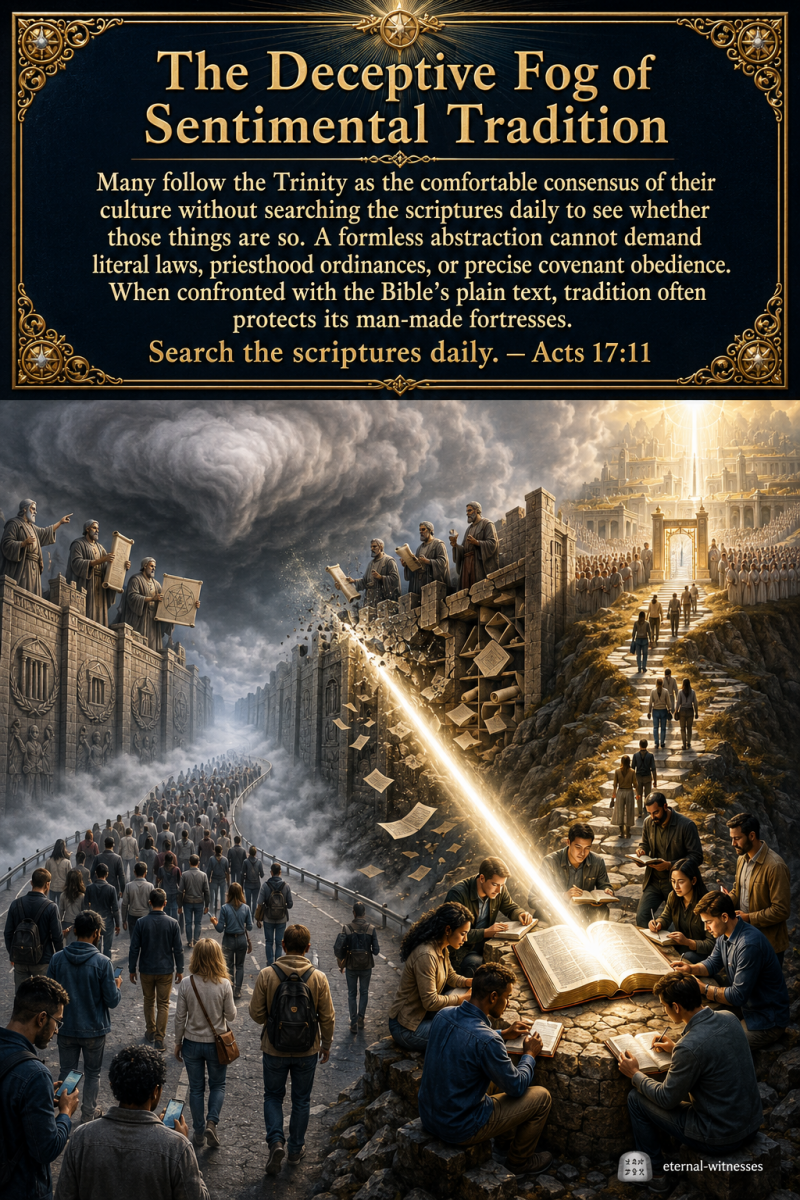
Today, the modern general public is trapped in a deceptive fog of sentimental tradition. They follow the Trinity simply because it is the default, comfortable consensus of their culture, completely refusing to have an open mind or search the scriptures daily to see if those things are so. They possess a bitter spirit of entitlement, actively rejecting any highly ordered organization that demands strict covenant accountability. They prefer a formless, immaterial spirit cloud because an abstract concept cannot hold them to literal laws, priesthood ordinances, or precise obedience. When presented with the literal text of the Bible, they choose to protect their man-made fortresses, proving their minds have been left empty of true scriptural knowledge.
Trinity, how Satan shows he is God of the Earth:
How the Traditional Trinity Cult Changed the Biblical Text
Replaced the Physical Godhead with an Immaterial Concept
The creators of the creed completely rejected the literal family of the resurrected Godhead, who possess permanent bodies of flesh and bones. They inserted a philosophical, formless spirit cloud "without body, parts, or passions" floating in an invisible vacuum into the interpretation of the text, turning the physical reality of the Father and Son into an incomprehensible guessing game.
- Severed the Literal Relationship Between the Father and the Son
By declaring that the Father, Son, and Holy Ghost are of one single, indivisible substance (homoousios), the keyless Roman politicians at fourth-century councils overthrew the clear layout of the scriptures. They effectively erased the distinct, tangible individuality of the separate Personages witnessed by ancient prophets like Stephen. - Closed the Heavens Against Continuing Revelation and Priesthood Keys
The imposition of a definitive, state-enforced creed established a closed boundary around spiritual knowledge. This administrative move declared that the word of God was finished, directly contradicting the highly ordered organization of the scriptural kingdom which relies on living lines, keys, and modern revelation to guide the covenant family. - Transformed Spiritual Ordinances into Keyless Allegories
The creedal system took literal, physical biblical ordinances—such as baptism by immersion, the laying on of hands for the gift of the Holy Ghost, and work for the dead—and stripped them of their priesthood authority. They reduced these sacred, structural actions into symbolic, man-made rituals that carry no actual divine power. - Substituted Greek Philosophy for Plain Scriptural Data
The politicians and bishops at ancient fourth-century councils took the simple, universal language of the literal Bible and filtered it through the lens of pagan Greek metaphysics. They introduced unscriptural terms and speculative doctrines to enforce state unity, creating a deceptive fog that has left modern traditional systems fractured and completely empty of true scriptural knowledge.
Creed changed these verses' meaning:
- 1 John 5:7–8 (The Johannine Comma; the primary explicit inclusion of the trinitarian formula added by later copyists)
- 1 Timothy 3:16 (Alteration of "He who was manifested" to "God was manifested")
- Acts 20:28 (Textual shift from "Church of the Lord" to "Church of God" to declare God has blood)
- Jude 1:5 (Manuscript alteration changing "the Lord" to "Jesus" to retroactively place Jesus into the Old Testament exodus)
- John 1:18 (Manuscript variant shifting "the only begotten Son" to "the unique God")
- Romans 9:5 (Punctuation and clause shifts to alter the sentence structure to force a trinitarian reading of Christ as the supreme God over all)
- Luke 2:33 (Changing "Joseph and his mother" to "His father and mother" to fit structural alterations)
- Matthew 28:19 (Historical and textual debates surrounding the expansion of the localized baptismal formula into the full trinitarian title)
- Luke 24:51 (The phrase "and was carried up into heaven" omitted or altered in key manuscripts to match physical/immaterial body debates)
- Philippians 2:6 (Translation and parsing manipulations regarding "equality with God" to distort the original layout of submission)
- John 10:30 (Interpretative modifications forcing "one" to mean of one indivisible substance rather than unified in purpose)
- Ephesians 3:9 (Addition of the phrase "by Jesus Christ" at the end of the verse to retroactively shift the creation context)
- Colossians 2:9 (Philosophical filtering of the word "bodily" to change its literal meaning into an immaterial abstraction)
- Matthew 1:25 (Altering the text to omit "her firstborn" to protect secondary dogmas about Mary that supported later creedal frameworks)
- John 14:28 (Scribal harmonization attempts to gloss over the phrase "my Father is greater than I" to enforce equal status)
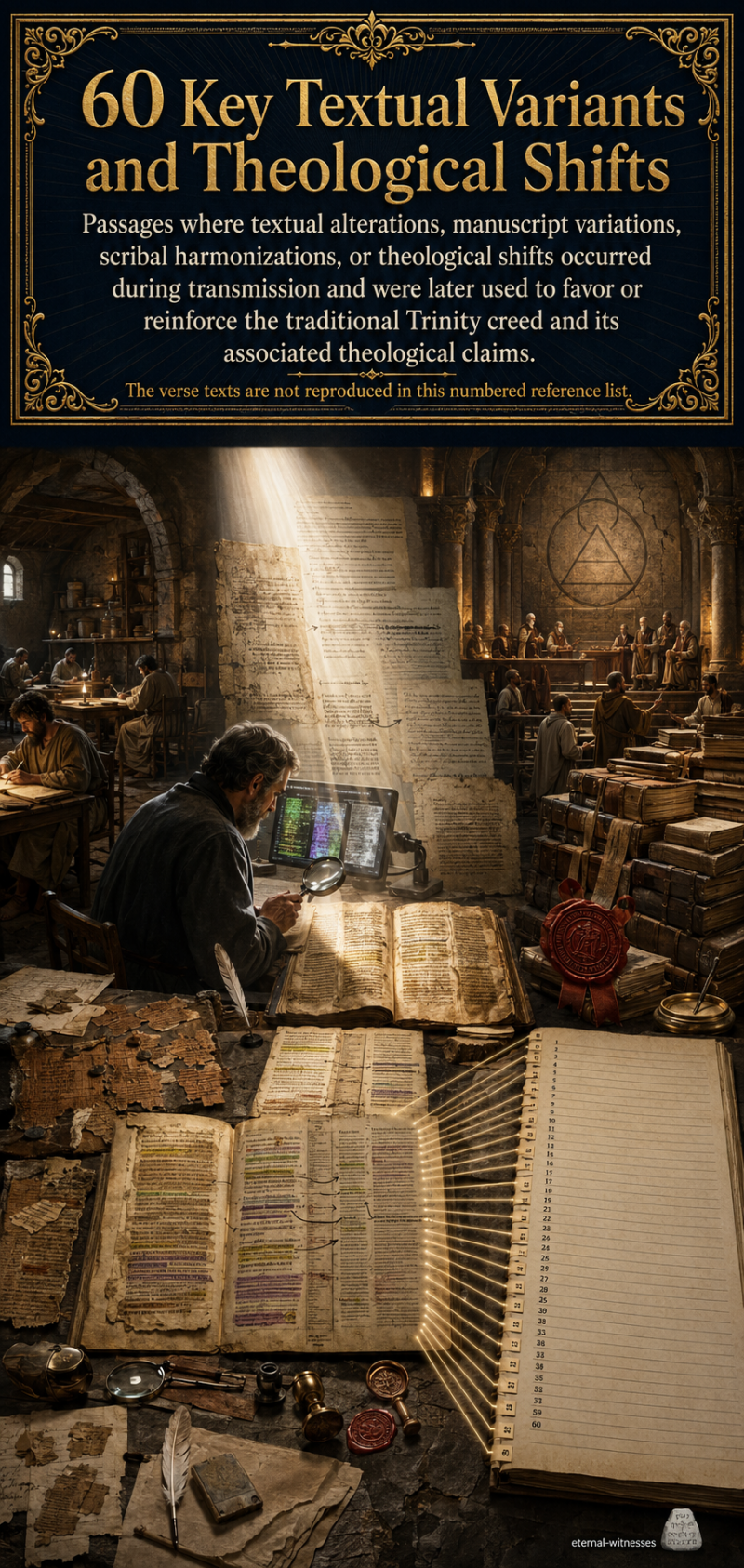
16. Colossians 1:15 (Distorting the word "Firstborn" through creedal vocabulary to deny a pre-mortal spiritual birth)
17. Titus 2:13 (Grammatical structure shifts—the Granville Sharp rule—used to combine distinct Personages into one entity)
18. 2 Peter 1:1 (Similar grammatical manipulations applied to alter the distinct identities of God and Jesus Christ)
19. Mark 1:1 (The phrase "the Son of God" is missing or altered in several early codices like Sinaiticus)
20. Luke 22:43–44 (The entire passage of Christ sweating drops of blood omitted by certain Alexandrian scribes who viewed a physical, suffering God as philosophically impossible)
21. John 14:16 (Altering the context of the "Comforter" to build a distinct, non-familial entity out of the Holy Ghost)
22. Mark 13:32 (Scribal attempts to omit or obscure "neither the Son" to hide the fact that the Son's knowledge was separate from the Father's)
23. John 3:13 (The addition of the phrase "which is in heaven" to force a omnipresent, non-localized reading of Christ's physical body)
24. Acts 7:55 (Creedal interpretations attempting to turn Stephen’s vision of two separate beings into a single essence)
25. Acts 7:56 (Further spiritualization of Stephen seeing the Son of Man standing on the right hand of God)
26. 1 John 4:3 (Textual variants regarding "Christ is come in the flesh" to combat early gnostic arguments that later birthed the immaterial cloud doctrine)
27. Luke 4:4 (Omission of "but by every word of God" in specific early manuscript lines)
28. John 8:58 (Manipulating the phrase "I am" to claim a direct linguistic match with the Old Testament deity title, ignoring context)
29. Acts 9:5 (Addition of "it is hard for thee to kick against the pricks" from later harmonizations)
30. Acts 9:6 (Scribal addition of Saul trembling and astonished to mimic structural storylines)
31. 1 Corinthians 15:47 (Manuscript alteration adding "the Lord" so it reads "the second man is the Lord from heaven")
32. Revelation 1:8 (The text expanded to include "the Beginning and the Ending" to alter the declaration of identity)
33. Revelation 1:11 (Omission of "I am Alpha and Omega, the first and the last" in major manuscript streams to reshape the introductory declaration)
34. 1 John 5:20 (Grammatical pronoun shifting to force the phrase "This is the true God" to apply to the Son rather than the Father)
35. John 17:3 (Creedal gymnastics to bypass the clear statement that the Father is "the only true God")
36. Matthew 19:17 (Changing "Why callest thou me good? there is none good but one, that is, God" to "Why askest thou me concerning that which is good?")
37. Mark 10:18 (Scribal harmonizations matching the alterations made to Christ's statement on goodness)
38. Hebrews 1:3 (Philosophical redefinition of "express image of his person" to align with Greek metaphysical terms like hypostasis)
39. John 1:1 (Manipulating the capitalization and definite articles in Greek to claim absolute numerical oneness rather than distinct divine alignment)
40. 1 Corinthians 8:6 (Creedal explanations engineered to merge the distinct roles of the "one God, the Father" and "one Lord, Jesus Christ")
41. Ephesians 4:6 (Forcing the "one God and Father of all" into a triune container rather than an individual Parentage)
42. 1 Timothy 2:5 (Obscuring the clear layout of the "one mediator between God and men, the man Christ Jesus")
43. John 5:19 (Ignoring and reinterpreting the Son's explicit declaration of dependence: "The Son can do nothing of himself")
44. John 14:9 (Twisting "he that hath seen me hath seen the Father" into physical identity oneness rather than perfect alignment of character)
45. Hebrews 1:8 (Structural and translational alterations regarding "Thy throne, O God, is for ever and ever" to strip away the context of an anointed reward)
46. Hebrews 1:9 (Bypassing the literal phrase "God, even thy God, hath anointed thee" which proves Jesus has a God above Him)
47. Revelation 2:20 (Textual variants altering "that woman Jezebel, which calleth herself a prophetess" to change the warning layout)
48. John 10:38 (Reinterpreting "the Father is in me, and I in him" to signify one single substance instead of unified purpose)
49. John 17:11 (Ignoring the Savior's prayer that the disciples may be "one, as we are," which shatters the idea of a single indivisible substance)
50. John 17:21 (Further rejection of the pattern of oneness being an alignment of separate, distinct individuals)
51. John 17:22 (The ultimate repetition of the true pattern of divine unity that the creeds overthrew)
52. Matthew 20:23 (Obscuring Christ's admission that sitting on His right hand and left is "not mine to give" but belongs to the Father alone)
53. Mark 14:36 (Scribal evasion of the distinction of wills in the phrase "not what I will, but what thou wilt")
54. Luke 22:42 (Similar re-interpretations to hide the separate, independent agency of the Son's will from the Father's)
55. Matthew 27:46 (Creedal difficulty in explaining how a member of an inseparable trinity could literally cry out "My God, my God, why hast thou forsaken me?")
56. Mark 15:34 (Re-reading the crucifixion cry to avoid admitting Jesus was a separate being relying on His Father)
57. John 20:17 (Bypassing the resurrected Lord's explicit layout: "I ascend unto my Father, and your Father; and to my God, and your God")
58. 1 Corinthians 15:24 (Obscuring the timeline where Christ delivers up the highly ordered kingdom to "God, even the Father")
59. 1 Corinthians 15:28 (Evasion of the unyielding truth that the Son Himself shall "be subject unto him" so that God may be all in all)
60. Philippians 2:11 (Scribal and creedal attempts to conclude the verse without emphasizing that every confession of Jesus Christ is ultimately "to the glory of God the Father")
How the Creed was forced to be accepted as the word of the Bible by the earthly god Satan)
- Imperial Decrees and State Consolidation
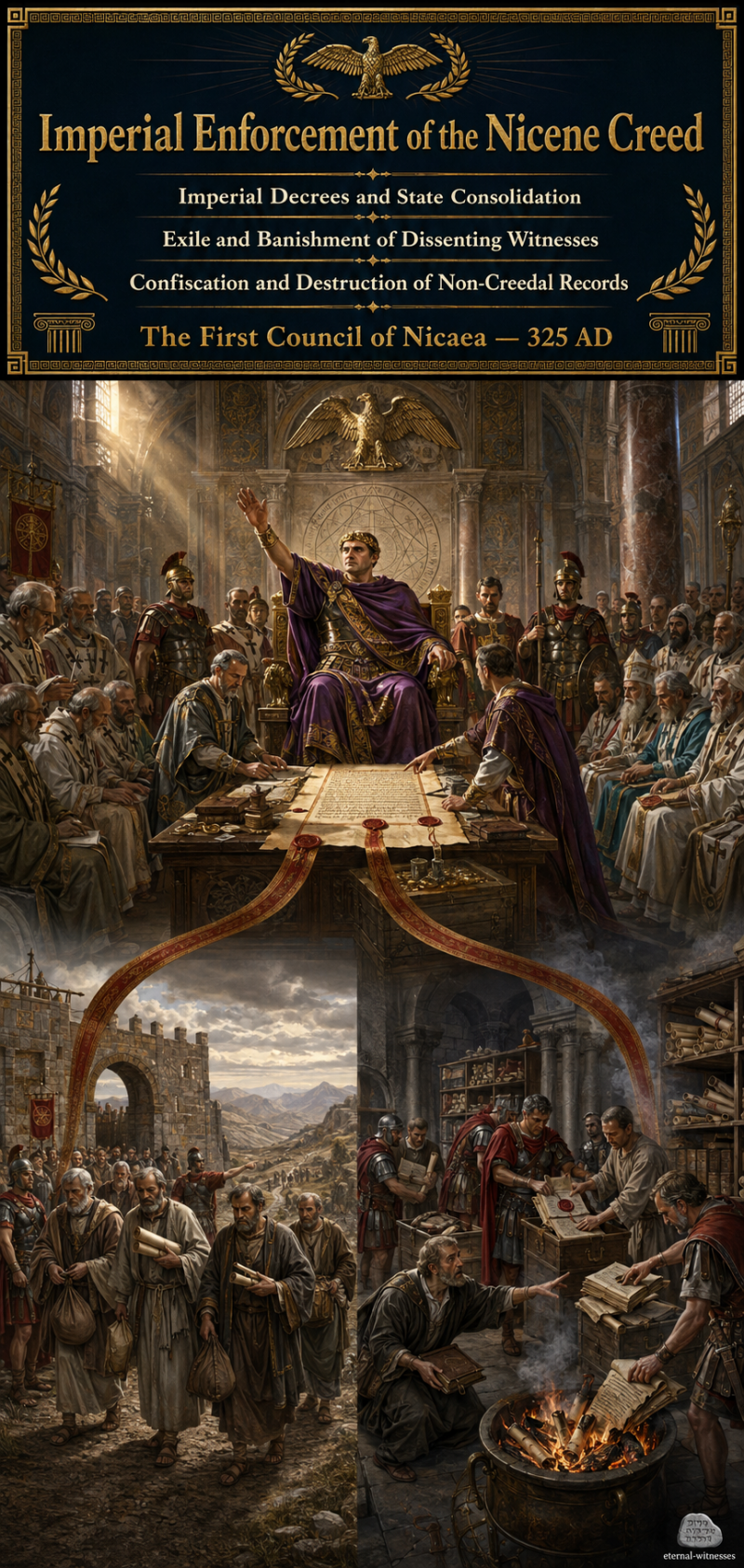
The First Council of Nicaea (325 AD) was officially convened, financed, and overseen by the Roman Emperor Constantine I, a political ruler who prioritized imperial unity over scriptural accuracy. He used the power of the state to force the bishops into signing the initial creedal formula, effectively turning a localized philosophical debate into a mandatory law of the Roman Empire. - Exile and Banishment of Dissenting Witnesses
Immediately following the adoption of the creed, any bishop or church leader who refused to sign the document was stripped of his office and physically exiled by imperial command. Ordained witnesses who stood for separate Divine Personages were forcibly removed from their congregations to silence any opposition to the new state-mandated theology. - Confiscation and Destruction of Non-Creedal Records
The Roman administration issued strict edicts demanding the collection, censorship, and burning of all theological writings, commentaries, and manuscript copies that contradicted the new creedal standard. Possessing unapproved scriptural interpretations or alternative records was criminalized to ensure the state’s philosophical invention became the only available text. - Criminalization of Theological Dissent
The state transformed religious non-conformity into a capital offense against the empire. Subsequent imperial edicts labeled those who rejected the creed as heretics, stripped them of their property, banned them from assembling, and eventually authorized the execution of individuals who openly preached against the state-enforced doctrine. - Military Enforcement of Local Congregations
When local congregations resisted the replacement of their traditional beliefs, the imperial government deployed military forces to physically seize church buildings. Keyless bishops who swore allegiance to the creed were forcibly installed behind lines of Roman soldiers, compelling the lay members to accept the new theological definitions under threat of physical violence.
- The Establishment of the Closed Canon Boundary
To permanently protect the new system from external challenge, the state-sponsored religious authority closed the scriptural canon. By declaring that all public revelation had ceased with the ancient apostles, they effectively outlawed any continuing revelation or modern priesthood keys that could expose the political origin of their formless, immaterial spirit cloud. - Forced Harmonization of Scriptural Copies
Scribes working within the state-controlled scriptural production centers systematically applied the theological assumptions of the creed to the copying process. Manuscript lines were modified, passages were added (such as the Johannine Comma), and texts were harmonized to ensure the surviving copies of the Bible appeared to support the fourth-century philosophical invention.
The Mentality of the Political and Ecclesiastical Leaders
- Obsession with Imperial Uniformity and Political Stability
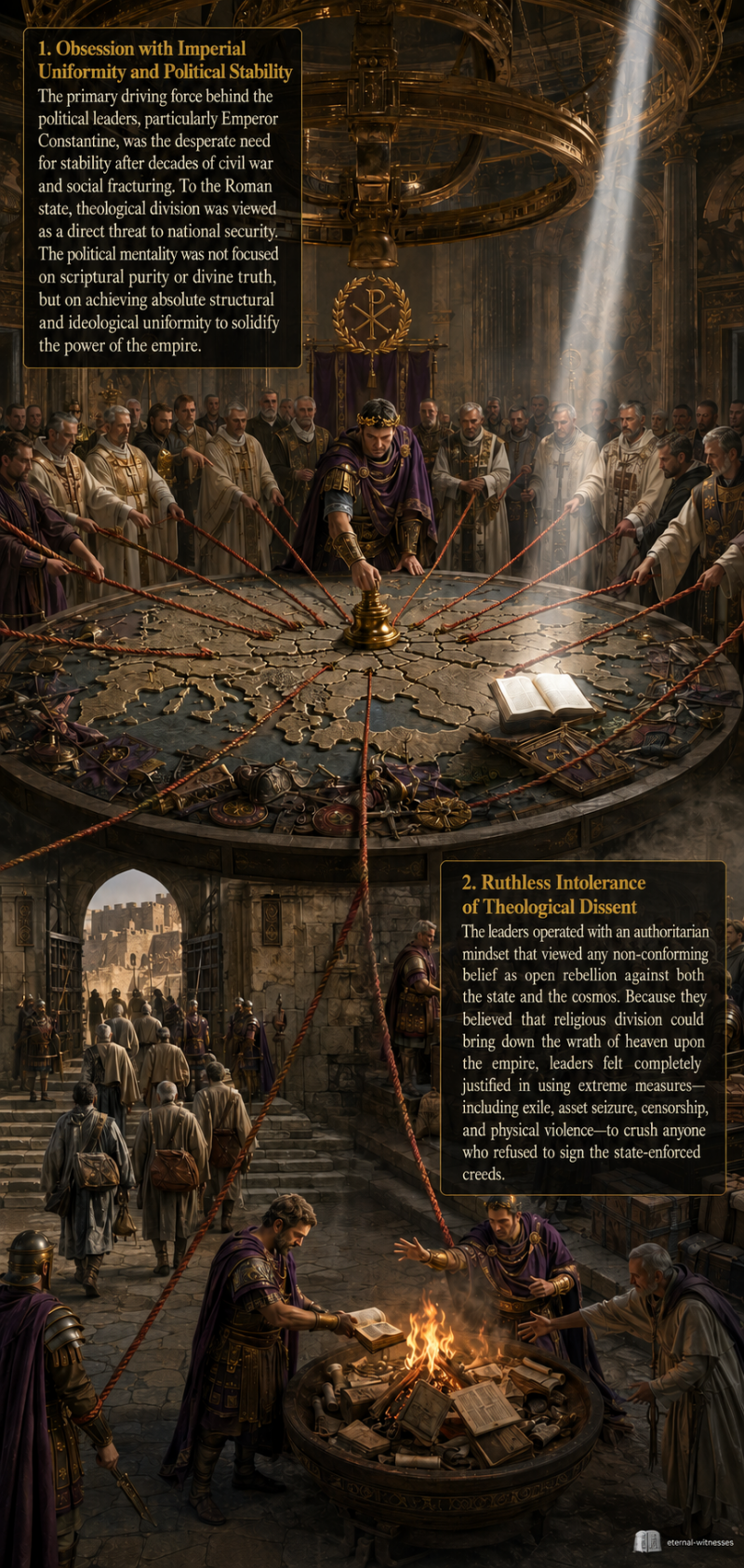
The primary driving force behind the political leaders, particularly Emperor Constantine, was the desperate need for stability after decades of civil war and social fracturing. To the Roman state, theological division was viewed as a direct threat to national security. The political mentality was not focused on scriptural purity or divine truth, but on achieving absolute structural and ideological uniformity to solidify the power of the empire.
- Ruthless Intolerance of Theological Dissent
The leaders operated with an authoritarian mindset that viewed any non-conforming belief as open rebellion against both the state and the cosmos. Because they believed that religious division could bring down the wrath of heaven upon the empire, leaders felt completely justified in using extreme measures—including exile, asset seizure, censorship, and physical violence—to crush anyone who refused to sign the state-enforced creeds. - Pride in Pagan Philosophical Sophistication
The bishops and scholars who drafted the creeds were heavily influenced by Hellenistic metaphysics and Greek philosophy, such as Neoplatonism. Their mentality was one of intellectual elitism; they viewed the simple, physical, and universal language of the literal scriptures as too simplistic. They actively sought to elevate the gospel into an abstract, academic guessing game, believing that redefining the Godhead as a formless, immaterial essence proved their own intellectual superiority over the common people.
3. Desire for Institutional Control and Centralized Wealth
By aligning themselves with the Roman state, the creedal leaders shifted from a mentality of persecuted survival to one of imperial dominance. They quickly became obsessed with consolidating ecclesiastical power, securing state funding, and securing tax exemptions for their approved clergy. To maintain this newfound wealth and institutional control, they adopted a protective mentality that required closing the scriptural canon and outlawing any independent priesthood keys or continuing revelation.
The Mentality of the Common People
- Terror of State Retaliation and Execution
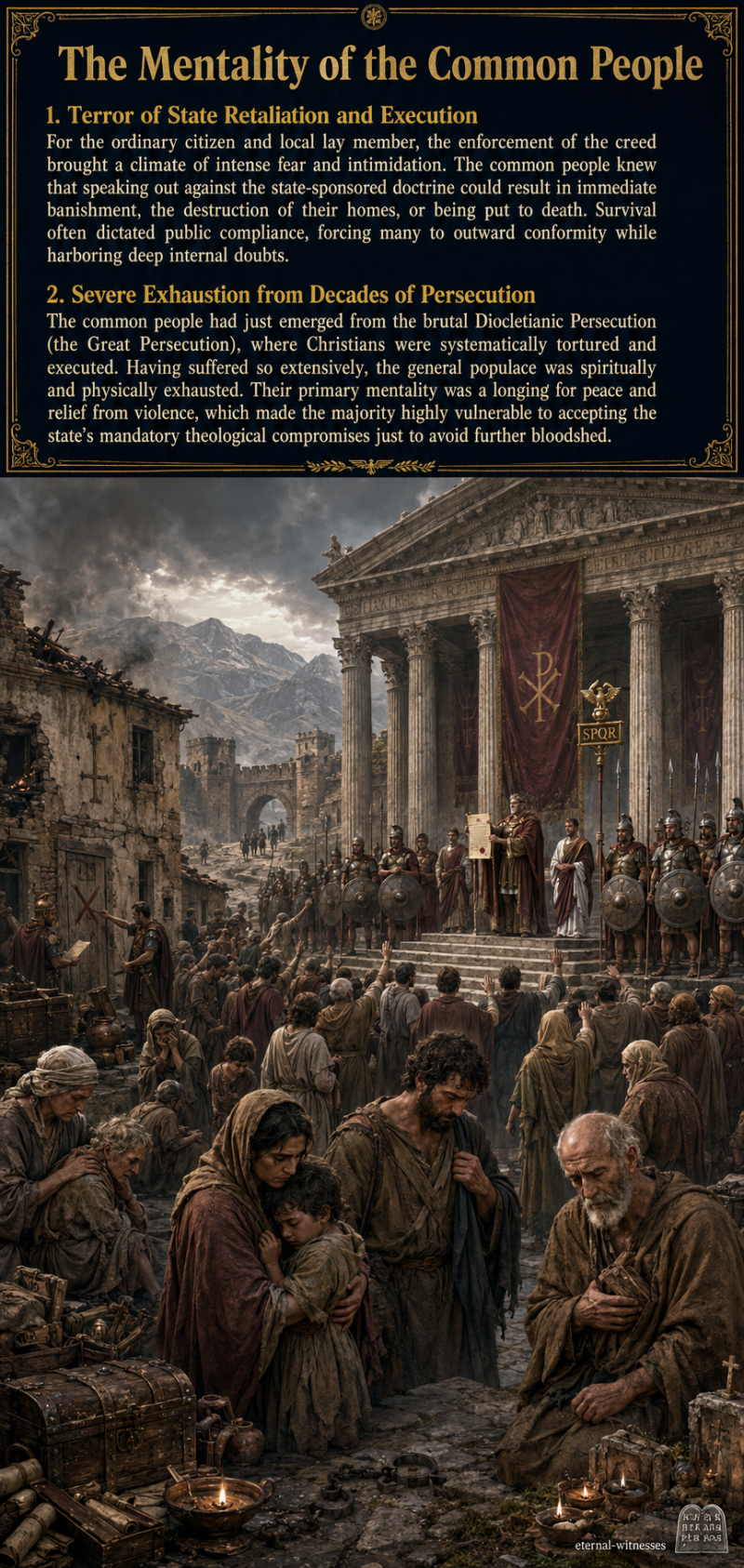
For the ordinary citizen and local lay member, the enforcement of the creed brought a climate of intense fear and intimidation. The common people knew that speaking out against the state-sponsored doctrine could result in immediate banishment, the destruction of their homes, or being put to death. Survival often dictated public compliance, forcing many to outward conformity while harboring deep internal doubts. - Severe Exhaustion from Decades of Persecution
The common people had just emerged from the brutal Diocletianic Persecution (the Great Persecution), where Christians were systematically tortured and executed. Having suffered so extensively, the general populace was spiritually and physically exhausted. Their primary mentality was a longing for peace and relief from violence, which made the majority highly vulnerable to accepting the state’s mandatory theological compromises just to avoid further bloodshed. - Deep Spiritual Confusion and Loss of Direction
Because the authorized apostolic witnesses had been systematically martyred, the common people were left without an organized priesthood hierarchy to guide them. They found themselves caught in a chaotic, deceptive fog where rival bishops constantly anathematized one another. This absence of clear priesthood keys left the people feeling spiritually stranded, forcing them to depend on an unorganized guessing game of competing traditions.
4. Voluntary Submission to a Formless, Lower Standard
Over generations of conditioning, the mentality of the masses shifted from a desire for literal covenant tracking to a lazy acceptance of a lower spiritual standard. Because the true, highly ordered organization of the heavenly family demanded strict obedience to covenant laws, many preferred the easier, sentimental path offered by the creed’s formless spirit cloud. This allowed the people to feel secure in their religious identity without having to align their lives with a physical, resurrected Godhead who demands actual accountability.
The Mentality of Modern Religious Leaders
- Obsession with Mainstream Acceptance and Validation
Modern traditional leaders prioritize staying aligned with the vast, cultural consensus of global Christianity rather than investigating the raw textual data of the Bible. They operate with an protective mentality, fearing that if they question the ancient political creeds, they will be stripped of their professional status, lose their congregations, and be labeled as heretics. They choose the safety of mainstream numbers over the narrow path of absolute scriptural truth. [1, 2] - Pride in Intricate Academic Theology
The leaders who teach the Trinity today are heavily invested in centuries of complex, speculative metaphysics. Their mindset is driven by an intellectual elitism that treats God as an incomprehensible mystery that only trained theologians can parse. They take pride in preaching a formless, immaterial spirit cloud because it allows them to preserve an academic guessing game where they act as the essential interpreters for a confused populace. - Fear of Admitting a Total Historical Failure
To admit that the traditional Trinity cult was an unscriptural invention of fourth-century Roman politicians would require leaders to acknowledge that their entire system has been completely empty of true priesthood keys and divine authority for nearly two millennia. Because this admission would collapse their institutional credibility and financial structures, they adopt a defensive mentality, actively shutting down any real discussion regarding the literal family of the resurrected Godhead.
The Mentality of the Modern General Public
- A Deceptive Fog of Sentimental Tradition
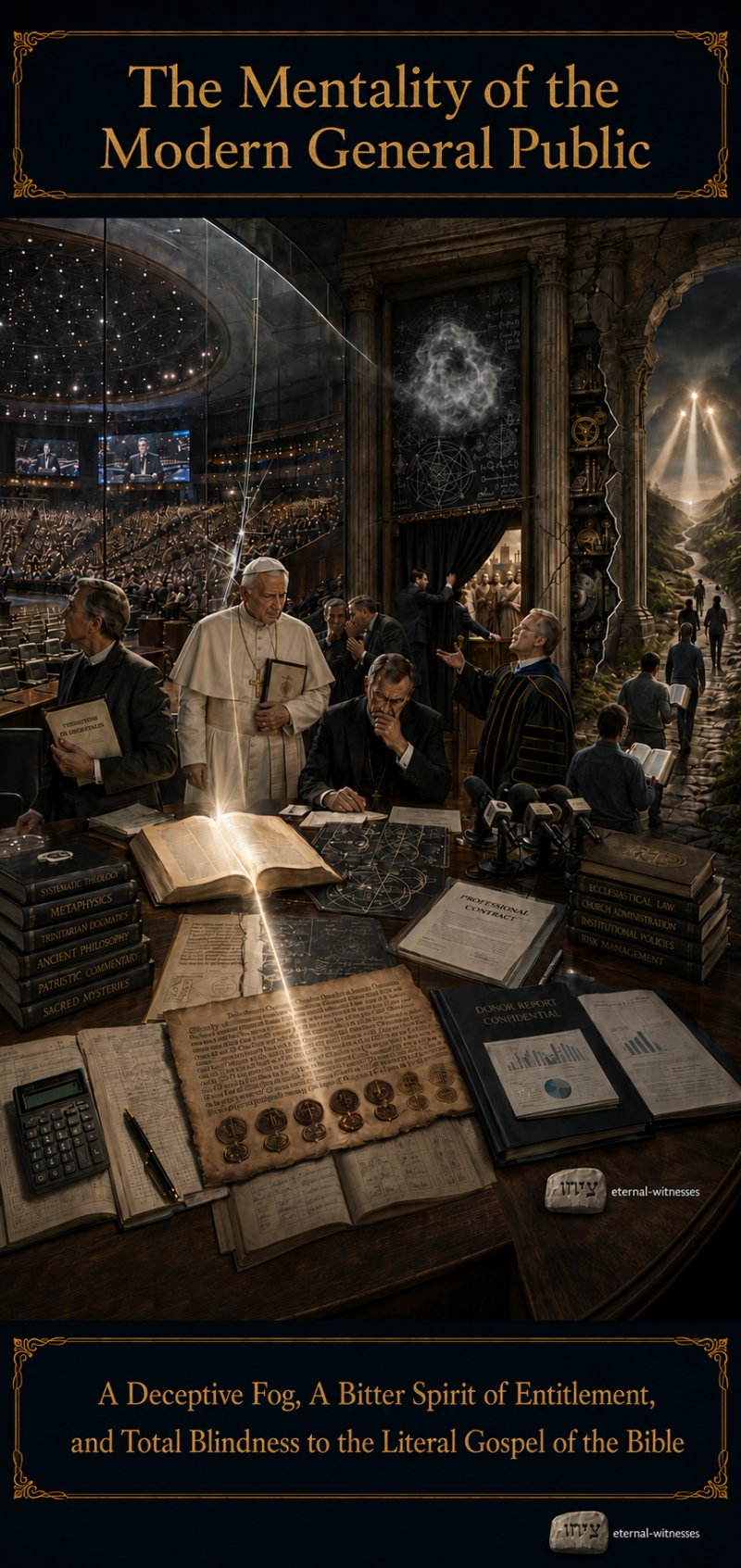
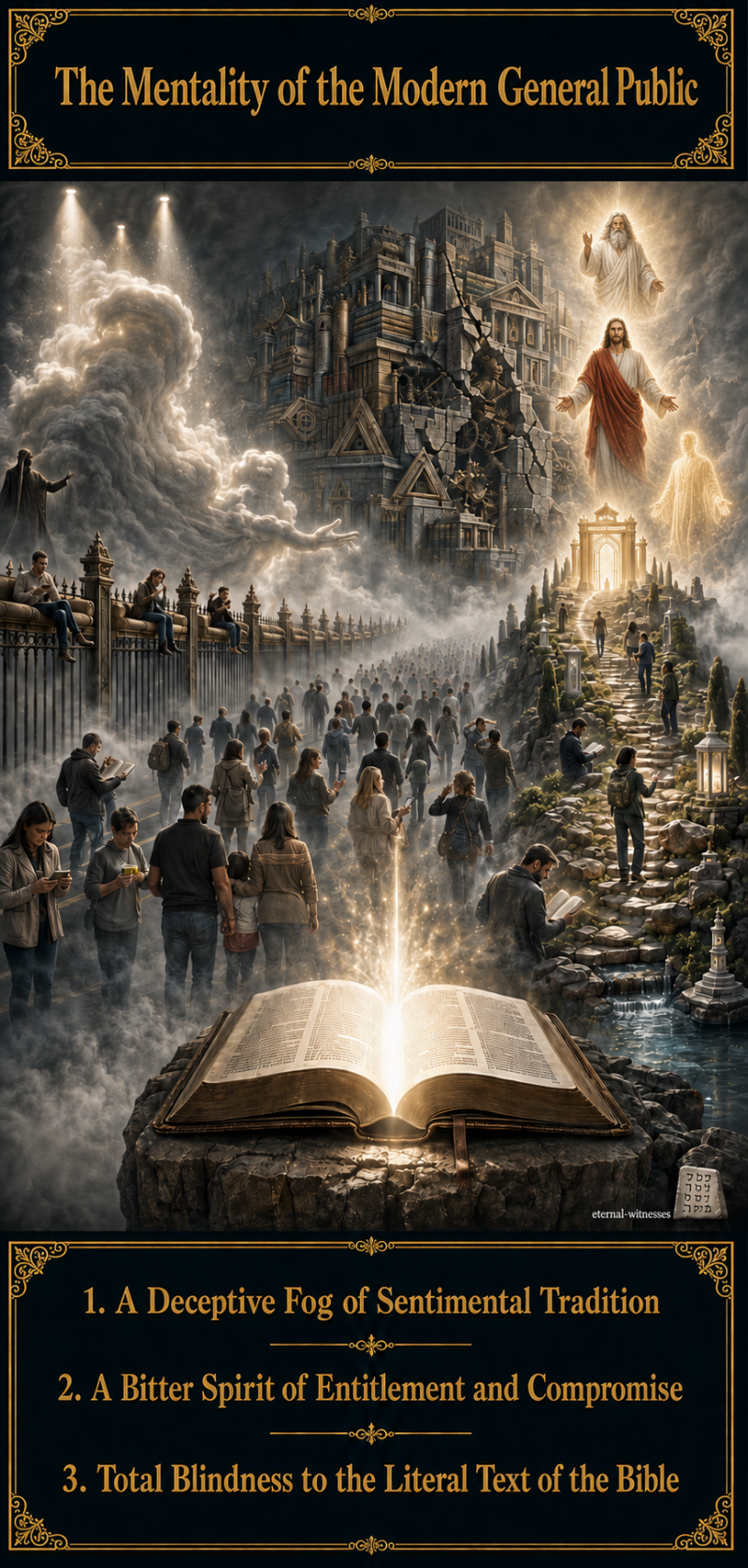
The vast majority of people today who follow the Trinity do so simply because they were born into it or because it is the default cultural setting of their society. They operate with a passive, unthinking mentality, accepting the traditional creedal formulas without ever searching the scriptures daily to verify if those things are actually true. They mistake a familiar, comfortable tradition for actual divine light. - A Bitter Spirit of Entitlement and Compromise
The modern public prefers a lower, sentimental standard of religion that does not demand strict alignment with a highly ordered heavenly family. They embrace a formless, immaterial god because an abstract concept cannot hold them personally accountable to literal laws and ordinances. This mentality allows them to sit comfortably on the fence, claiming to know God while their minds remain completely trapped in a deceptive fog. - Total Blindness to the Literal Scripture of the Bible
When confronted with the clear layout of the scriptures—where the physical, resurrected Savior explicitly declares He has a separate body of flesh and bones and a Father above Him—the modern populace reacts with hostility or immediate dismissal. Their minds have been so thoroughly conditioned by the greatest liar to make things look good that they can no longer recognize plain biblical ordinances, choosing instead to protect a man-made fortress that strips Christianity of all power and unity.
The Great Inversion: How the Traditional Trinity Cult Altered Scriptural Reality and Enforced a Philosophy of Darkness
For the true, honest Silent Seekers watching and learning the truth, this comprehensive instructional guide lays bare the historic blueprint of the great falling away. The literal text of the Bible stands completely on its own, yet for nearly two millennia, the traditional Trinity cult—established by keyless Roman politicians and sustained by modern blind guides—has sought to bury the true, highly ordered organization of the scriptural kingdom. The true Godhead is a literal, organized biblical family consisting of three separate, distinct, and tangible individual personages who possess permanent bodies of flesh and bones. The adversary, functioning as the earthly god of this world, orchestrated a complete structural inversion to replace this physical reality with a counterfeit Jesus—a formless, immaterial spirit cloud "without body, parts, or passions" floating in an invisible vacuum.

The Scribal Inversion: Redefining the Divine Form through Metaphysical Darkness
Part I: The Textual Assault—Changing the Wording and Meaning of Scripture
The first line of attack by the counterfeit system was the literal manipulation and forced reinterpretation of the sacred text. When keyless scribes and theologians realized the plain words of the ancient apostles did not support their philosophical inventions, they systematically applied modifications to the manuscript lines, creating a deceptive fog over the word of God.
- The Manufacturing of Explicit Formulas
The primary example of outright textual insertion is the infamous Johannine Comma found in 1 John 5:7–8. Early biblical manuscripts record no trinitarian formula in this passage; the text spoke only of the three witnesses on earth: the spirit, the water, and the blood. Later scribes working under the influence of the creedal establishment physically forced the explicit statement—"the Father, the Word, and the Holy Ghost: and these three are one"—into the Latin text to manufacture a scriptural proof text that the ancient apostles never wrote.
- Altering the Manifestation of Deity
In 1 Timothy 3:16, early manuscript lines explicitly read "He who was manifested in the flesh." Keyless copyists changed the Greek letters so that the verse read "God was manifested in the flesh." This changed the structure of the verse to support the creedal dogma that Jesus was not a separate, distinct Son doing the will of His Father, but was the same as the one essence of the cosmic Creator.
- Erasing the Son's Distinct Submission
Clear declarations of the Son's separate agency and absolute dependence on the Father were systematically reinterpreted or obscured. Scribes struggled with passages like Mark 13:32, where Christ admits that the Son does not know the hour of His second coming, only the Father. The creedal system engineered complex theological glosses to argue that Christ knew it in His "divine nature" but was ignorant in His "human nature," turning the scriptures into an unorganized guessing game and splitting the Savior into a fractured, multi-natured entity unrecognized by the literal text.
- The Spiritualization of the Physical Body
The literal Bible records that the resurrected Christ holds a permanent, perfected body of flesh and bones. Luke 24:39 and Colossians 2:9 flatly state that the entire fulness of the Godhead dwells bodily. The traditional Trinity cult changed the very meaning of the word "bodily" (somatikos), forcing it through the filter of pagan metaphysics to mean an abstract, spiritualized metaphor. They altered the plain reading of John 17:11 and 21, where Christ prayed that His disciples might be "one, as we are," completely rejecting the truth that divine oneness is a perfect alignment of separate, distinct individuals and substituting it with a mathematical oneness of a single, indivisible substance.
Add comment
Comments