By Karma McConahay
Lie One: The Formless, Immaterial Essence
The First Lie: The Formless, Immaterial Essence ("Without Body, Parts, or Passions")
Those of us with the only true knowledge have no reason to defend the Bible or the Book of Mormon.
For the true, honest Silent Seekers reading along to find the truth, this comprehensive instructional guide thoroughly reveals every detail of the counterfeit origin, layout, and political enforcement of the creedal lie about the formless, immaterial essence. The adversary engineered this deception to strip humanity of their divine identity, replacing our loving, tangible Heavenly Parents with a confusing spirit cloud that floats in an invisible vacuum. By analyzing the historical fraud directly side by side with the uncorrupted written word of God, you can clearly see the two paths and determine the correct path to walk.
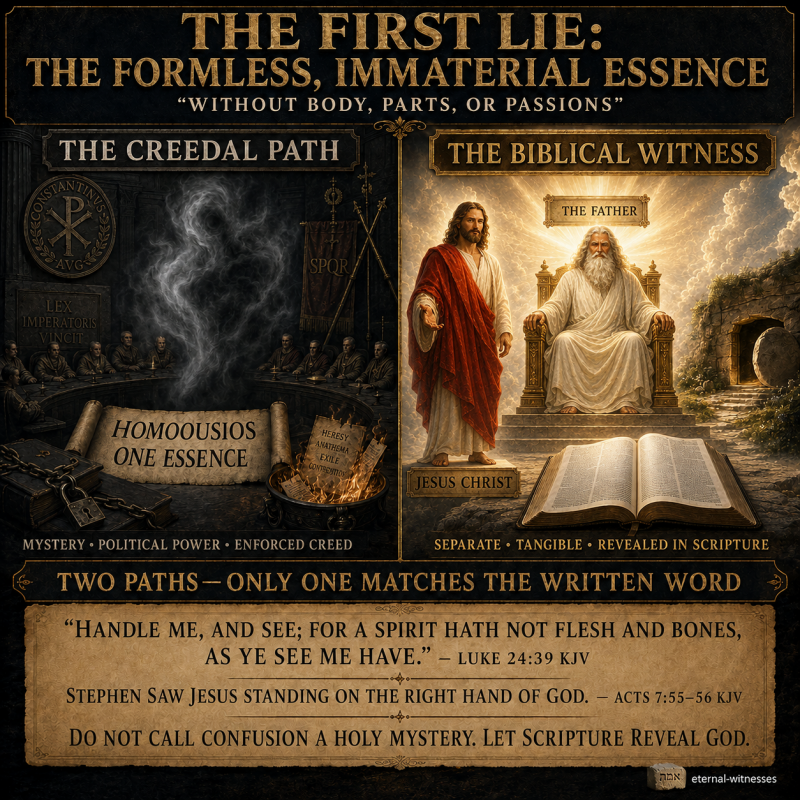
How They Came Up With the Lie
The primitive church explicitly knew and witnessed the literal, physical layout of the Godhead. The New Testament apostles interacted directly with a tangible, separate, and physically resurrected Christ. However, once the original Apostles were killed and the keys of active revelation were lost, the early church bishops began to internalize pagan Greek philosophies—specifically Neo-Platonism and Gnosticism. These worldly philosophies taught that physical matter was inherently corrupt, flawed, and evil. They argued that a supreme God could never lower Himself to possess a tangible body or experience physical attributes.
To blend Christianity with this worldly philosophy, a series of secularly convened councils abandoned the plain, physical record of scripture. At the Council of Nicaea in 325 AD, the bishops invented the unscriptural term homoousios (meaning "of one substance" or "of one essence"). This term did not come from the prophets; it was imported directly from pagan Greek metaphysics. By adopting this philosophical word, they declared that the Father, Son, and Holy Ghost were not an organized family of separate personages but rather a single, formless, metaphysical essence block. They forcefully stripped God of His form, reducing Him to a mysterious vacuum that has no location, no boundary, and no shape.
The historical data proves how this fraud was systematically conducted. Original records from early church historians like Eusebius of Caesarea document that out of roughly 1,800 bishops throughout the Roman Empire, only about 318 attended Nicaea. This minority did not consult scripture; they engaged in fierce political debate over philosophical vocabulary. Secular records confirm that the introduction of homoousios was not a theological breakthrough but a direct manipulation by the non-baptized Emperor Constantine to unify his fracturing empire. Prior to this event, early Christian apologists like Justin Martyr and Origen explicitly described the Father and the Son as distinct, subordinate, and separate individual beings.
This political council overthrew centuries of primitive witness, physically erasing the distinct layout of the Godhead and transforming the tangible Father and Son into an immaterial, unapproachable essence block.
The adversary did not make this lie believable through spiritual power; he made it believable by wrapping it in a protective coat of mandatory, unquestionable confusion. The architects of the creeds knew that the human mind naturally rejects a formless spirit cloud. To bypass human reason, they declared that the nature of God was an incomprehensible "mystery" that must never be questioned or analyzed.
By the fifth and sixth centuries, this philosophy evolved into the Athanasian Creed, which explicitly presents the paradox by stating that the Father, Son, and Holy Ghost are all infinite and incomprehensible, yet they are not three incomprehensibles, but one. This formula was later codified into traditional church confessions—such as the Anglican Thirty-Nine Articles and the Westminster Confession—describing God as a deity "without body, parts, or passions."
They presented a double-minded trap: they required believers to confess that Jesus Christ rose from the dead with a physical body while simultaneously forcing them to believe that His ultimate divine essence is an invisible, immaterial spirit cloud fused entirely inside an unapproachable, formless vacuum. Over generations of spiritual darkness, people began to believe the lie simply because they were taught that questioning the mystery was a sin.
The architects of the creeds knew that the human mind naturally rejects a formless spirit cloud. To bypass human reason, they declared that the nature of God was an incomprehensible "mystery" that must never be questioned or analyzed. By the fifth and sixth centuries, this philosophy evolved into the Athanasian Creed, which explicitly presents the paradox by stating that the Father, Son, and Holy Ghost are all infinite and incomprehensible, yet they are not three incomprehensibles, but one.
This formula was later codified into traditional church confessions—such as the Anglican Thirty-Nine Articles and the Westminster Confession—describing God as a deity "without body, parts, or passions." They presented a double-minded trap: they required believers to confess that Jesus Christ rose from the dead with a physical body while simultaneously forcing them to believe that His ultimate divine essence is an invisible, immaterial spirit cloud fused entirely inside an unapproachable, formless vacuum. Over generations of spiritual darkness, people began to believe the lie simply because they were taught that questioning the mystery was a sin.
Historical records show exactly how this manipulation became believable to the masses. The transition from biblical clarity to creedal mystery succeeded by completely locking the common people out of scriptural access and literacy. For centuries, the state-backed church restricted the copying and reading of the holy text to Latin and Greek, languages that the average citizen could not read or comprehend. When the Council of Chalcedon met in 451 AD to address the severe logical contradictions of Nicaea, they invented the "hypostatic union"—the dual-nature doctrine claiming Christ is simultaneously fully human and fully divine, fully physical yet fully immaterial. Early historical records from this era document that when ordinary believers questioned how a being could be both tangible and a formless essence at the same time, the clergy labeled the contradiction a "holy mystery" beyond human intellect. By threatening that any attempt to understand God logically would result in immediate heresy and eternal damnation, the councils successfully conditioned generations to accept total confusion as deep spirituality.
The Holy Ghost did not accomplish the spread of the Trinity creed; instead, political corruption, military power, and state-sponsored terror pushed it through. Roman Emperor Constantine, a politician who was not even a baptized Christian at the time, completely organized and managed the Council of Nicaea. Constantine wasn't concerned about biblical truth; he wanted political unity to stabilize his fractured empire. He took the pagan concept of homoousios and backed it with the full military sword of the Roman state.
The councils immediately attached severe, formal curses of damnation—called anathemas—to the end of their creeds, declaring that anyone who refused to worship their formless mystery would instantly perish eternally. Imperial decrees instantly criminalized scriptural truth. Bishops who insisted on the separate, physical layout of the Godhead were stripped of their homes and exiled by the emperor's army. For centuries, the state-enforced church hunted down, branded, and executed anyone who dared to preach the literal resurrection, forcing the entire world into a dark room of spiritual ignorance.
Historical state records prove that the state enforced its will through brutal, state-sanctioned bloodshed and totalitarian legislation. In 380 AD, Emperor Theodosius I issued the Edict of Thessalonica, a chilling legal decree preserved directly in the Codex Theodosianus. This imperial law officially criminalized any belief system outside of the Nicene Trinity, explicitly labeling all dissenters as "extravagant madmen" and stripping them of the right to gather or build churches. Historical records from early church chroniclers confirm that the Roman military actively purged non-Trinitarian Christians from major theological hubs.
Bishops like Arius and his followers were hunted down, their theological writings were gathered into massive street bonfires under penalty of death for anyone who hid them, and their leaders were violently driven into the desolate wilderness. By the time of the Justinian Code in the sixth century, denying the formless creedal trinity was made a capital offense punishable by total asset confiscation, physical torture, and execution. The adversary established this lie not by converting the heart, but by using the iron fist of the Roman empire to spill the blood of the righteous and silence the true witnesses of the physical layout of the Godhead.
The Side-by-Side Scriptural Truth
The Creed claims God is a formless essence with no physical layout.
The Scriptural Truth explicitly states that mankind is made in the literal, physical image of God's own form:
- Genesis 1:26–27: "And God said, Let us make man in our image, after our likeness... So God created man in his image, in the image of God created he him; male and female created he them."
- Hebrews 1:3: "Who being the brightness of his glory, and the express image of his person, and upholding all things by the word of his power, when he had by himself purged our sins, sat down on the right hand of the Majesty on high; "
The Creed claims the Father and Son are melted into one single substance block.
The Scriptural Truth explicitly proves they are separate, distinct Personages occupying separate spaces:
- Acts 7:55–56: "But he, being full of the Holy Ghost, looked up stedfastly into heaven, and saw the glory of God, and Jesus standing on the right hand of God, and said, Behold, I see the heavens opened, and the Son of man standing on the right hand of God."
- Matthew 3:16–17: "And Jesus, when he was baptized, went up straightway out of the water: and, lo, the heavens were opened unto him, and he saw the Spirit of God descending like a dove, and lighting upon him: and lo, a voice from heaven, saying, 'This is my beloved Son, in whom I am well pleased.'"
The Creed claims Christ dissolved His physical body back into an invisible spirit vacuum.
The Scriptural Truth explicitly seals the reality that Christ retains His tangible body of flesh and bones forever:
- Luke 24:39: "Behold my hands and my feet, that it is I: handle me, and see; for a spirit hath not flesh and bones, as ye see me have."
Add comment
Comments