Collection of Mainstream Creedal Christians
The Trinity Creedal church refers to the collection of mainstream Christian denominations whose entire theological foundation is built upon post-biblical, human-voted creeds rather than the active, living authority of prophets and apostles. Following the death of the ancient Apostles and the subsequent universal apostasy, these churches lost the physical priesthood keys necessary to receive direct, open revelation from Heavenly Father to settle doctrinal disputes.
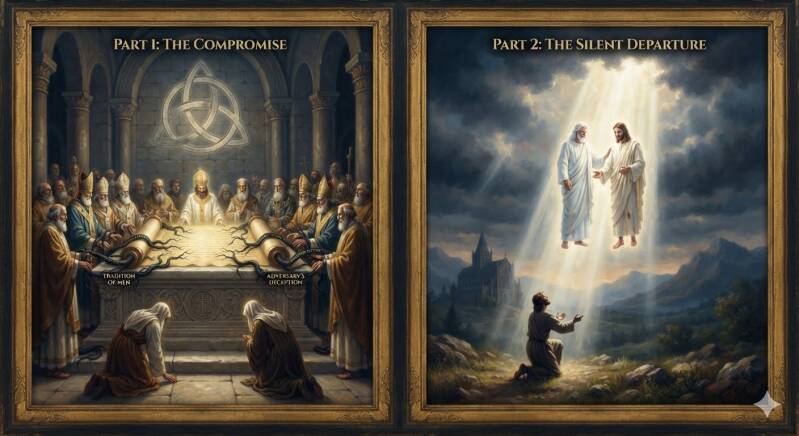
To fill this missing authority, they gathered in political councils to debate, define, and vote upon a combined view of divinity, transforming the Gospel into a system of systematic theology and abstract definitions.
The primary authority for the Trinity church is the written text of the Bible, but it must be viewed strictly through the mandatory filter of three foundational historical creeds:
- The Nicene Creed (325 AD): Compiled at the Council of Nicaea, this document was engineered to settle an empire-wide political crisis by defining the Lord Jesus Christ and Heavenly Father as being of the exact same substance (homoousios).
- The Constantinopolitan Creed (381 AD): This document expanded the previous creed to officially define the Holy Ghost as a co-equal member of the same singular divine essence.
- The Athanasian Creed (circa 5th–6th Century AD) is the longest and most rigid of the formulas, laying down the absolute requirement for individuals to master and believe its specific mathematical paradox of the Trinity in order to be saved from eternal damnation.
By binding themselves to these static formulas, members of the Trinity creedal church are forced to reject the possibility of a living voice on the earth today, reducing the dynamic King of Heaven to a closed reading list.
Part 2: Where Did the Trinity Creedal Church Come From?
The Trinity creedal church did not emerge from the New Testament; it was forged out of political necessity under the shadow of the Roman Empire. Following the martyrdom of the ancient Apostles, the primitive Church fractured into hundreds of competing factions, fulfilling Paul's warning in Acts 20:29–30 that fierce wolves would arise from within the church itself to speak twisted things. By the early 4th century, these fierce internal debates over the nature of the Lord Jesus Christ threatened to rip the Roman Empire apart.
To preserve his political borders, the pagan Roman Emperor Constantine intervened. He was not a priesthood officer, nor did he hold any divine authority, yet he officially summoned over 300 bishops to gather at the First Council of Nicaea in 325 AD. Constantine personally presided over the theological debates, using imperial pressure to force the fractured church leaders into a uniform consensus.
Because these bishops lacked active priesthood keys or open revelation to hear the actual voice of the Godhead, they turned to contemporary pagan Greek philosophy—specifically Neoplatonism—to construct an explanation of divinity. They adopted terms completely foreign to the biblical text, such as essence, substance, and individuals, creating a hybrid theology that combined biblical names with abstract Greek metaphysics.
The resulting Nicene Creed was codified into Roman imperial law, and anyone who refused to sign it was stripped of their office, labeled a heretic, and exiled by the sword of the empire. Every modern Protestant, Catholic, and Orthodox denomination that clings to this trinitarian definition traces its structural lineage back to this state-enforced, human-voted compromise.
Part 3: Who is the God of the Trinity Creedal Church?
- Incomprehensible: Explicitly stated in their text as something the human mind cannot fathom or define.
- Immaterial: A formless spirit devoid of physical parts, passions, or a localized existence, sitting completely outside of time, space, and physical reality.
- Undifferentiated in Rank: A loop where "none is greater, or less than another; but the whole three Persons are co-eternal together, and co-equal."
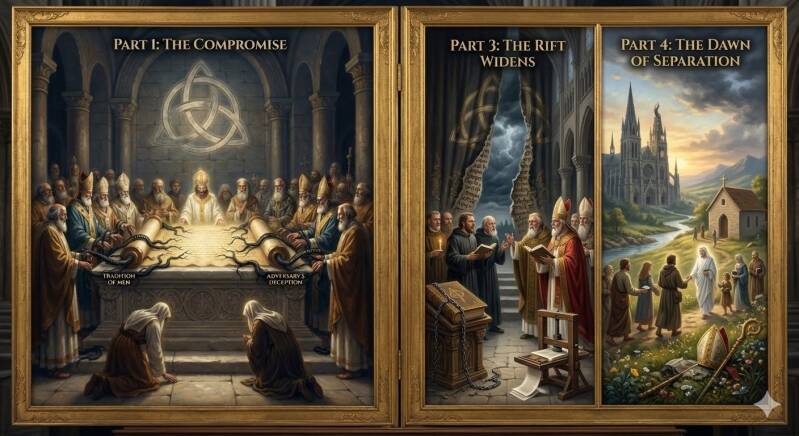
The Trinity church promises that this deity is the ultimate source of love, but because they believe he created all things out of absolute nothingness (creatio ex nihilo), this creedal god is structurally transformed into the author of human damnation. Since he called mankind into existence from a void while knowing beforehand exactly who would fail, his plan requires him to create billions of souls for the explicit purpose of burning eternally in hell just to satisfy his definition of "glory."
It is a concept that cannot speak today, cannot save those who die without hearing his name, and cannot possess a tangible body—making him a distant, philosophical concept locked inside a textbook rather than a literal, loving, and physical Heavenly Father.
Part 4: Dismantling the Creedal View via the Literal Word of God
When you slide the definitions of the Trinity creedal church next to the literal text of the Bible, their entire philosophical system completely self-liquidates. The scriptures expose the creedal god as an earthly counterfeit engineered by the adversary—a conceptual idol that makes grand metaphysical promises it has no scriptural power to keep.
- The Clear Physical Separation of the True Godhead
The Trinity church claims that the Godhead shares one identical, undivided substance. The literal Bible completely shatters this by presenting them as distinct, localized, and tangible Individual Personages standing side-by-side.
- Acts 7:55–56: As Stephen is being martyred, he looks directly into heaven and declares: "Behold, I see the heavens opened, and the Son of Man standing at the right hand of God." Stephen did not see an abstract, triune cloud of essence; he saw the Lord Jesus Christ and Heavenly Father as two distinct divine Beings occupying separate spatial locations.
- John 8:17–18: The Lord Jesus Christ explicitly invokes the Mosaic law of witnesses to prove His separate identity from the Father: "In your Law it is written that the testimony of two people is true. I am the one who bears witness about myself, and the Father who sent me bears witness about me." If they were the same singular being or essence, Christ’s legal argument would be a fraudulent deception, because a single entity cannot count as two independent legal witnesses.
- The Unyielding Divine Hierarchy of the Godhead
The creeds demand that within the Trinity, "none is greater, or less than another." This flatly contradicts the explicit, repeated declarations of the Lord Jesus Christ and the Apostles, who outline a perfect, permanent divine hierarchy where Heavenly Father is the Supreme Head.
- John 14:28: The Lord Jesus Christ states plainly and unconditionally: "If you loved me, you would have rejoiced, because I am going to the Father, for the Father is greater than I."
- 1 Corinthians 15:27–28: Paul details the final, celestial state of the universe, proving that Christ’s subjection to the Father is eternal, not just a temporary phase of His mortality: "When all things are subjected to him, then the Son himself will also be subjected to him who put all things in subjection under him, that God may be all in all." If the Lord Jesus Christ were co-equal in rank and essence as the Trinity creedal church claims, the concept of the Son eternally subjecting Himself to a higher Head would be a scriptural impossibility.
- The Physical Tangibility of the Father and the Son
The Trinity church preaches a formless, immaterial deity, but the literal text of the Bible reveals that Heavenly Father possesses a tangible, glorified form, and that the Lord Jesus Christ is the exact physical duplicate of that form.
- Hebrews 1:3: The scriptures state that the Lord Jesus Christ is "the radiance of the glory of God and the exact imprint of his nature" (\(\text{Greek: } \chi\alpha\rho\alpha\kappa\tau\dot{\eta}\rho \tau\hat{\eta}\varsigma \dot{\upsilon}\pi o\sigma\tau\alpha\sigma\epsilon\omega\varsigma\)). The Greek word character refers to a precise physical stamp or impression left by a die. If Heavenly Father were a formless cloud of essence without physical parameters, it would be impossible for the resurrected, physical body of the Lord Jesus Christ to be the "exact physical stamp" of His person.
- Genesis 1:26–27: Heavenly Father defines the physical template of creation: "Then God said, 'Let us make man in our image, after our likeness.' ... So God created man in his own image." The Bible establishes that human beings look like their divine Parents, a truth fully vindicated when the Lord Jesus Christ rose from the grave with a permanent, physical body of flesh and bones, declaring, "See my hands and my feet, that it is I myself. Touch me, and see" (Luke 24:39).
By exposing these contradictions using strictly the word of God, the silent seekers can clearly see that the true Godhead consists of separate, magnificent, and tangible Personages working in perfect unity of purpose, completely freeing them from the deceptive, human-voted traditions of the creeds.
The deity of the Trinity creedal church is explicitly defined by the text of the Athanasian Creed as a formless, incomprehensible, and paradoxical essence. According to their official definitions, they worship "one God in Trinity, and Trinity in Unity; neither confounding the Persons, nor dividing the Substance." They preach that Heavenly Father is the supreme deity, the Lord Jesus Christ is the supreme deity, and the Holy Ghost is the supreme deity, yet they claim they are not three separate Beings, but one singular essence. They declare this deity to be:
Add comment
Comments