Worshiping a god that Murders to be followed.
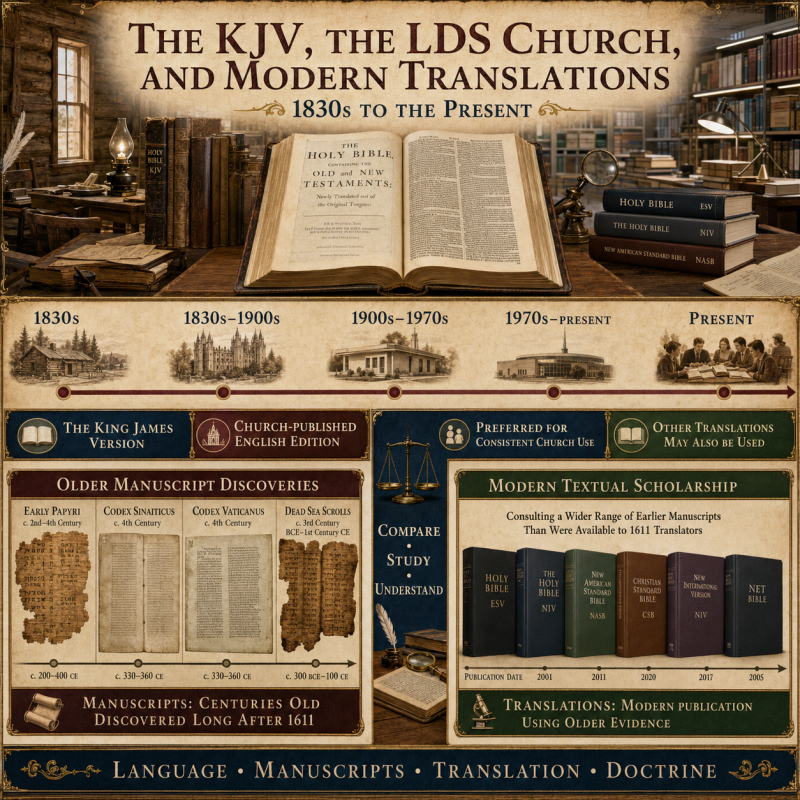
The Church of Jesus Christ of Latter-day Saints (LDS Church) officially maintains the King James Version (KJV) as its primary English text of the Bible, acknowledging its historical complexities through a foundational article of faith.
The text is arranged in chronological order based on the historical events described.
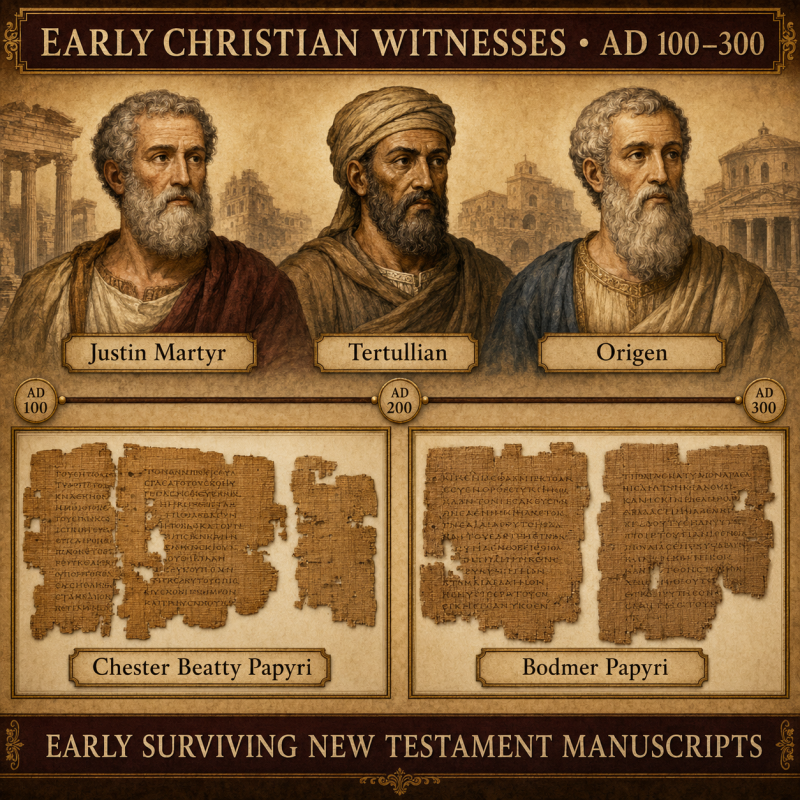
- 100–300 AD: Pre-Nicene writers (Justin Martyr, Tertullian, Origen) and the earliest surviving papyri (Chester Beatty and Bodmer).
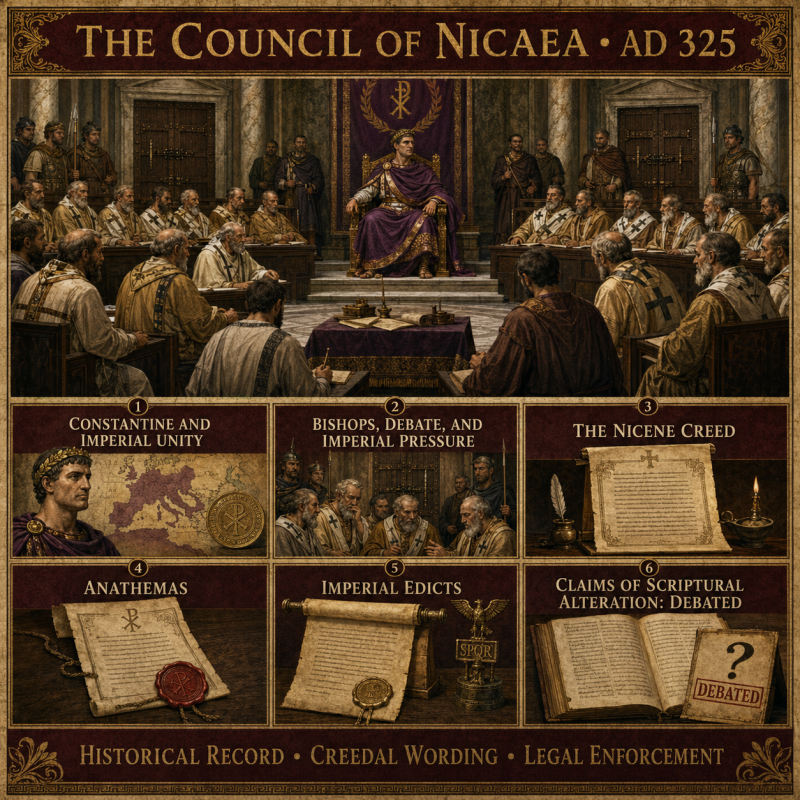
- 325 AD: The Council of Nicaea, Constantine's motives, the coercion of bishops, specific scriptural alterations, the exact wording of the creed, legal anathemas, and imperial edicts.
- 325–330 AD: The immediate execution of Nicene laws (seizures, taxes, military actions).
- 330–361 AD: The table of Imperial Reversals (Constantine's later reign, Constantius II, Julian the Apostate).
- 380s AD: The Gothic Bible translation by Ulfilas.
- 380–381 AD: The Edict of Thessalonica by Emperor Theodosius I and the permanent codification of the Trinity.
- 4th–5th Century AD: The immediate daily impact of these laws on the common people inside the Roman Empire.
- 410 AD onward: Pre-Nicene influences outside Rome, specifically how the Sasanian Persian Empire protected dissidents and established self-governing Christian systems.
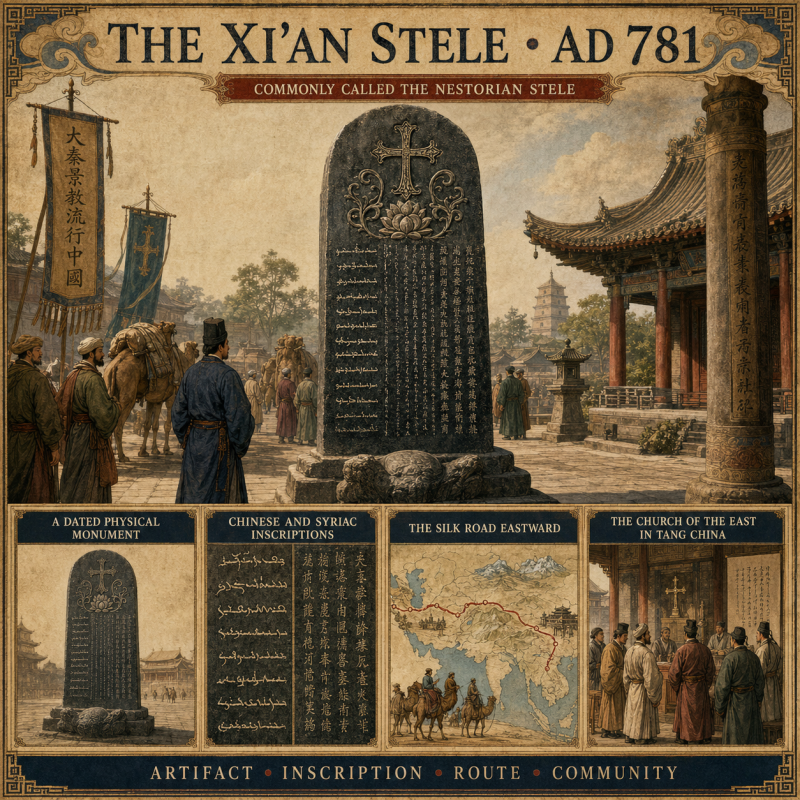
- 781 AD: The Nestorian Stele in China as physical proof of the eastward expansion of non-Nicene groups.
- Manual Era (Ancient to Medieval): The mechanical copying process within ancient scriptoriums and how textual errors occurred, followed by how modern scholars use textual criticism to spot those changes.
- 534 AD: The legal consolidation under the Justinian Code and its class-based penalties.
- 16th Century: The Protestant Reformation, the Radical Reformers' specific biblical arguments, and the response of the Catholic Church from the Council of Trent extending into the 20th century.
- 1813–1822: Thomas Jefferson’s private correspondence regarding Nicaea.
- 1787–1791: The framing of the U.S. Constitution and the Establishment Clause.
- 1830s to Present: The modern theological stance of the LDS Church regarding the KJV and the alignment of modern Bible translations based on older manuscript discoveries.

Pre-Nicene Writers on the Father and the Son (100–300 AD)
Before the Council of Nicaea, early Christian theologians analyzed the relationship between God the Father and Jesus Christ without the constraints of an imperial creed. They used terms that modern scholars categorize as distinctly subordinationist, viewing the Son as separate and second to the Father.
Justin Martyr (100–165 AD): Writing in his First Apology, Justin explicitly placed Jesus in a secondary position behind the uncreated Creator. He argued that the Father is the ultimate source of all authority, while the Son is His messenger: "We worship the Creator of this universe... Next to Him, we honor Jesus Christ, who was our teacher... having learned that he is the Son of the true God, and holding him in the second place."
Tertullian (155–220 AD): Although he was the first Latin writer to use the term trinitas (trinity), Tertullian rejected the idea that the Father and Son share an identical, co-eternal existence. In his treatise Against Hermogenes, he stated that the Father's status as "Father" required the creation of the Son: "There was a time when the Son was not... God was not always a Father, for He could not be a Father before there was a Son."
Origen of Alexandria (185–253 AD): Origen taught that the Father alone is the absolute, supreme God (Autotheos). He described the Son as a distinct divine entity who derives his divinity entirely from the Father, making the Son an intermediary between the Creator and the creation.
Prior to the 19th and 20th centuries, Bible translations relied on medieval Greek copies dating from the 9th to 14th centuries. The discovery of ancient Egyptian papyri pushed the available manuscript evidence back to the 2nd and 3rd centuries—long before Constantine and the Council of Nicaea.
- The Chester Beatty Papyri (Discovered 1930): This collection includes \(\mathfrak{P}^{45}\) and \(\mathfrak{P}^{46}\), dating to approximately 200–250 AD. \(\mathfrak{P}^{46}\) contains the earliest surviving copies of Paul’s epistles, including Philippians and Colossians. These manuscripts proved that the foundational Greek text used by early Christians did not contain the late medieval additions used to defend Trinitarian theology.
- The Bodmer Papyri (Discovered 1952): This archive contains \(\mathfrak{P}^{66}\) and \(\mathfrak{P}^{75}\), dating to roughly 175–225 AD. They contain the oldest surviving continuous texts of the Gospel of John. These discoveries confirmed that while minor variations existed between local scribes, the core narrative and phrasing of the Gospels were already established across the Mediterranean before any Roman Emperor intervened.
- The Textual Independence: These papyri showed that pre-Nicene Christians read the exact same phrases ("firstborn of all creation" or "the Father is greater than I") that the subordinationist bishops later used to argue their case against the state creed, proving these theological positions were rooted in the text itself.


The Council of Nicaea, Emperor Constantine's Political Motives, and the Development of the Biblical Text
The historical and textual evidence regarding how imperial control, coercion, and the adaptation of scriptural interpretation intersected at Nicaea centers on specific mechanisms.
- Imperial Motivation: Control of the Uneducated Masses
Scholars of the Roman Empire note that Constantine’s primary goal was political stability, not theological purity. The Roman Empire was vast, and the uneducated populace relied entirely on the state-sanctioned church hierarchy for truth.
- The Political Need for Unity: Constantine viewed Christian division as a threat to his rule. By enforcing a single, uniform creed across the empire, the state could utilize a centralized church infrastructure to maintain social order and obedience among the uneducated masses.
- The Imperial Endorsement: By weaponizing a single theological stance, the Emperor made dissent against the Church equivalent to treason against the State.
- How the Creed Was Forced Upon the Bishops
The methods used to secure signatures on the Nicene Creed combined imperial pressure, psychological coercion, and the threat of state violence:
- Imperial Presence: Constantine personally presided over the council, sitting on a golden throne in full imperial regalia. For bishops who had survived the brutal Diocletianic Persecution just years prior—bearing physical scars and mutilations—the message was clear: compliance brought imperial favor, while defiance brought renewed suffering.
- The Ultimatum of Banishment: Constantine made it explicitly clear that signing the creed was a requirement to remain in the empire. Those who refused faced immediate exile, loss of property, and ecclesiastical defrocking.
- The Threat of Death: Following the council, Constantine’s imperial edicts declared that possessing or concealing banned theological writings would be punished by execution.
- Scriptural Passages and Textual Changes
The following key scriptures are central to this debate, as their traditional understandings were altered or codified under the threat of imperial force:
- Philippians 2:6
- Pre-Nicene / Subordinationist Reading: Christ existed in the form of God but did not grasp at or claim equality with God, acting as a distinct, submissive agent of the Father.
- Nicene Alteration: The council enforced the interpretation that "equal" meant sharing an identical, co-eternal, undivided divine substance (homoousios), transforming a text about Christ's humility into a metaphysical definition of the Trinity.
- John 1:1
- Pre-Nicene / Subordinationist Reading: "The Word was with God, and the Word was divine [or a god]," implying a distinct, secondary divine being through whom the Father created the universe.
-
- Nicene Alteration: The state-enforced creed codified the phrase "the Word was God" to mean absolute identity of substance, legally banning any interpretation that viewed the Son as separate or subordinate in nature. The grammatical friction hinges entirely on the presence or absence of the Greek definite article ("the"). Prior to fourth-century codifications, reading theos without the article highlighted Christ's divine character or secondary status, rather than an absolute identity lock with ho theos (the Father).
- Colossians 1:15
- Pre-Nicene / Subordinationist Reading: Christ is "the firstborn of all creation," meaning he was the very first entity brought forth or created by the Father.
-
- Nicene Alteration: Because this verse directly supported Arius, the Nicene theology forced an alteration in meaning, declaring that "firstborn" did not imply a beginning in time, effectively reshaping the text's plain language to fit imperial orthodoxy.
- John 14:28
- Pre-Nicene / Subordinationist Reading: Jesus states plainly, "The Father is greater than I," establishing a clear hierarchy.
- Nicene Alteration: The council's framework re-engineered the application of this verse, ruling that it only applied to Jesus’s human nature, not his divine nature, thereby overriding the literal phrasing to maintain the state-approved doctrine of absolute equality.
The Wording of the Nicene Creed (325 AD)
The text of the creed was specifically engineered to insert non-scriptural Greek philosophical terms. This locked in a single interpretation and legally outlawed the subordinationist view of the scriptures. The original 325 AD text reads as follows, with the specific phrases used to counter the verses highlighted:
"We believe in one God, the Father Almighty, Maker of all things visible and invisible. And in one Lord Jesus Christ, the Son of God, begotten of the Father the only-begotten; that is, of the essence of the Father (ek tes ousias tou patros), God of God, Light of Light, very God of very God, begotten, not made, being of one substance with the Father (homoousios to patri); By whom all things were made, both which be in heaven and which be in earth; who for us men, and for our salvation, came down and was incarnate and was made man; he suffered, and the third day he rose again, ascended into heaven; from thence he shall come to judge the quick and the dead. And in the Holy Ghost."
The Legal Anathemas (The Enforced Condemnations)
To ensure compliance, the bishops attached a legal codicil to the end of the creed. This targeted the literal reading of verses like Colossians 1:15 ("firstborn of all creation"):
"But those who say: 'There was a time when he was not;' and 'He was not before he was made;' and 'He was made out of nothing,' or 'He is of another substance or essence,' or 'The Son of God is created, or changeable, or alterable'—they are condemned by the holy catholic and apostolic Church."
The Imperial Edicts of Constantine
Following the council, Emperor Constantine issued official imperial decrees. These merged church doctrine with the criminal law of the Roman Empire, establishing political control over the populace.
- Edict 1: The Banishment and Criminalization of Arius: Constantine officially equated theological dissent with a contagion that threatened the empire. He ordered the total erasure of the opposing faction: "Since Arius has imitated wicked and unpious men, he deserves to suffer the same infamy... We decree that Arius and his followers shall be called 'Porphyrians,' so that they may be named after those whose manners they have imitated. And further, if any treatise composed by Arius should be found, it shall be committed to the flames..."
- Edict 2: The Death Penalty for Hiding Writings: "...so that not only the corrupt doctrines may be utterly destroyed, but that not even a memory of what he wrote may be left. And this I strictly command, that if any man shall be found to have concealed any book composed by Arius, and shall not immediately bring it forward and burn it in the fire, his punishment shall be death. As soon as he is taken in this offense, he shall suffer capital punishment."
- Edict 3: Letter to the Church Alexandria (Enforcing the Verdict): Constantine wrote directly to the public to assert that the council's decision was absolute and driven by divine authority, rendering any further debate or independent interpretation illegal: "That which has commended itself to the judgment of three hundred bishops cannot be anything else than the doctrine of God... Let no one hesitate, let no one delay, but let everyone return with all readiness to the path of truth; so that when I come to you, I may express my collective thanks to God, the inspector of all things, because I see you restored to unity and sharing in one identical faith."
The Execution of Nicene Laws (325–330 AD)
Following the Council of Nicaea, the Roman Empire enforced the Nicene Creed by seizing non-compliant churches and using economic pressure to suppress opposition. Immediately following the council, the Roman state utilized its administrative and military machinery to enforce the new theological standards across the empire, focusing on structural and economic suppression.
- Seizure of Church Properties: Constantine ordered the confiscation of all meeting houses, churches, and properties belonging to bishops and congregations that refused to adopt the Nicene Creed. These properties were legally transferred to the state-approved Nicene clergy.
- Tax and Immunity Stripping: Under Roman law, Christian clergy enjoyed exemptions from public taxes, civic duties, and military service. The imperial administration stripped dissenting bishops and priests of these privileges, exposing them to financial ruin and forced labor in municipal governments.
- Military Interventions: In regions like Egypt and Libya, where support for Arius was deeply rooted among the populace, the Roman military was deployed to physically remove non-compliant clergy from their pulpits and install Nicene-aligned bishops by force.
The Imperial Reversals (330–361 AD)
The decades following Nicaea demonstrated that imperial theology shifted entirely based on the political alliances of the reigning emperor. Constantine and his immediate successors repeatedly reversed their policies, alternating between backing and banning the Nicene Creed. Subsequent decades saw rapid policy shifts, with emperors oscillating between supporting and opposing the creed, culminating in Theodosius I mandating Nicene Christianity as the sole state religion.

The Gothic Bible Translation by Ulfilas (380s AD)
Long before the Germanic and Gothic tribes crossed the Danube to dismantle the Western Roman Empire, they were converted to Christianity by a missionary named Ulfilas (311–383 AD). Ulfilas, a missionary of Cappadocian descent, became the bishop to the Gothic tribes living north of the Danube. To convert the Goths, he undertook the monumental task of translating the Greek scriptures into the Gothic language, a tongue that had never been written down before.
- Inventing a New Alphabet: Because the Gothic language had no written script, Ulfilas invented a completely new 27-letter alphabet. He engineered it specifically for translation by combining elements of Greek characters, Roman letters, and traditional Germanic runes to capture the exact sounds of the language.
- Preserving Subordinationist Phrasing: Ulfilas translated the Bible into the Gothic language but explicitly taught them the subordinationist, pre-Nicene view of scripture. His translation of the Greek texts intentionally preserved the clear distinction between the supreme Father and the subordinate Son. For example, in his translation of Philippians 2:6, he avoided any phrasing that implied Jesus possessed an identical substance block with the Father, rendering the verse to emphasize Christ’s distinct identity and his submission to God. For centuries, the Visigoths and Ostrogoths operated independent kingdoms inside Europe that viewed the Trinity as a corrupt Roman political invention, refusing to submit to Nicene bishops.
- The Military Omission: Historical records from early church historians note that Ulfilas left out the Books of Kings (Samuel and Kings) from his Gothic Bible translation. He did this because the Gothic tribes were already highly volatile and warlike; he feared that reading stories of divinely sanctioned Israelite warfare would encourage further violence against the Roman borders.
- The Codex Argenteus: The most famous surviving copy of Ulfilas’s translation is the Codex Argenteus (The Silver Bible), produced in the 6th century for the Ostrogothic King Theodoric the Great. Written in silver and gold ink on purple-dyed vellum, this manuscript stands as archaeological proof of a highly sophisticated, completely non-Nicene Christian civilization thriving inside Europe.
The Final Codification: The Edict of Thessalonica (380 AD)
The political oscillation ended when Emperor Theodosius I took power. He determined that the only way to permanently stabilize the empire was to completely outlaw all non-Nicene forms of worship, making Nicene Christianity the official state religion of Rome.
The Text of the Edict (Cunctos Populos)
On February 27, 380 AD, Theodosius issued the imperial decree that legally codified the Trinity and criminalized all alternative interpretations:
"It is our desire that all the various nations which are subject to our Clemency and Moderation, should continue to profess that religion which was delivered to the Romans by the divine Apostle Peter... and which is now professed by the Pontiff Damasus and by Peter, Bishop of Alexandria... According to the apostolic teaching and the doctrine of the Gospel, let us believe in the one deity of the Father, the Son and the Holy Spirit, in equal majesty and in a holy Trinity. We authorize the followers of this law to assume the title of Catholic Christians; but as for the others, since, in our judgment they are foolish madmen, we decree that they shall be branded with the ignominious name of heretics, and shall not presume to give to their conventicles the name of churches. They will suffer in the first place the chastisement of the divine condemnation and in the second the punishment of our authority which in accordance with the will of Heaven we shall decide to inflict."
Following this edict, Theodosius convened the First Council of Constantinople (381 AD). This event dealt a final blow to Arian opposition inside the empire by systematically revising the original 325 AD Nicene text into the definitive Niceno-Constantinopolitan Creed. The council legally expanded the creed to declare the absolute equality of the Holy Spirit with the Father and the Son, cementing the modern Trinitarian formula into Roman law and deploying imperial inquisitors to dismantle all dissenting Christian institutions.
Impact on the Common People (4th–5th Century AD)
The transition of the Nicene Creed into imperial law transformed the daily lives of ordinary citizens, particularly the uneducated masses who lived outside the upper echelons of political power.
- Social Ostracization and Loss of Civil Rights: Citizens who refused to profess the state-approved Nicene Creed were legally branded as "heretics". Under the Theodosian Code, this status stripped them of the right to inherit property, make legal wills, or testify in a court of law, effectively rendering them second-class citizens.
- The Destruction of Local Community Hubs: For many commoners, the local church was the center of economic charity and social safety nets. When the state seized non-Nicene churches, the local distribution of food, medical care, and financial aid to the poor was abruptly halted, forcing families to conform to the state religion to receive basic community support.
- The Rise of State Inquisitors: The imperial government established the office of the Inquisitores—state officials backed by military guards tasked with hunting down underground religious gatherings. Common people lived under constant surveillance, as neighbors were legally incentivized to report non-conforming households to imperial authorities in exchange for a portion of the accused person's seized property.
Pre-Nicene Influences on Non-Roman Christian Groups
Because the Council of Nicaea was an imperial event called by a Roman Emperor, its legal enforcement stopped at the borders of the Roman Empire. Independent Christian groups operating outside Roman jurisdiction rejected the state creed and preserved pre-Nicene, subordinationist theology for centuries.
- The Church of the East (Persian Empire): Located entirely within the Sasanian Persian Empire—Rome’s fiercest geopolitical rival—Persian Christians flatly rejected Roman imperial councils. They viewed the Nicene Creed as a political tool of the Roman Emperor. Operating in Syriac rather than Greek, they maintained a distinct theology that viewed Christ as a separate, submissive entity from the Father, completely free from the concept of homoousios.
- The Ethiopian Orthodox Church: Operating beyond the southern borders of the Roman Empire, the Kingdom of Aksum (modern Ethiopia) developed its biblical tradition independently. Because they were not subject to Roman imperial censorship, they preserved a massive biblical canon that includes books like Enoch and Jubilees, which were completely pushed out or ignored by the state-sanctioned church councils of the Mediterranean.
How the Persian Empire Protected Non-Nicene Christians
The Sasanian Empire (Persia) was Rome’s superpower rival. When Rome adopted the Nicene Creed as its official state religion, theology immediately became a matter of international geopolitics and espionage.
- From Persecution to Protection: Initially, Persian kings persecuted Christians, viewing them as potential spies for the Christian Roman Emperors. However, when the Persian court realized that non-Nicene Christians were being exiled, hunted, and stripped of their properties by the Roman state, the Persian strategy flipped completely.
- The Council of Seleucia-Ctesiphon (410 AD): The Persian King of Kings, Yazdegerd I, permitted the Christian minority in his empire to organize their own independent hierarchy. This autonomous body explicitly rejected the authority of the Roman state bishops and the theological definitions of the western councils, proving to the Persian crown that their loyalty belonged to Persia, not Rome.
- Establishing an Asylum for Dissidents: The Persian Empire became a safe haven for theologians, scholars, and bishops fleeing Roman imperial inquisitors. When the Roman Empire shut down the famous theological School of Edessa due to its non-conformist teachings, the scholars fled across the border into Nisibis, under Persian protection. The Persian state funded and protected this school, allowing it to become the premier intellectual center for spreading non-Nicene Christianity throughout Asia, reaching as far as India and China completely untouched by Roman law.
Daily Life of a Christian Under Persian (Sasanian) Law
Living under the Zoroastrian Sasanian Empire, Christians occupied a specific legal status that contrasted sharply with the experience of religious minorities inside the Roman Empire.
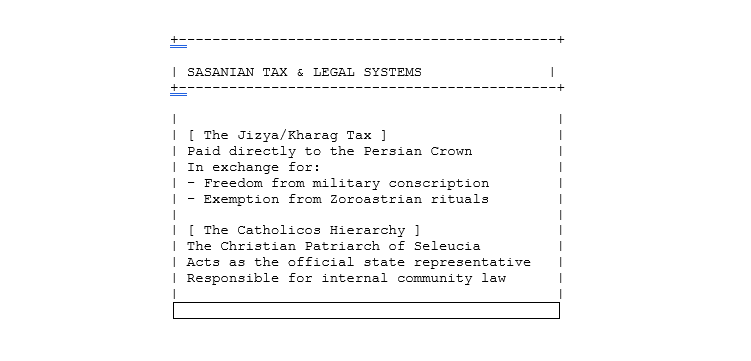
- The Millet System (Self-Governance): The Persian crown treated Christians as a distinct, self-governing legal community. The head of the Church (the Catholicos of Seleucia-Ctesiphon) was recognized as an official state official. He was personally responsible to the Persian King of Kings for collecting taxes and maintaining order within the Christian population, leaving internal legal disputes to be judged by church canons rather than imperial law.
- The Price of Autonomy (Taxation): Christians were required to pay a special poll tax (jizya or kharag) directly to the crown. In exchange for this financial tribute, they were completely exempt from military service and were not forced to participate in the state-mandated Zoroastrian fire-temple rituals.
- Social and Religious Boundaries: While Christians were free to operate businesses, own land, and build churches, the Persian state enforced strict boundaries to protect the dominant Zoroastrian faith. It was a capital offense punishable by death for any Christian to attempt to convert a Zoroastrian person, or for a Zoroastrian to abandon their ancestral faith for Christianity.
The Nestorian Stele: Archaeological Proof of Christianity in China (781 AD)
The spread of non-Nicene Christianity outside the Roman Empire reached its peak when Persian-backed missionaries traveled along the Silk Road into Tang Dynasty China. The primary archaeological proof of this expansion is the Nestorian Stele (also known as the Xi'an Stele), a massive limestone block erected in 781 AD near the imperial capital of Chang'an.
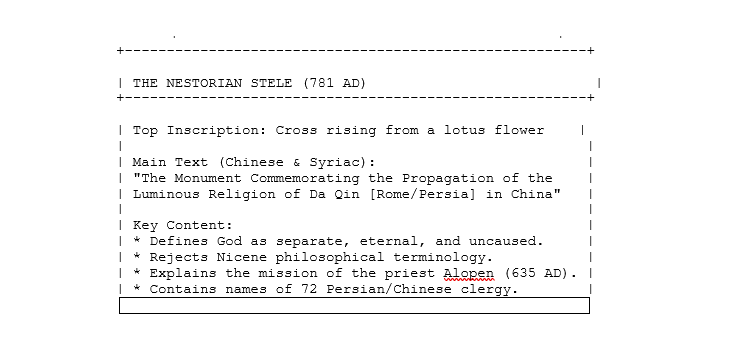
- The Text and Vocabulary: Written in both Chinese and Syriac, the stone text explicitly avoids the Greek metaphysical language used at Nicaea. Instead, it adapts to its audience by using Buddhist and Daoist terms to explain the cosmos. It describes God as the supreme, separate source of all creation, and Jesus Christ as a distinct divine entity who came to earth to restore human nature.
- The Imperial Endorsement: The stele records that in 635 AD, a Persian missionary priest named Alopen arrived at the court of Emperor Taizong. The Emperor had Alopen’s scriptures translated into the imperial library, approved their teachings, and issued an official edict granting state protection to the religion.
- Visual Syncretism: At the top of the stele, archaeologists found a distinct visual fusion: a Christian cross rising directly out of a Buddhist lotus flower and surrounded by Daoist clouds, proving the existence of a thriving, completely non-Roman Christian culture in Asia.
The Daily Process Inside an Ancient Scriptorium
Before the invention of the printing press, every copy of a scriptural text was produced entirely by hand in a dedicated workshop known as a scriptorium. This manual process introduces distinct human elements into the survival of historical texts.
- The Dictation Method: In larger scriptoriums, a master reader stood at the front of the room and read the Greek text aloud syllable by syllable. A dozen or more scribes sat at desks, writing down what they heard simultaneously. This system frequently introduced errors due to homophony—words that sound identical in Greek but have entirely different spellings and meanings, leading to unintended textual variants.
- Visual Blind Spots: Scribes working under dim candlelight frequently suffered from a visual error called homoeoteleuton (same endings). If two consecutive lines of a manuscript ended with the same word or phrase, the scribe's eye would accidentally skip from the first occurrence to the second. This caused entire sentences or theological qualifiers to be completely erased from that specific line of copies.
- Marginal Gloss Insertion: Scribes frequently wrote explanatory notes, cross-references, or theological definitions directly into the side margins of the parchment. When that manuscript was shipped to a different scriptorium decades later to be copied again, the next scribe often could not tell if the marginal note was a correction the previous writer accidentally left out, or just a private commentary. To be safe, they frequently copied the comment directly into the main text, permanently altering the phrasing for future generations.
How Scholars Spot Alterations in Ancient Manuscripts
Textual critics use a precise scientific methodology to examine thousands of manuscript fragments. They can identify exactly where, when, and why a text was added or altered over the centuries.
- External Evidence (The Timeline Test): Scholars organize manuscripts by age and geographical origin. If a specific phrase (like the Trinitarian formula in 1 John 5:7) does not appear in any Greek manuscript from the 2nd, 3rd, 4th, or 5th centuries, but suddenly shows up in a Latin text from the 8th century, it is mathematically flagged as a late insertion rather than an original apostolic writing.
- Internal Evidence (The Scribal Habits Test): Scribes frequently copied notes directly from the margins of a page into the main body of the text. Scholars trace how a priest's private theological commentary written in the margins of a 5th-century manuscript accidentally became integrated into the actual scripture text by a copyist in a 6th-century scriptorium.
- The Rule of the Harder Reading (Lectio Difficilior): Ancient scribes often altered texts to fix perceived theological difficulties or to counter heresies. Therefore, textual critics assume that the more difficult or complex reading is usually the original, while a smooth, perfectly polished Trinitarian reading is highly likely to be a later edit designed to support state-approved orthodoxy.
Influence on Later European Law
The legal frameworks created by Constantine and Theodosius I laid the structural foundation for Church-State relations in Europe for the next 1,000 years, dictating the legal code of the Middle Ages.
- The Legal Concept of Heresy as High Treason: By tying the Nicene Creed directly to the Emperor’s authority, the Roman decrees established the legal precedent that theological error was not just a sin against God, but an act of political treason against the crown. This exact legal mechanism was later utilized by medieval European monarchs to justify the execution of religious dissidents during the Spanish and Medieval Inquisitions.
- The Foundation of the Divine Right of Kings: The alliance formed at Nicaea between the Emperor and the church hierarchy evolved into the medieval doctrine of the Divine Right of Kings. European monarchs claimed their absolute political authority was ordained directly by God, using a centralized, state-sanctioned church to mandate absolute obedience from the uneducated peasant classes.
The Justinian Code (534 AD)
Emperor Justinian consolidated all previous Roman laws into a definitive legal system. Book 1, Title 1 of this code was explicitly dedicated to the Nicene Trinity. It established that religious orthodoxy was the foundational requirement for entering into legal contracts, operating businesses, and holding public citizenship across Europe.
Penalties by Social Class under the Justinian Code (534 AD)
The Corpus Juris Civilis (Justinian Code) systematically codified punishments for religious non-conformity based strictly on a citizen's social status. This framework ensured that the elite were stripped of power while the lower classes were subjected to physical and economic subjugation.
- The Aristocracy and Political Elite (Illustres and Clarissimi): High-ranking senators, military commanders, and judges who privately held non-Nicene beliefs faced immediate removal from public office, complete forfeiture of their ranks and titles, and the confiscation of their private estates. They were legally barred from ever holding public employment or advising the crown.
- The Middle Class and Guild Merchants (Negotiatores): Shopkeepers, traders, and guild craftsmen who refused to profess the state creed were subjected to heavy financial fines that doubled with each offense. If they persisted, their businesses were permanently shut down, their trade licenses revoked, and they were expelled from urban commercial centers, destroying their livelihoods.
- The Working Class and Agricultural Serfs (Coloni): Because the uneducated lower classes possessed little money or property to confiscate, the law prescribed physical coercion. Landowners were legally required to physically chastise and whip their tenant farmers and laborers who skipped Nicene services. If a serf continued to resist, they were shackled in irons during their labor, and their food rations were legally cut to the bare minimum required for survival until they submitted.
Impact on the Protestant Reformation (16th Century)
One thousand years later, the legal and scriptural precedents set by the Roman Empire at Nicaea became a central battleground during the Protestant Reformation. Early reformers sought to dismantle the medieval system built upon these ancient imperial decrees.
- Rejection of Canon Law and Imperial Decrees: Reformers like Martin Luther and John Calvin launched the doctrine of Sola Scriptura ("Scripture Alone"). This was a direct assault on the legal legacy of Nicaea and Justinian. The Reformers argued that the Word of God held absolute authority over any creed written by a council or any law signed by a Roman Emperor.
- The Continued Weaponization of the State: Despite rejecting the Pope's authority, early Protestant states maintained the exact structural mechanism invented by Constantine and Theodosius. In Calvin’s Geneva and Luther’s Germany, the state still mandated religious uniformity by law. For instance, John Calvin utilized the ancient Roman legal precedent of "heresy as treason" to approve the execution of Michael Servetus, who was burned at the stake for explicitly preaching against the Nicene formulation of the Trinity.
- The Rise of the Radical Reformation: Groups like the Anabaptists and later Unitarians argued that the mainline Protestant Reformers had not gone far enough. They claimed that the true, primitive church of the Apostles had been fundamentally corrupted the moment Constantine merged the Church with the Roman state at Nicaea. They demanded a total separation of Church and State and a return to interpreting scriptures exactly as they were written, completely free from state-enforced creeds and philosophical terms.
Radical Reformers vs. The Nicene Creed: The Biblical Arguments
During the 16th and 17th centuries, Radical Reformers—such as Michael Servetus, the Polish Brethren, and early Unitarians—rejected the Council of Nicaea's vocabulary. They argued that the introduction of non-scriptural terms like homoousios ("of the same substance") was an illegal alteration of biblical truth. They used specific texts to challenge the state-enforced creed:
- Mark 13:32
- The Text: "But of that day and that hour knoweth no man, no, not the angels which are in heaven, neither the Son, but the Father."
- The Radical Argument: Reformers argued that if Jesus and the Father shared an identical, undivided divine substance, they must possess the exact same omniscience. Because Jesus explicitly lacks knowledge that only the Father possesses, they argued the Nicene doctrine of absolute equality was a scriptural falsehood.
- 1 Corinthians 8:6
- The Text: "But to us there is but one God, the Father, of whom are all things, and we in him; and one Lord Jesus Christ, by whom are all things, and we by him."
- The Radical Argument: Radicals emphasized that Paul explicitly restricts the title of "the one God" strictly to the Father, while defining Jesus Christ distinctly as the "one Lord" or agent of that God. They asserted Nicaea directly violated this verse by merging them into a single substance block.
- John 17:3
- The Text: "And this is life eternal, that they might know thee the only true God, and Jesus Christ, whom thou hast sent."
The Radical Argument: In this prayer, Jesus addresses the Father directly, calling Him "the only true God." Radical Reformers argued that the literal phrasing legally excludes any secondary or co-equal person from being that same unique, singular supreme entity.
Thomas Jefferson’s Letters on the Council of Nicaea
Thomas Jefferson spent decades studying early church history. Thomas Jefferson condemned the Council of Nicaea, labeling its Trinitarian doctrines "hocus-pocus" and a perversion of early Christian teachings, as detailed in his personal correspondence. In his private correspondence, he repeatedly argued that the fusion of the Roman state with the theological innovations of Nicaea permanently corrupted the plain, moral teachings of Jesus. For more on Jefferson's views on the Bible, visit The Humanist.com.
- Letter to John Adams (August 22, 2013/Historical Record): Jefferson directly criticized the metaphysical definitions enforced by the early councils, comparing them to mystical nonsense designed to confuse the uneducated: "A fabric of any mysticism should be stationary in these days, we notice have been built on the primitive and simple structure of Jesus... The Nicene paradox that one is three, and three are one, has been directed by the priesthood to mystify the people, making them easier to govern by kings and priests."
- Letter to James Smith (December 8, 1822): Jefferson argued that the Trinitarian formulas codified under Constantine were a mathematical absurdity that distorted the true nature of God: "No historical fact is better established, than that the doctrine of one God, pure and uncompounded, was that of the early disciples of Jesus... The incomprehensible jargon of the Trinitarian arithmetic, moved by the Council of Nicaea, has given a religion of mystery which the uneducated masses blindly follow, instead of the sublime religion of philanthropy and peace taught by Jesus himself."
How the American Founders Dismantled European Imperial Law
When drafting the foundational laws of the United States, the American Founders were highly conscious of the 1,500-year history of state-enforced religion that began with Constantine at Nicaea. They engineered the U.S. Constitution specifically to tear down the legal frameworks of the Theodosian and Justinian Codes.
- The Rejection of Creeds for Public Office: Article VI, Clause 3 of the U.S. Constitution explicitly states that "no religious test shall ever be required as a qualification to any office or public trust under the United States." This directly overturned the ancient Roman law that made a profession of the Nicene Creed mandatory for holding public office or serving in the military.
- The Establishment Clause: The First Amendment explicitly states, "Congress shall make no law respecting an establishment of religion, or prohibiting the free exercise thereof." Influenced heavily by Thomas Jefferson’s Virginia Statute for Religious Freedom, this clause permanently severed the mechanism invented by Constantine, ensuring that the federal government could never again weaponize state power, taxes, or military force to mandate a specific theological creed.
- Private Views of the Founders: Several prominent founders, including Thomas Jefferson, John Adams, and Benjamin Franklin, privately aligned with the Radical Reformers' views on Nicaea. Jefferson famously wrote in an 1813 letter to John Adams that the Nicene concept of the Trinity was mere "hocus-pocus" and a corruption of Jesus's plain teachings, stating that the fusion of church and state had only served to keep the uneducated populace in chains under kings and priests
How Modern Bible Translations Handle Disputed Verses
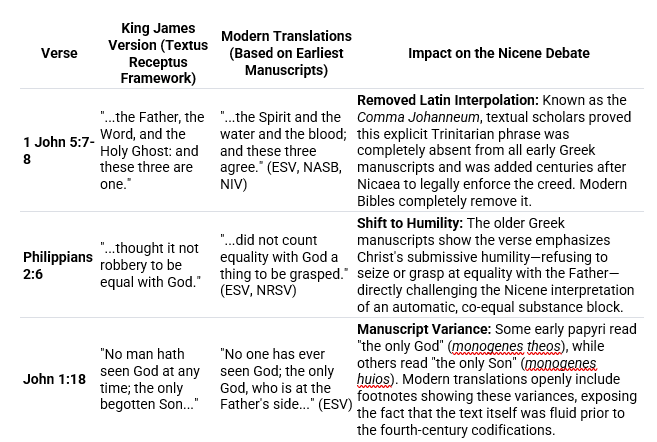
Modern textual criticism—the study of thousands of ancient Greek manuscripts discovered long after the Protestant Reformation—has led modern Bible translators to update key verses. These updates often align closer with the original readings defended by pre-Nicene Christians rather than the theological frameworks enforced by the medieval Church. Modern Bible translations reflect this historical dispute by updating texts like Philippians 2:6, John 1:1, and 1 John 5:7-8 based on older manuscripts that often challenge the rigid definitions enforced at Nicaea. The compilation of the baseline text relied heavily on the Textus Receptus framework, which was a late medieval Greek compilation published by Erasmus in 1516. Erasmus relied on only a few late manuscripts, which explains why centuries-late Latin interpolations like the Comma Johanneum crept into early English printing traditions. The standard translations illustrate this shift:
How the Catholic Church Responded to Modern Translations
For centuries following the Council of Trent (1545–1563), the Roman Catholic Church legally mandated the Latin Vulgate as the sole authoritative text, banning vernacular translations and blocking the use of historical-critical manuscript studies. However, the discovery of older manuscripts forced a complete shift in institutional policy during the 20th century.
- The Encyclical Divino Afflante Spiritu (1943): Issued by Pope Pius XII, this papal decree completely reversed centuries of Catholic policy. The Pope officially authorized Catholic biblical scholars to bypass the Latin Vulgate and translate the Bible directly from the original Hebrew and Greek manuscripts, explicitly encouraging the use of textual criticism and archaeology.
- The Vatican II Decree Dei Verbum (1965): The Second Vatican Council formalized this openness, stating that "easy and suitable access to Sacred Scripture should be provided for all the Christian faithful" and endorsing ecumenical translations based on the earliest Greek texts.
- The Adoption of Critical Texts: Today, official Catholic translations (such as the New American Bible or the Revised Standard Version Catholic Edition) use the same unified critical Greek text (Nestle-Aland) as mainstream Protestant Bibles. As a result, modern Catholic Bibles now include the exact same textual footnotes regarding disputed verses, openly acknowledging where late additions (like the Comma Johanneum in 1 John 5:7) were inserted into the tradition.
Add comment
Comments