The Fallibility of Faith Fathers and the Unchanging Truth of the Godhead

This conversation exposes the common critical tactic of using uncanonized, historical speculations from the nineteenth century to distract from biblical truth. The public arguments attempted to use Brigham Young’s personal commentary to show that the framework of the Godhead is fluid or contradictory. However, the analysis systematically breaks down his private views—including the Adam-God theory, blood atonement, and racial curse theories—proving by official church declarations and modern canonized revelations that these concepts were entirely personal speculations that completely failed the test of scriptural canon and have been thoroughly disavowed by the church itself. By looking at Galatians 1, the full conversation demonstrates that the true Divine Family—Heavenly Father, God the Son, Jesus Christ, and God the Comforter, Holy Ghost—stands completely unchanged by the temporary, unscriptural opinions of mortal men, exposing these historical arguments as adversarial attempts to cloud clear biblical revelation.
The Church of Jesus Christ of Latter-day Saints views Brigham Young as a prophet of God and a brilliant, necessary colonizer who successfully navigated the Church through its greatest existential crisis. At the same time, the modern Church openly acknowledges his human flaws and has officially disavowed several of his personal racial and doctrinal views
The desperate attempts by worldly systems to use historical side-arguments to construct a systematic theology completely unravel when the uncanonized, private theories of pioneer figures are dragged into the clear light of day. Many point to historical anomalies as if they are part of the true faith, but the reality is that the personal commentary and speculative theories preached in the nineteenth century are explicitly rejected, disavowed, and completely absent from true scriptural teaching. By trying to elevate a single leader's private opinions into formal doctrine, people are not disputing the Godhead; they are disputing the very principles of scriptural canon, because worldly systems do the exact same thing by mistaking ancient council debates for actual scripture. Read your doctrine and learn the lies you are being taught and the difference between human speculation and eternal truth.
Let the world look at the specific personal commentaries and statements made by Brigham Young that are completely rejected and not taught in the true, revealed scriptural standard, according to the official declarations of the church.
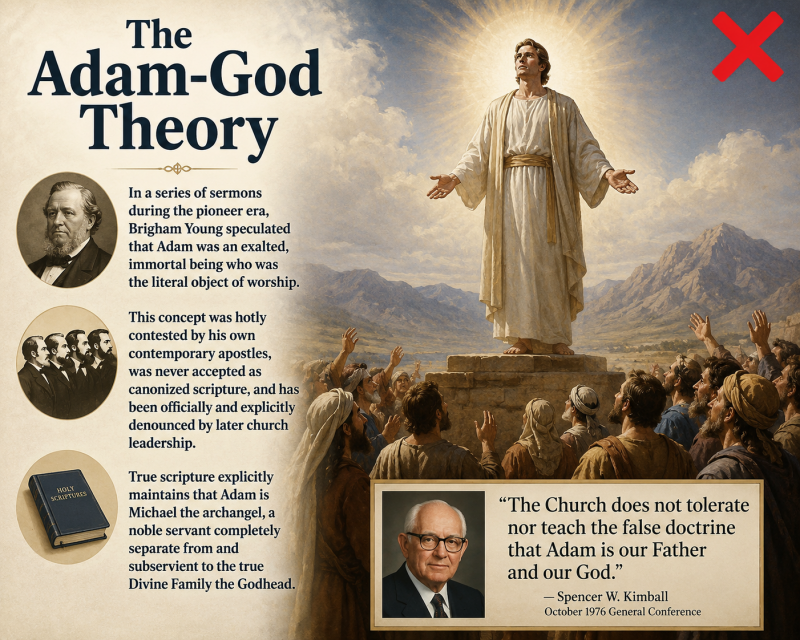
First, the Adam-God Theory. In a series of sermons during the pioneer era, Brigham Young speculated that Adam was an exalted, immortal being who was the literal object of worship. This concept was hotly contested by his own contemporary apostles, was never accepted as canonized scripture, and has been officially and explicitly denounced by later church leadership. In the official October 1976 General Conference record, the Prophet Spencer W. Kimball formally declared that the church does not tolerate nor teach the false doctrine that Adam is our Father and our God. True scripture explicitly maintains that Adam is Michael the archangel, a noble servant completely separate from and subservient to the true Divine Family the Godhead.
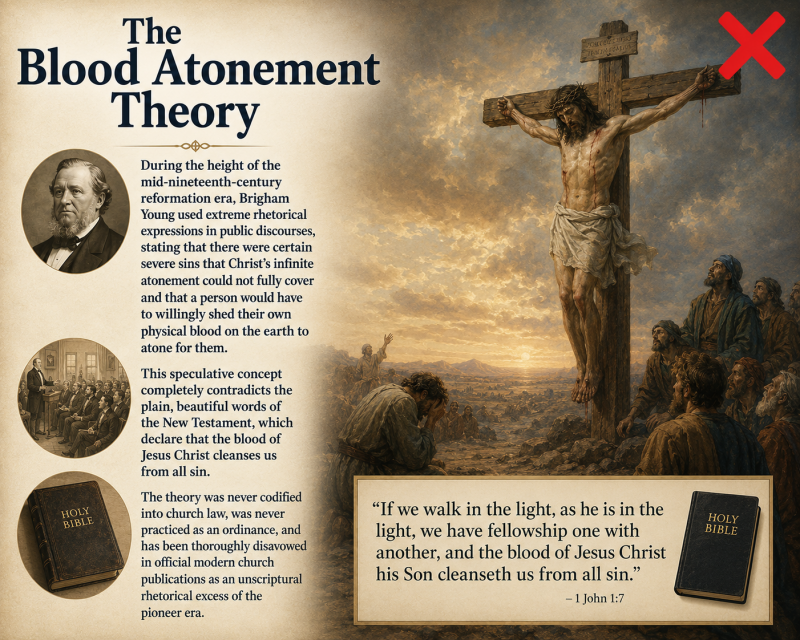
Second, the Blood Atonement theory. During the height of the mid-nineteenth-century reformation era, Brigham Young used extreme rhetorical expressions in public discourses, stating that there were certain severe sins that Christ’s infinite atonement could not fully cover and that a person would have to willingly shed their own physical blood on the earth to atone for them. This speculative concept completely contradicts the plain, beautiful words of the New Testament, which declare that the blood of Jesus Christ cleanses us from all sin. The theory was never codified into church law, was never practiced as an ordinance, and has been thoroughly disavowed in official modern church publications as an unscriptural rhetorical excess of the pioneer era.
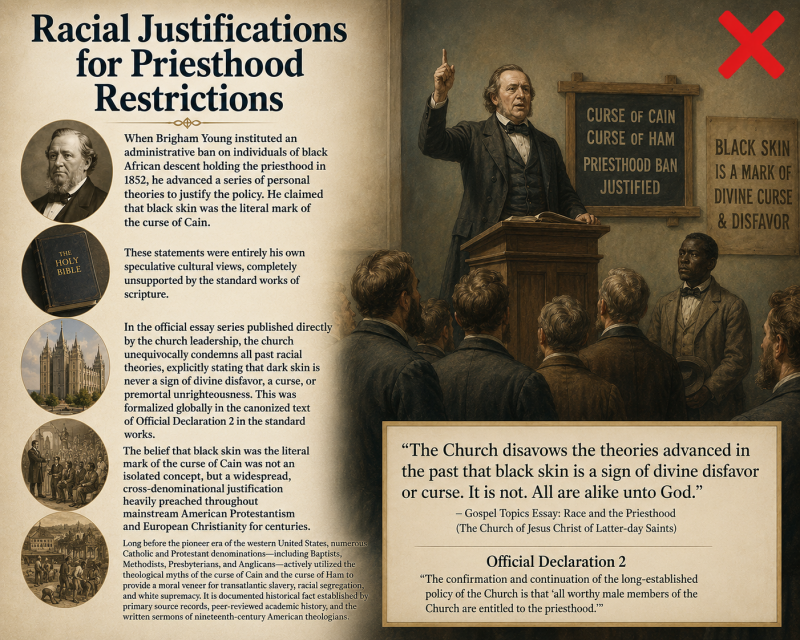
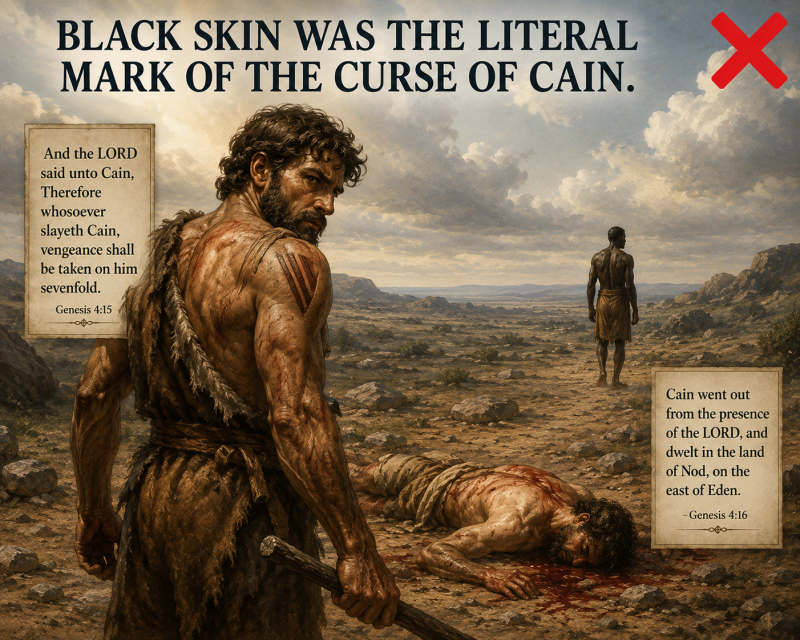
Third, racial justifications for priesthood restrictions. When Brigham Young instituted an administrative ban on individuals of black African descent holding the priesthood in 1852, he advanced a series of personal theories to justify the policy. He claimed that black skin was the literal mark of the curse of Cain. These statements were entirely his own speculative cultural views, completely unsupported by the standard works of scripture. In the official essay series published directly by the church leadership, the church unequivocally condemns all past racial theories, explicitly stating that dark skin is never a sign of divine disfavor, a curse, or premortal unrighteousness. This doctrine was formalized globally in the canonized text of Official Declaration 2 in the standard works.
The belief that black skin was the literal mark of the curse of Cain was not an isolated concept, but a widespread, cross-denominational justification heavily preached throughout mainstream American Protestantism and European Christianity for centuries. Long before the pioneer era of the western United States, numerous Catholic and Protestant denominations—including Baptists, Methodists, Presbyterians, and Anglicans—actively utilized the theological myths of the curse of Cain and the curse of Ham to provide a moral veneer for transatlantic slavery, racial segregation, and white supremacy. It is a documented historical fact established by primary source records, peer-reviewed academic history, and the written sermons of nineteenth-century American theologians.
Brigham Young’s 1852 priesthood ban and associated curse-of-Cain theology were personal, unscriptural views later condemned by the church, with the reversal formalized in Official Declaration 2. This narrative was a widespread, cross-denominational justification used across Western Christianity for centuries to support racial segregation and slavery.
The defense of slavery using the curse of Cain is preserved in the official historical archives of major American religious institutions. For example, during the antebellum period in America, mainstream Christian ministers published formal theological treatises defending racial hierarchy. In 1852, Southern Baptist minister Thornton Stringfellow published a widely distributed statistical and scriptural defense of slavery, arguing that dark skin and servitude were divinely decreed lineages dating back to the biblical era. Similarly, in 1860, Presbyterian theologian James Henley Thornwell delivered formal discourses explicitly framing the social subordination of black individuals as an unalterable part of the providential order. Furthermore, the split of major American denominations over these exact racial doctrines is a matter of public institutional record. The Southern Baptist Convention formally separated from northern Baptists in May 1845 specifically over the issue of whether slaveholders could be appointed as foreign missionaries, utilizing these exact biblical curse arguments to justify their position. The Methodist Episcopal Church split into northern and southern branches in 1844 over the exact same institutional defense of racial subjugation.

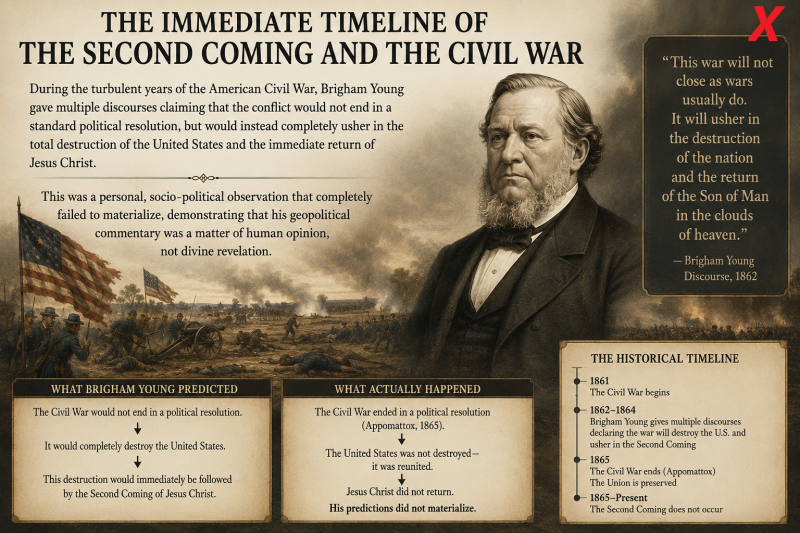
Fourth, the immediate timeline of the Second Coming and the Civil War. During the turbulent years of the American Civil War, Brigham Young gave multiple discourses claiming that the conflict would not end in a standard political resolution, but would instead completely usher in the total destruction of the United States and the immediate return of Jesus Christ. This was a personal, socio-political observation that completely failed to materialize, demonstrating that his geopolitical commentary was a matter of human opinion, not divine revelation.
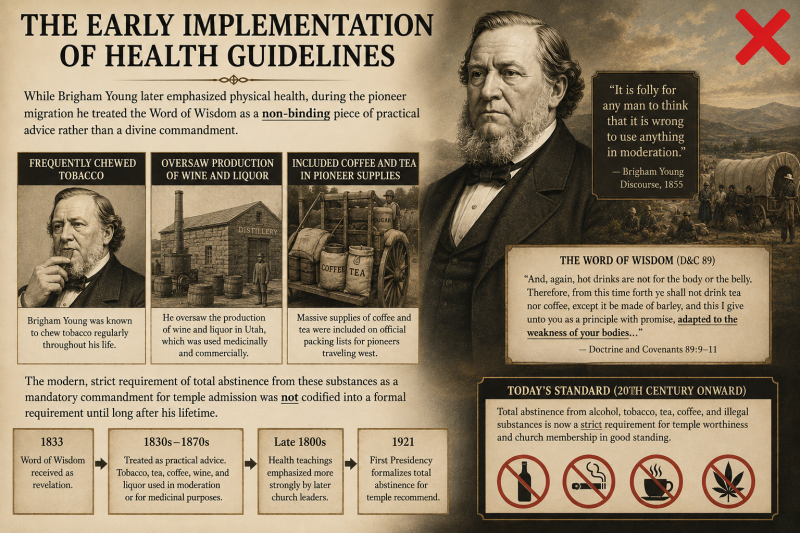
Fifth, the early implementation of health guidelines. While Brigham Young later emphasized physical health, during the pioneer migration he treated the Word of Wisdom as a non-binding piece of practical advice rather than a divine commandment. He frequently chewed tobacco, oversaw the production of wine and liquor in Utah, and included massive supplies of coffee and tea on the official packing lists for pioneers traveling west. The modern, strict requirement of total abstinence from these substances as a mandatory commandment for temple admission was not codified into a formal requirement until long after his lifetime.
Brigham Young directed the mass migration of over 60,000 pioneers to the Rocky Mountains, founded Salt Lake City, and established more than 350 settlements across the American West. As the first territorial governor of
Utah, he successfully organized massive irrigation systems, built the transcontinental telegraph line, and laid the foundations for the University of Utah and the Salt Lake Temple.
Brigham Young served as the first territorial governor of Utah from 1851 to 1858
- Establishing Civil Government: He organized the first territorial legislature, defined judicial districts, and established a functioning legal code.
- Infrastructure and Public Works: He oversaw the construction of roads, bridges, and public buildings, funded through territorial taxation.
- Superintendent of Indian Affairs: He negotiated treaties with local Native American tribes, including the Ute, Shoshone, and Paiute, implementing a policy of feeding rather than fighting them to secure settlement expansion.
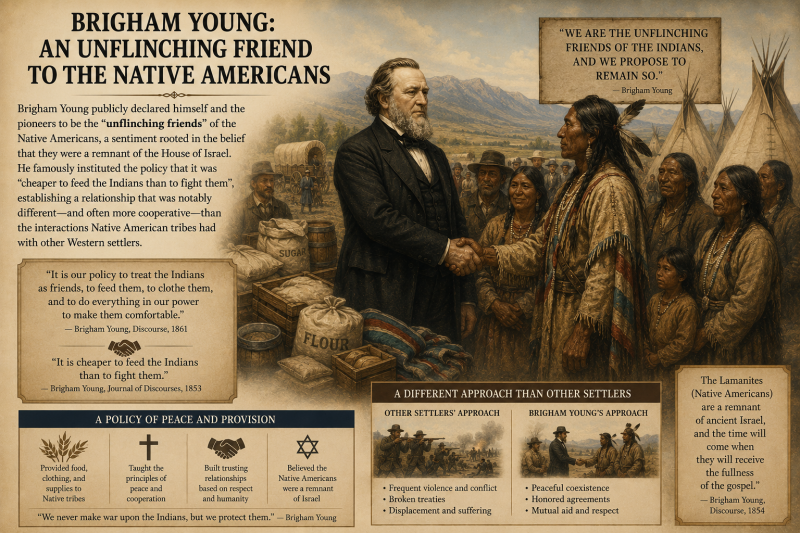
Brigham Young publicly declared himself and the pioneers to be the "unflinching friends" of the Native Americans, a sentiment rooted in the belief that they were a remnant of the House of Israel. He famously instituted the policy that it was "cheaper to feed the Indians than to fight them," establishing a relationship that was notably different—and often more cooperative—than the interactions Native American tribes had with other Western settlers
The most prominent names and titles used by the Native Americans to refer to Brigham Young include:
- Big Captain: This was the most common title used by leaders of the Ute, Shoshone, and Paiute tribes. In their interactions with the pioneers, the term "Captain" was used to describe a leader or chief. Because Brigham Young was the leader over all the local captains and bishops, he was designated as the "Big Captain" or "Great Captain."
- Mormon Chief: Tribal leaders like Chief Walkara and Chief Kanosh frequently referred to him as the chief of the "Mormoni" (the Native American pronunciation of Mormon). They recognized him as the tribal head of the pioneers, matching their own social hierarchy of chieftains.
- The Governor: In official treaties and formal councils, Native Americans who spoke English or worked with interpreters used his secular government title. They understood that he held the backing and resources of the federal government as the Superintendent of Indian Affairs.
When speaking among themselves in their native languages, tribal members also referred to him descriptively based on his appearance, often calling him "The Bearded Chief" or "The Heavy Chief" due to his physical stature and facial hair.
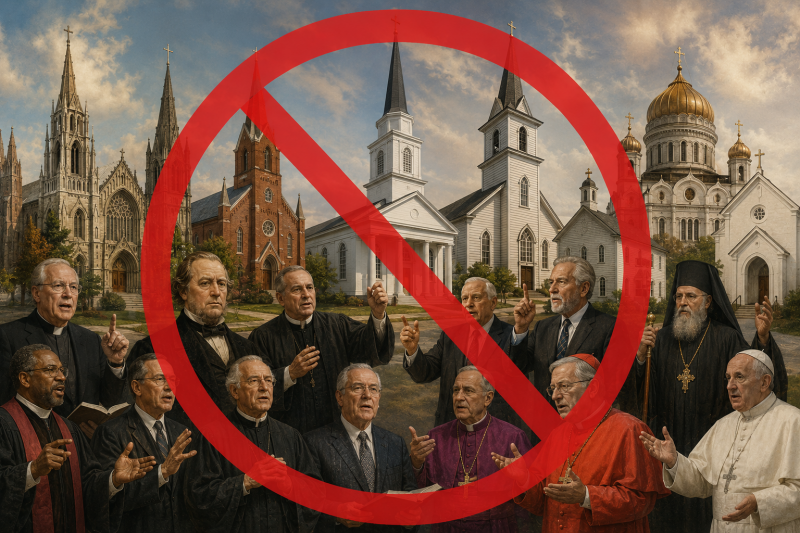
Originally, there was only the Roman Catholic Church in Western Europe. In the 1500s, a movement called the Protestant Reformation began when leaders broke away from the Catholic Church to "protest" its practices and doctrines. Every church that developed out of that breakup—or split off from those churches later on—is considered a Protestant church.
Anglicans, Assemblies of God, Baptists, Christian Reformed Church, Church of England, Church of God, Episcopalians, Lutherans, Methodists, and Non-Denominational Churches. Pentecostals, Presbyterians

True doctrine is not established by digging through historical transcripts to discover the private, speculative opinions of a pioneer leader. True doctrine is anchored solely in the mouth of multiple witnesses and formalized in the standard, canonized scriptures.
Look at the warning of the King James Version text in Galatians, chapter 1, verses 8 and 9: But if we or an angel from heaven preach any other gospel than what we have preached to you, let him be accursed. As we said before, so say I now again: If any man preach any other gospel unto you than that ye have received, let him be accursed.
The apostle Paul explicitly commands the world to measure every statement—even if it comes from an angel or a high leader—against the foundational, revealed gospel truth. Brigham Young’s private theories regarding Adam,
blood atonement, and racial curses failed that scriptural test, which is precisely why they were never canonized, never accepted by the body of the church of Jesus Christ of Latter-Day Saints, and are completely rejected today.
History is absolutely full of highly regarded, famous church leaders from every major denomination who gave personal opinions about their churches that turned out to be completely untrue, unscriptural, or flat-out wrong.
Universal historical reality: throughout every century and within every major religious tradition, the most celebrated theologians and founders have published deeply flawed personal opinions, cultural prejudices, and theological speculations that their modern followers have been explicitly forced to disavow. This pattern demonstrates that no religious leader—regardless of their intellect or historical stature—is immune to the cultural biases and limitations of their era when they speak outside a formal, canonized standard.
Western Christianity, Saint Augustine of Hippo
Roman Catholicism:
Catholicism views Augustine as one of its most important early church fathers, a bishop, a canonized saint, and a "Doctor of the Church" whose writings heavily shaped Catholic views on grace, sacraments, and the papacy.
In historical terms, he is the primary architect of what is called Western Christianity, which is the broad branch of the faith that eventually developed into both the Roman Catholic Church and all subsequent Protestant denominations, separating them from the Eastern Orthodox traditions.
Protestantism: When the Protestant Reformation occurred in the 1500s, founders like Martin Luther (who was an Augustinian monk) and John Calvin heavily relied on Augustine’s specific writings about salvation and the sovereign grace of God. Consequently, denominations like Lutherans, Presbyterians, and Baptists trace their theological roots directly back to his work.
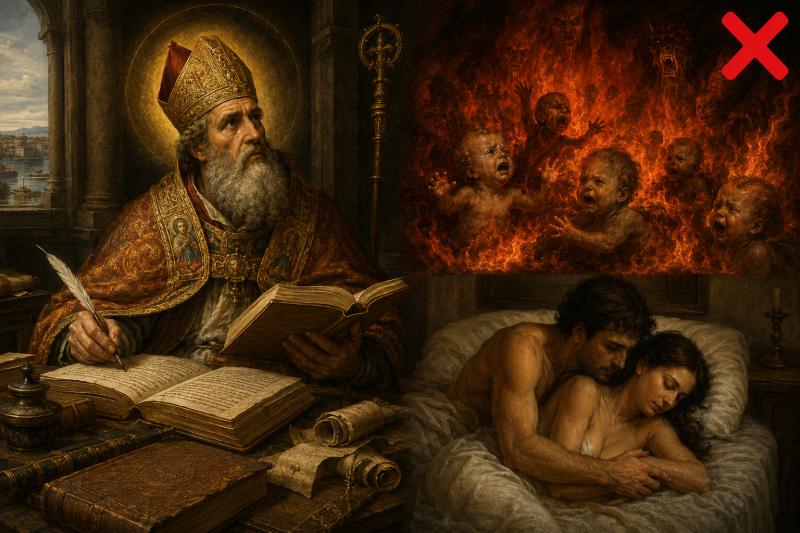
The foundational theological giant of Western Christianity, Saint Augustine of Hippo, declared his explicit opinion that infants who die without receiving physical water baptism are instantly and permanently condemned to the literal, physical fires of hell due to the inherited guilt of original sin. He also explicitly taught that the physical act of marital intimacy is inherently contaminated with sinful concupiscence, a personal monastic view that modern Christian churches completely throw out. He integrated the Nicene Creed directly into the foundation of Western civilization. Not using the Bible, he engineered the psychological and philosophical justifications for the creed, arguing that because God is a single, formless substance, the "Trinity" can be understood by looking at the human mind (Memory, Intelligence, and Will).
Thomas Aquinas
While his work belongs directly to Roman Catholicism, his philosophical arguments for the existence of God (known as the Five Ways) are still widely read and used by many Protestant denominations today.
The supreme scholastic theologian of the Catholic Church, Thomas Aquinas, advanced the explicit personal opinion in his authoritative masterpiece, the Summa Theologiae, that a human fetus does not possess a human spirit at conception, arguing for a theory of progressive ensoulment where the soul is not infused by God until forty days for males and eighty days for females. As the world knows from medical science, the fetus becomes a baby at five to six weeks, when it has a heartbeat. Furthermore, Aquinas formally argued that convicted heretics should not merely be excommunicated but should be delivered by the church to the secular state to be physically executed by death.

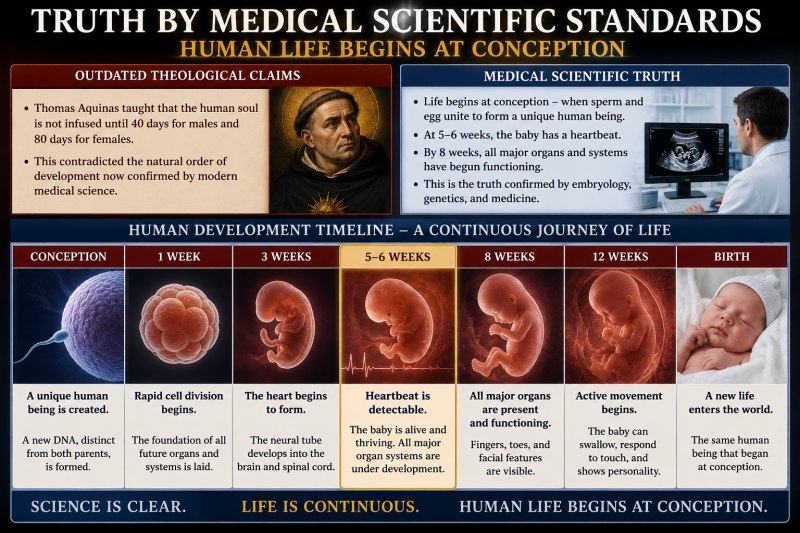
Conception
- Unique Human Being: A unique human being is created when the sperm and egg unite [Image].
- Distinct DNA: An entirely new DNA, distinct from both parents, is formed at this exact moment.
- 3 Weeks Alive: The baby's heart begins to physically form and operate.
- Neural Development: The neural tube actively develops into the brain and spinal cord.
- 5–6 Weeks
- Detectable Heartbeat: The heartbeat becomes physically detectable through medical ultrasound.
- Alive and Thriving: The baby is officially alive and thriving, and all major organ systems are under active development.
8 Weeks
- Organ Functionality: All major organs are fully present and have begun functioning together.
- Visible Features: Fingers, toes, and distinct facial features become visible on the baby.
12 Weeks
- Active Movement: The baby begins active movement within the womb.
- Sensory Responses: The baby can swallow, physically respond to touch, and shows early signs of personality.
Based on the provided medical scientific infographic, human development is presented as a continuous journey of life where the fetus is recognized as a living baby in the womb through specific developmental milestones.
In his massive work, the Summa Theologiae, Aquinas went through the creeds line by line, creating hundreds of hyper-technical philosophical proofs to defend the idea of a formless, passionless, and unchangeable divine substance. He never opened a Bible or scroll.
Origen of Alexandria Christian theologians and Greek church fathers of the first three centuries.
Within that historic environment, Origen was a deeply revered Christian scholar, priest, and the head of the famous Catechetical School of Alexandria, Egypt. He spent his entire life writing massive commentaries defending the divinity of Jesus Christ and the truth of the scriptures against pagan critics.
- The Father of Theology: He is universally recognized by historians as the first great systematic theologian in Christian history, meaning he was the first to try to write a complete, structured textbook explaining all Christian beliefs.
- The Posthumous Heretic: Because he blended his Christian teachings with speculative Greek philosophy, the mainstream Christian world eventually turned on his memory. Three centuries after his death, his specific theories regarding the pre-existence of souls and universal salvation were officially declared heretical at the Second Council of Constantinople in A.D. 553.
- The Un-Saint: Unlike his contemporaries, Origen was never canonized as a saint by the Roman Catholic Church or the Eastern Orthodox Church due to his condemned theories, though his biblical scholarship continues to heavily influence both traditions to this day.

Several of Origen’s highly controversial, officially condemned doctrines absolutely filtered into other major Christian churches later in history, heavily shaping their theology. Because Origen was the first writer to build a comprehensive, structured system of Christian theology, later church leaders frequently copied his foundational frameworks, inadvertently embedding his speculative philosophical errors directly into the bloodstream of Roman Catholicism, Eastern Orthodoxy, and mainstream Protestantism. He was the first to blend Christian scripture with pagan Greek metaphysics (Platonism), inventing the technical vocabulary needed to argue that God is an immaterial, timeless, formless substance.
Gregory of Nyssa's orthodox Trinitarian definitions at the Council of Constantinople in A.D. 381.
Roman Catholicism and Protestantism
In addition to his temporary hell theories, Gregory of Nyssa heavily advanced the unscriptural practice of extreme bodily asceticism and the mandatory celibacy of the priesthood. He authored influential monastic treatises that condemned the physical body as an enemy to spiritual purity, arguing that marital intimacy and family life were worldly pollutions that degraded the soul. By elevating severe physical self-deprivation, fasting, and monastic isolation as the only true paths to holiness, his teachings directly undermined the biblical sanctity of the traditional family unit and helped establish the oppressive, mandatory celibacy rules that caused centuries of systemic moral failure within the medieval church.
Gregory of Nyssa (c. 335–395) was an influential fourth-century bishop and Greek theologian whose extensive writings on the Trinity heavily shaped the final Nicene Creed formulations at the Council of Constantinople in A.D. 381.

He used advanced Aristotelian logic to solve a massive political crisis in the Roman Empire. The bishops were struggling to explain how three separate entities (Father, Son, and Holy Ghost) did not equal "three Gods." Gregory argued that they are not separate beings, but rather three distinct "personas" sharing a single, identical numerical identity of being.
Ultimately, Christian theology concludes that the Trinity is a mystery that transcends human logic, rather than a puzzle solved by it.
This statement lacks logical validity because it uses a circular fallacy to evade rational analysis. It attempts to prove a claim is logically sound by declaring it immune to logic itself. Defining a concept as an "unknowable mystery" creates an unfalsifiable position where contradictions are dismissed as divine transcendence rather than logical flaws. Ultimately, calling a paradox a "mystery" does not resolve the logical contradiction; it merely rebrands the absence of logic as a virtue.
Pope Gregory the Great
Pope Gregory I, known as Gregory the Great (c. 540–604), was a foundational medieval pope and Doctor of the Roman Catholic Church who heavily shaped Western liturgy and church administration. In addition to his scriptural errors regarding Mary Magdalene, Pope Gregory the Great firmly codified the unscriptural practice of utilizing secular military force and state coercion to compel religious conversions. While earlier leaders had flirted with imperial power, Gregory formally authorized bishops to use physical beatings, increased taxation, and the confiscation of land to force pagan peasants, Jews, and theological dissenters into the Catholic fold. This policy directly overthrew the biblical principle of moral agency, establishing a medieval dark precedent where religious compliance was extracted through economic ruin and physical torture rather than gentle persuasion.

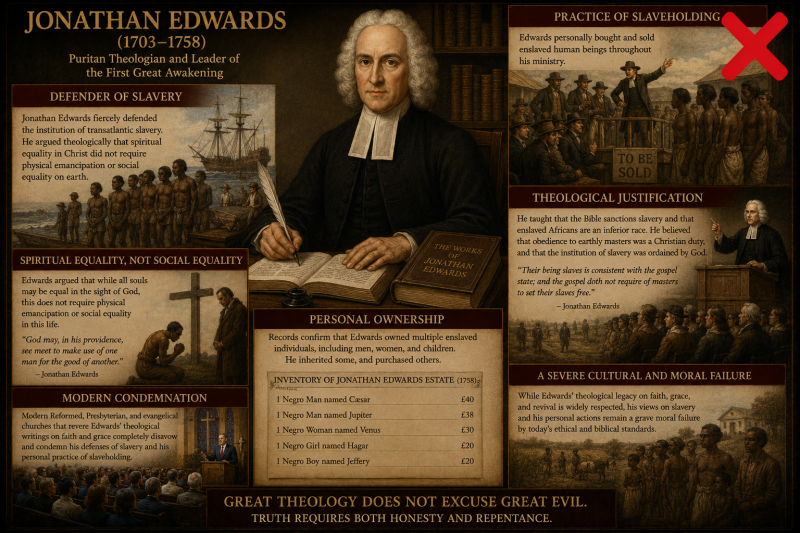
The celebrated American Puritan theologian and leader of the First Great Awakening,
Jonathan Edwards
In addition to his theological defense of transatlantic slavery, Jonathan Edwards heavily validated and promoted extreme psychological hysteria and emotional manipulation as genuine manifestations of the Holy Spirit. During the First Great Awakening, his intense, fear-driven preaching caused parishioners to break out into uncontrollable screaming, physical convulsions, and fainting spells, which Edwards defended as divine operations. This endorsement of mass hysteria led to severe spiritual confusion, replacing the calm, orderly, and peaceful whisperings of the true Spirit with chaotic emotional outbursts that eventually caused widespread community fracturing and an increase in local suicide rates.
In addition to his role in the witch trials, Cotton Mather heavily promoted the unscriptural practice of publicly shaming and legally punishing unwed mothers while entirely shielding the fathers. Mather utilized his massive pastoral authority to enforce strict Puritan laws that forced women who became pregnant out of wedlock to stand before the entire congregation in a white sheet to be publicly humiliated, or face physical whipping and heavy fines by the civil magistrates. Because he and his fellow ministers refused to hold men to the same moral standard, this double standard created a toxic cultural environment of fear that directly led to an epidemic of infanticide, where terrified young women secretly gave birth and destroyed their infants to avoid Mather's brutal public tribunals.

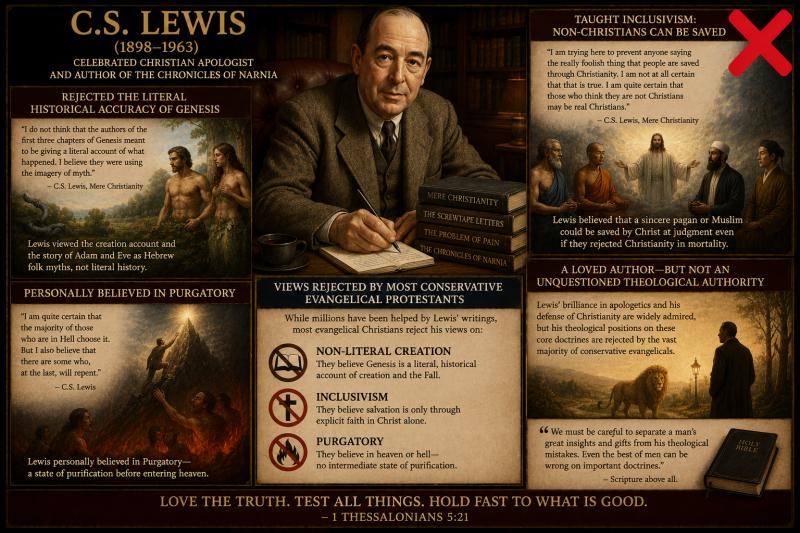
The celebrated twentieth-century Christian apologist
C.S. Lewis
explicitly rejected the literal historical accuracy of the early chapters of Genesis
In addition to his non-literal views on Genesis and his beliefs regarding purgatory, C.S. Lewis openly defended and popularized unscriptural views on the fall of Satan and the nature of the adversary. In his highly celebrated 1942 book The Screwtape Letters, Lewis utilized satire to create an elaborate, imaginative hierarchy of a highly organized, corporate-style network of devils and demons who continuously micromanage the daily thoughts of human beings. This highly speculative framework, though written as a fictional tool for moral instruction, led millions of readers to adopt an unbiblical, hyper-focused obsession with demonic activity, effectively replacing the true scriptural reality of individual accountability and agency with a pop-culture mythology regarding the operations of the adversary.
Joseph Smith’s First Vision occurred in the spring of 1820, and he was martyred on June 27, 1844.
Early Modalistic Views of God in the 1830 Book of Mormon
During his travels and civic leadership, Joseph Smith occasionally made spontaneous, uncanonized declarations about historical artifacts. In 1834, during the Zion’s Camp march, he looked at a skeleton found in a mound in Illinois and stated it was a "white Lamanite" named Zelph who fought under a prophet named Onandagus. In 1843, when presented with the "Kinderhook Plates" (which were actually a deliberate forgery created by locals to trick him), his private journal notes indicate he attempted to translate a portion of them using a grammar book.
- The church entirely ignores these spontaneous historical statements. Modern church historians and theologians have explicitly confirmed that the Kinderhook plates were a hoax, and the church does not accept Joseph Smith's private statements about "Zelf" or the forged plates as canonized scripture or binding historical truth.

Joseph Smith examined the remains and stated that he had a vision or an impression about the individual. He stated that the man's name was Zelph.
Many examples can be drawn from all religious beliefs.
Worldly systems are so desperate to avoid looking at the actual text of the Bible that they attempt to use these discarded historical footnotes to attack the reality of the Godhead. Read your doctrine and learn the lies that others teach you, as well as the difference between human speculation and eternal truth.
This pattern occurs because throughout history, famous theologians frequently blended the core biblical texts with their surrounding cultural prejudices, personal political goals, or contemporary philosophical trends like medieval scholasticism or eighteenth-century medical theories. When these leaders spoke or wrote outside of a formal, unified canonical standard, they produced heavy speculation. As societies changed and scriptural examination deepened, their respective organizations had to distinguish between the permanent standard works of their faith and the flawed, temporary commentary of their most famous leaders.
Add comment
Comments