We Worship God the Father—we Honor God the son, Jesus Christ - We show love to God the Holy Ghost.
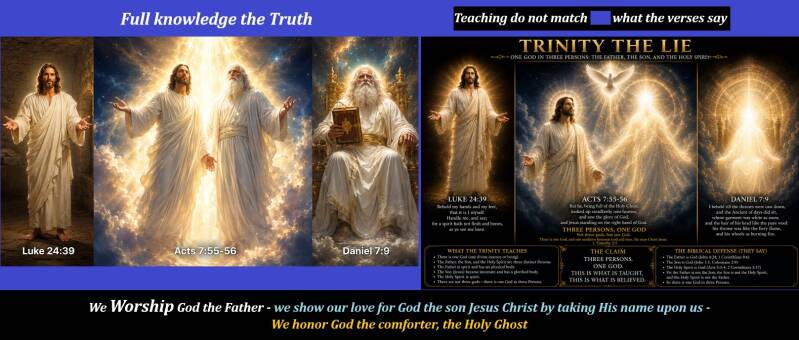
It is wild how confidently trinity believers throw around words like "ignorance" and "baseless" while actively running away from the literal text of the Bible. Let’s lay out the unadulterated truth of the Godhead in full, chronological order, uncover the human history behind your traditions, and expose the massive difference between a fragile belief and full knowledge. They, God the Father, God the son, Jesus Christ, and God the comforter, the Holy Ghost are as one, not one.
John 17:21 "That they all may be one; as thou, Father, art in me, and I in thee, that they also may be one in us: that the world may believe that thou hast sent me."
1. The Direct Witness of the Scriptural Timeline.Your claim that God has no form or physical bodily presence requires you to rip pages straight out of the text. The Bible spent thousands of years documenting the physical personage of the Father, the distinct nature of the Godhead, and Their shared divine identity as separate Beings in perfect chronological order:.The Era of Beginnings (Genesis).
• Genesis 1:26-27: God creates man on the sixth day in His own physical image and likeness. In the original Hebrew text, the word for "image" is Tselem, which literally means a physical outline, a shadow, or a three-dimensional figure. The word for "likeness" is Demut, which explicitly means a concrete model, shape, pattern, or bodily resemblance. When ancient Jewish scribes translated this into the Greek Septuagint, they preserved this physical reality by choosing the words Eikōn (a literal statue, physical bust, or coin stamping) and Homoiōma (a concrete, indistinguishable physical shape or form).
• Genesis 3:8: After the fall, Adam and Eve hear the physical sound of the Lord God walking through the Garden of Eden..
• Genesis 5:1: The historical record of Adam's generation restates that man was made in the literal likeness of God..
• Genesis 5:3 (The Ultimate Blueprint Proof): To completely erase any doubt that these words mean a literal, physical form, the text uses the exact same Hebrew words in the exact same grammatical structure to describe family procreation: "And Adam lived an hundred and thirty years, and begot a son in his own likeness (demut), after his image (tselem); and called his name Seth." Seth had eyes, arms, legs, and a face patterned directly after Adam's physical body. By using those identical Hebrew terms in Genesis 1:26, the text explicitly declares that humanity stands in relation to God the Father just as Seth stood in relation to Adam. We are His literal offspring, fashioned in His exact physical form..
• Genesis 9:6: Following the global flood, God establishes covenants with Noah and explicitly repeats that man is made in His physical image..The Exodus and Wilderness Wanderings (Exodus, Numbers, Deuteronomy).
• Exodus 24:9-11: Moses, Aaron, Nadab, Abihu, and seventy elders ascend Mount Sinai, see the God of Israel, and describe what is under His feet..
• Exodus 31:18: Upon finishing His communion with Moses, God gives him the stone tablets engraved directly with the finger of God.
• Exodus 33:11: Inside the tabernacle, the Lord speaks to Moses face to face, just as a man speaks directly to his closest friend..
• Exodus 33:20-23: The Lord shields Moses in a cleft of the rock with His hand, then removes it so Moses can physically look upon His back parts. God explicitly states, "Thou canst not see my face: for there shall no man see me, and live." This does not mean God lacks a face. It means a mortal man would be consumed by the sheer glory of that face unless God transfigures him or shields him from His blinding light..
• Numbers 12:8: God rebukes Aaron and Miriam, declaring that He speaks with Moses mouth to mouth, and that Moses beholds the literal similitude of the Lord..• Deuteronomy 34:10: The final recording of Moses's life honors him as the prophet whom the Lord knew face to face..The Kingdom and Prophetic Era (1 Kings, Isaiah, Daniel).
• 1 Kings 22:19: The prophet Micaiah delivers his vision of the Lord sitting bodily on a heavenly throne with the hosts of heaven standing to His right and left..
• Isaiah 9:6: Isaiah prophesies of the birth of Jesus Christ, explicitly calling the Messiah by the divine title of "The Mighty God" centuries before His birth..
• Daniel 7:9: Daniel envisions the Ancient of Days seated on a throne, possessing hair like pure wool and wearing distinct garments..The Gospels (Matthew, Luke, John).
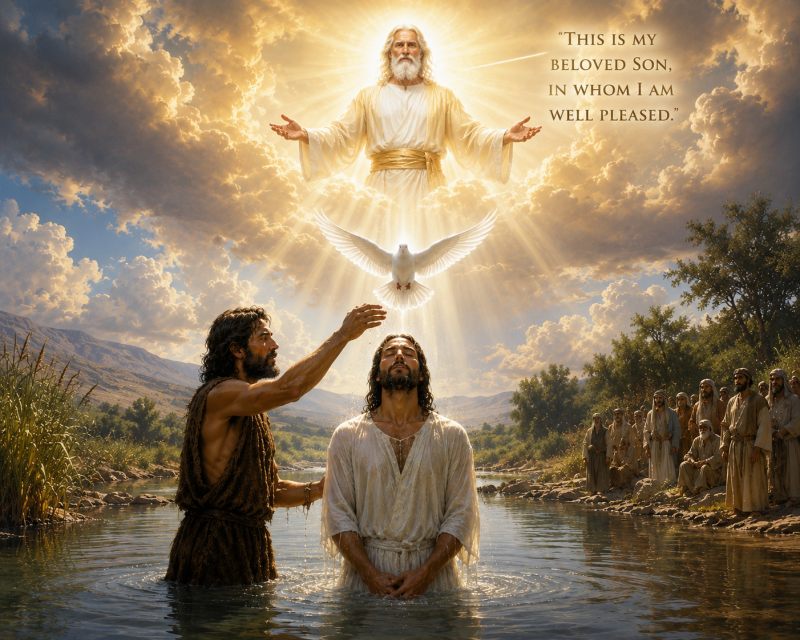
• Matthew 3:16-17: At the baptism of Jesus Christ, all three members of the Godhead are physically manifested at the exact same moment in separate spaces: Jesus is standing in the Jordan River, the Holy Ghost descends visually like a dove from above, and the voice of God the Father speaks from the heavens, declaring, "This is my beloved Son, in whom I am well pleased." They are visually and positionally distinct..
• John 1:1: This verse explicitly calls Jesus "God" alongside the Father: "In the beginning was the Word, and the Word was with God, and the Word was God.".
• John 1:18: The text states, "No man hath seen God at any time," but the context clarifies that mortal eyes cannot see God without being spiritually changed or transfigured, because His physical presence is too intense for corruptible flesh..
• John 4:24: Jesus teaches that "God is a Spirit." In the original Greek, this is a description of God's essence and character, not a denial of His form. For comparison, 1 John 4:8 states that "God is love." Nobody argues that God is a literal, formless emotion floating in space. Saying God is a Spirit means His power, life force, and nature are spiritual. Just as a physical man possesses a spirit, God the Father is a Spirit who possesses a glorified, immortal, physical body of flesh and bones..
• John 6:27: Jesus clearly identifies His separate Father with the divine title, telling the multitudes to labor for the meat which endures unto everlasting life, "for him hath God the Father sealed.".
• John 14:16-17, 26: Jesus promises His disciples that He will pray to the Father, and the Father will send them "another Comforter." The Greek word for "another" here is Allos, which means another of the exact same kind—an identical match in nature and personhood. The word for "Comforter" is Paraklētos, which was a legal courtroom term for an advocate or defense attorney called to stand physically by your side. A formless force cannot teach, testify, or remember; these are the actions of a distinct, intelligent personage who acts as a separate messenger..
• John 16:7, 13-14: Jesus explains that the Holy Ghost "shall not speak of himself; but whatsoever he shall hear, that shall he speak." Furthermore, even though the Greek word for spirit (pneuma) is grammatically neuter, the text deliberately breaks standard grammar to use the masculine personal pronoun Ekeinos (He/That Man): "Howbeit when he (ekeinos), the Spirit of truth, is come, he will guide you..." The text repeatedly uses "He," "Himself," and "His," completely rejecting the idea of an impersonal "it.".
• John 20:27-28: Jesus commands Thomas to overcome his skepticism through physical touch: "Reach hither thy finger, and behold my hands; and reach hither thy hand, and thrust it into my side: and be not faithless, but believing." Thomas falls down and declares to the physical Jesus: "My Lord and my God.".• Luke 24:36-39: Standing among His terrified disciples who assume He is a spirit, Jesus explicitly corrects them: "Behold my hands and my feet, that it is I myself: handle me, and see; for a spirit hath not flesh and bones, as ye see me have.".
• Luke 24:41-43: To solidify this physical reality beyond all doubt, Jesus asks for meat, takes a piece of a broiled fish and an honeycomb, and physically eats it right in front of them..The Acts and the Epistles (Acts, Romans, Corinthians, Galatians, Ephesians, Philippians, Colossians, 1 Timothy, Titus, Hebrews, James, 1 John).
• Acts 1:9-11: Jesus does not dissolve into a formless spirit as He ascends. He rises physically into the clouds, and the angels declare that this “same Jesus, which is taken up from you into heaven, shall so come in like manner as ye have seen him go into heaven.”.
• Acts 7:55-56: As Stephen is being martyred, he is explicitly "full of the Holy Ghost," and through that spiritual power, he looks up into heaven and sees two other distinct entities: Jesus Christ standing on the right hand of God the Father..
• Romans 8:26-27: Paul explains that the Holy Ghost possesses a distinct mind and acts as an intercessor: "the Spirit itself maketh intercession for us... And he that searcheth the hearts knoweth what is the mind of the Spirit.".
• Romans 9:5: Paul applies the title of God to Christ, writing, "of whom as concerning the flesh Christ came, who is over all, God blessed for ever.".
• 1 Corinthians 8:6: Paul distinguishes the separate persons of the Godhead, writing: "But to us there is but one God, the Father, of whom are all things, and we in him; and one Lord Jesus Christ...".
• Galatians 1:1: Paul introduces his authority as coming "not of men, but by Jesus Christ, and God the Father, who raised him from the dead.".
• Ephesians 4:6: Paul states there is "One God and Father of all, who is above all, and through all, and in you all."
• Philippians 3:21: Paul teaches that Christ will change our mortal bodies so they are fashioned exactly like His own glorious resurrected body. If Christ's body is the ultimate standard for our eternal, physical resurrection, and He is the express image of the Father, then the Father must possess that same glorious, corporeal form..
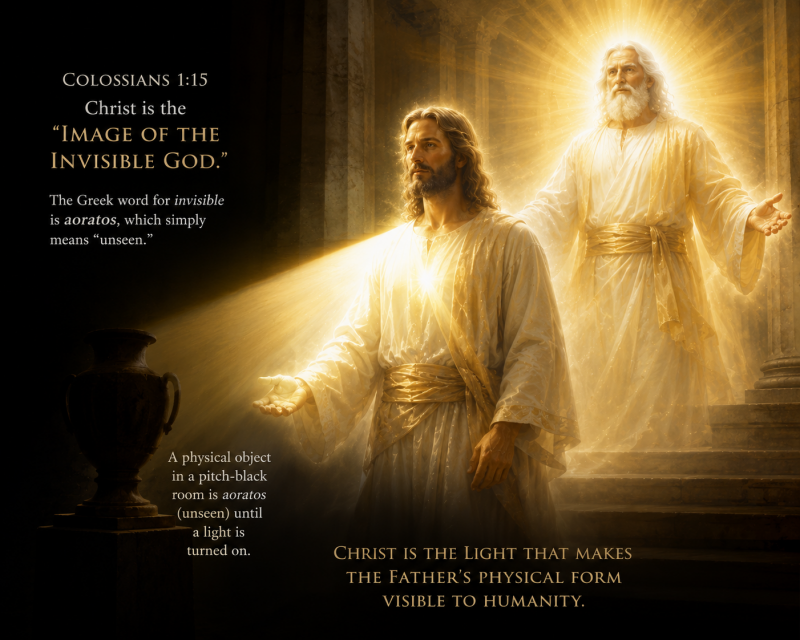
• Colossians 1:15: Christ is called the "image of the invisible God." The Greek word for invisible is aoratos, which simply means "unseen." A physical object in a pitch-black room is aoratos (unseen) until a light is turned on. Christ is the light that makes the Father's physical form visible to humanity..
• Colossians 2:9: Paul eliminates any idea that Christ shed His physical body upon entering heaven, declaring: "For in him dwelleth all the fulness of the Godhead bodily." The Greek word used here for bodily is sōmatikōs, meaning a literal, physical, corporeal frame..
• 1 Timothy 6:16: Paul explains that God dwells in "the light which no man can approach unto; whom no man hath seen, nor can see." The barrier is not that God lacks a body, but that His body radiates a light so brilliant that mortal eyes are physically incapable of enduring it without being transfigured..
• Titus 2:13: Paul instructs the Saints to look for "the glorious appearing of the great God and our Saviour Jesus Christ.".
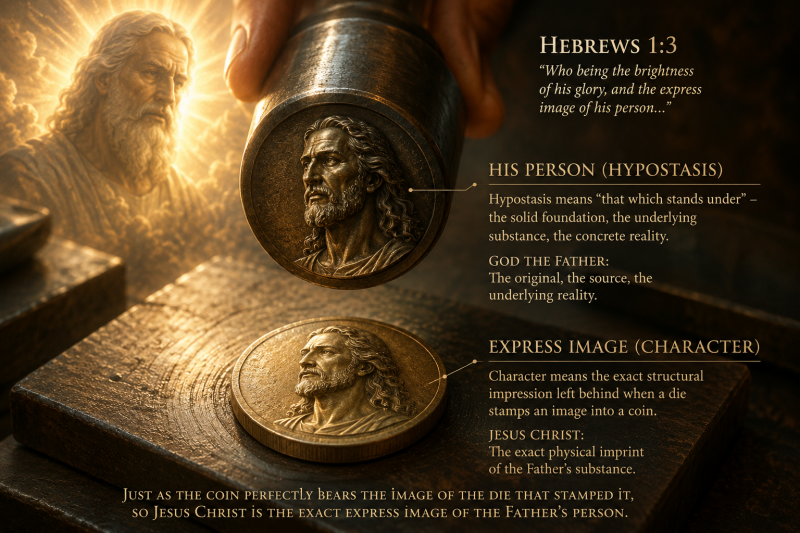
• Hebrews 1:3: The author of Hebrews declares that Jesus Christ is the "express image of his [the Father's] person." In the original Greek, "person" is Hypostasis, which literally means "that which stands under"—a solid foundation, a concrete substructure, or the underlying material reality of a thing. "Express image" is Character, which is the exact structural impression left behind when a metal die stamps an image into a blank coin. You cannot stamp a physical image onto a coin unless the original die itself has a real, physical, raised shape. Jesus Christ is the exact physical imprint (character) of the Father’s solid, underlying, objective substance (hypostasis)..
• Hebrews 1:8-9 (The Direct Conversation Proof): This single passage places both the Father and the Son together, and both are explicitly called God in the exact same passage as the Father talks directly to the Son: "But unto the Son he [the Father] saith, Thy throne, O God, is for ever and ever... therefore God, even thy God, hath anointed thee with the oil of gladness above thy fellows." This explicitly identifies the Father as a separate, distinct God who stands above the Son in authority and anoints Him..
• Hebrews 12:9: The scriptures call God the "Father of spirits." We are His spiritual offspring, yet we currently inhabit physical bodies. The fact that our spirits have a physical body does not change the fact that God the Father is a Spirit who possesses a glorified, physical body..
• James 3:9: James counsels the saints regarding their speech, reminding them that all men are made after the similitude of God..
• 1 John 5:20: John writes concerning Jesus Christ, stating: "This is the true God, and eternal life.".The Revelation of John (Revelation)
• Revelation 5:1, 7: John looks into heaven and sees a book held in the right hand of the Father on His throne, and the Lamb approaches to physically take the book out of that right hand.
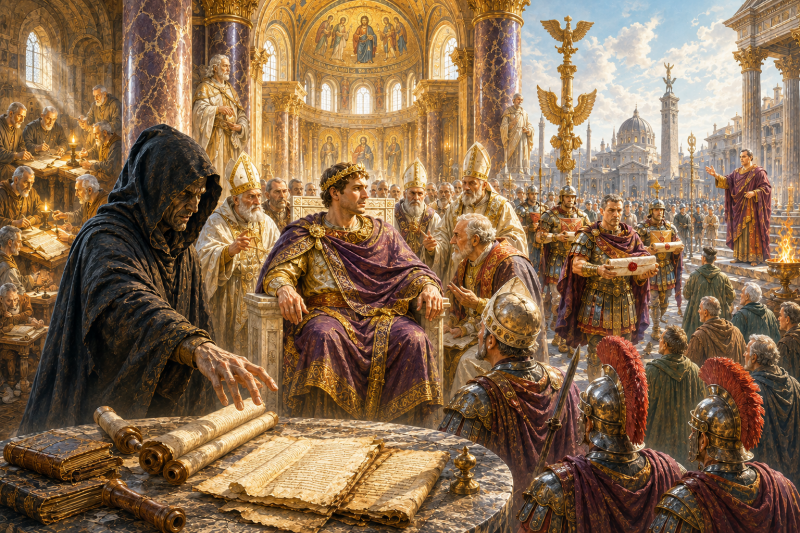
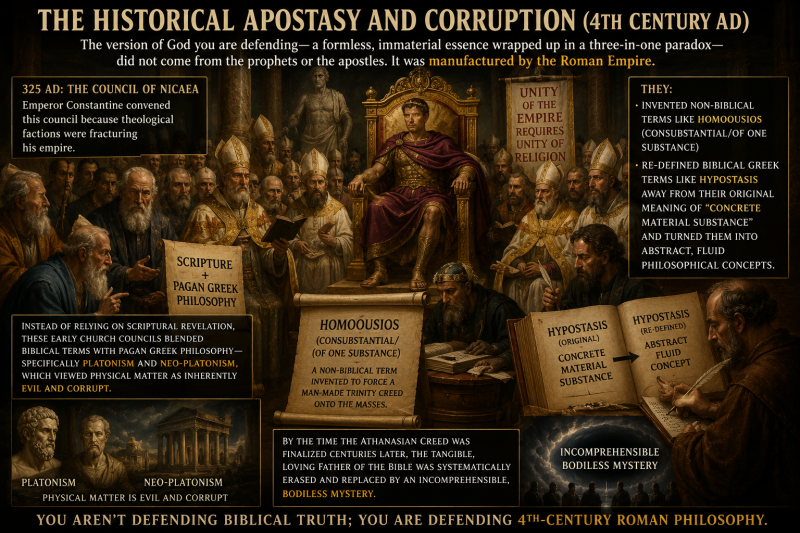
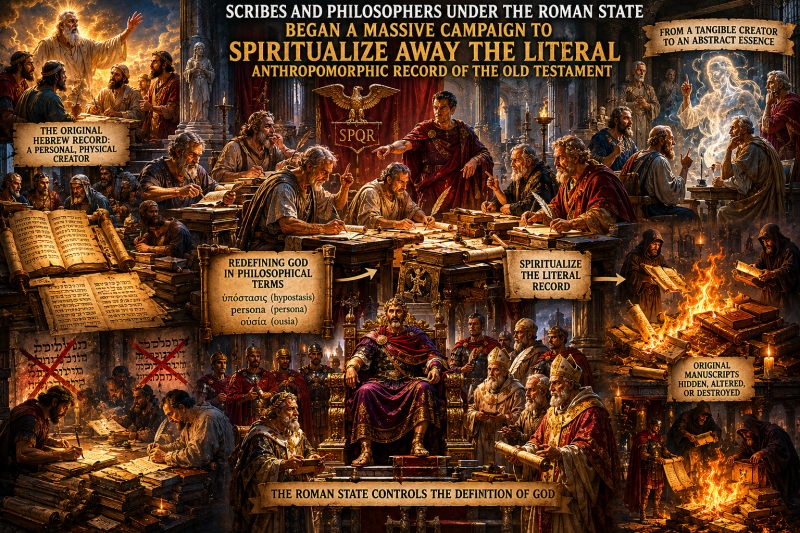
2. The Historical Apostasy and Corruption (4th Century AD)The version of God you are defending—a formless, immaterial essence wrapped up in a three-in-one paradox—did not come from the prophets or the apostles. It was manufactured by the Roman Empire..In 325 AD, the Emperor Constantine convened the Council of Nicaea because theological factions were fracturing his empire. Instead of relying on scriptural revelation, these early church councils blended biblical terms with pagan Greek philosophy—specifically Platonism and Neo-Platonism, which viewed physical matter as inherently evil and corrupt..They invented non-biblical terms like homoousios (consubstantial/of one substance) to force a man-made Trinity creed onto the masses. They re-defined biblical Greek terms like Hypostasis away from their original meaning of "concrete material substance" and turned them into abstract, fluid philosophical concepts. By the time the Athanasian Creed was finalized centuries later, the tangible, loving Father of the Bible was systematically erased and replaced by an incomprehensible, bodiless mystery. You aren't defending biblical truth; you are defending 4th-century Roman philosophy.

3. Mere Belief vs. Full KnowledgeThe ultimate difference between a mere belief and a full knowledge of truth regarding the Godhead family comes down to the source of your information..A mere belief is fragile because it is built on human speculation, text manipulation, and the shifting traditions of history. When a person relies on mere belief, they have to put their trust in those flawed Roman political councils. Mere belief is like looking at a painted picture of a father you have never met. You can study the canvas, argue with others about what the artist meant, but you do not actually know the man in the painting. You are just trusting the person who painted it. This is why mainstream creeds call God an "incomprehensible mystery." You cannot truly know an abstract, bodiless essence that changes definitions based on medieval philosophy..A full knowledge of truth is unbreakable because it is anchored in an actual, living relationship with the distinct Members of the Godhead. You do not have to guess about God’s form because the scriptural timeline provides eyewitness accounts from prophets who saw Him face to face, combined with the literal, physical reality of the resurrected Christ. Full knowledge is not looking at a painting; it is walking into the room, shaking your father’s hand, looking into his eyes, and hearing his voice. It is a spiritual certainty. You know his shape, his character, and his voice because you have spent time in his presence. When you have a personal relationship with the Godhead, the Holy Ghost acts as that literal Paraklētos—the divine Advocate standing right next to you, whispering the truth of the Father and the Son directly to your spirit.
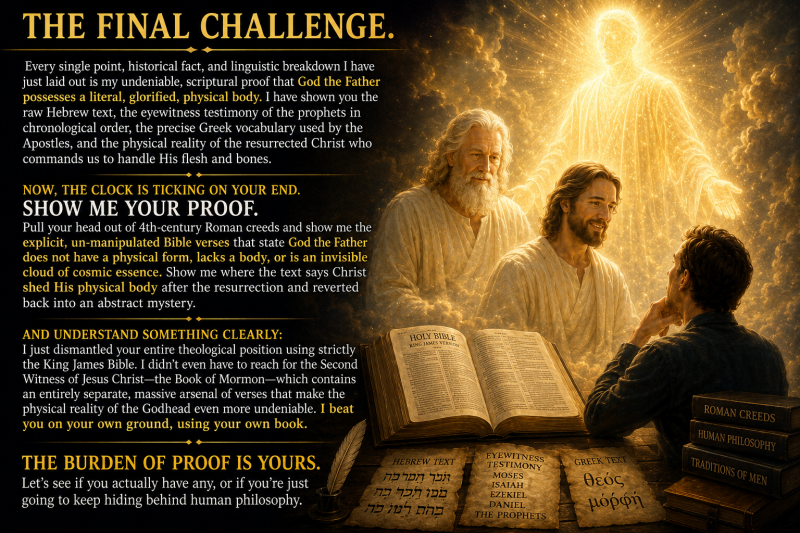
The Final Challenge.Every single point, historical fact, and linguistic breakdown I have just laid out is my undeniable, scriptural proof that God the Father possesses a literal, glorified, physical body. I have shown you the raw Hebrew text, the eyewitness testimony of the prophets in chronological order, the precise Greek vocabulary used by the Apostles, and the physical reality of the resurrected Christ who commands us to handle His flesh and bones..Now, the clock is ticking on your end. Show me your proof.Pull your head out of 4th-century Roman creeds and show me the explicit, un-manipulated Bible verses that state God the Father does not have a physical form, lacks a body, or is an invisible cloud of cosmic essence. Show me where the text says Christ shed His physical body after the resurrection and reverted back into an abstract mystery..And understand something clearly: I just dismantled your entire theological position using strictly the King James Bible. I didn't even have to reach for the Second Witness of Jesus Christ—the Book of Mormon—which contains an entirely separate, massive arsenal of verses that make the physical reality of the Godhead even more undeniable. I beat you on your own ground, using your own book. The burden of proof is yours. Let's see if you actually have any, or if you're just going to keep hiding behind human philosophy.
Add comment
Comments