The Nicene Trap: Escaping the Logic of the Fourth Century
The purpose of this document is to strip away centuries of philosophical traditions and return to the plain, literal text of the Holy Bible. For nearly seventeen hundred years, mainstream Christian theology has viewed scripture through the lens of fourth-century Greek metaphysics—substituting the raw, historic testimony of the prophets with abstract concepts like homoousios, immutability, and perichoresis.
This guide is designed to expose the logical traps built into modern systematic theology textbooks, specifically those derived from Augustine, Aquinas, Calvin, Berkhof, and Grudem. By deconstructing theological escape hatches like "divine accommodation" and "anthropomorphism," this work empowers readers to confront the scriptural truth: that the Godhead consists of separate, independent, and physically real Individuals. It serves as both a correction to intellectual pride and a reclamation of the true, living Creator revealed to the prophets.
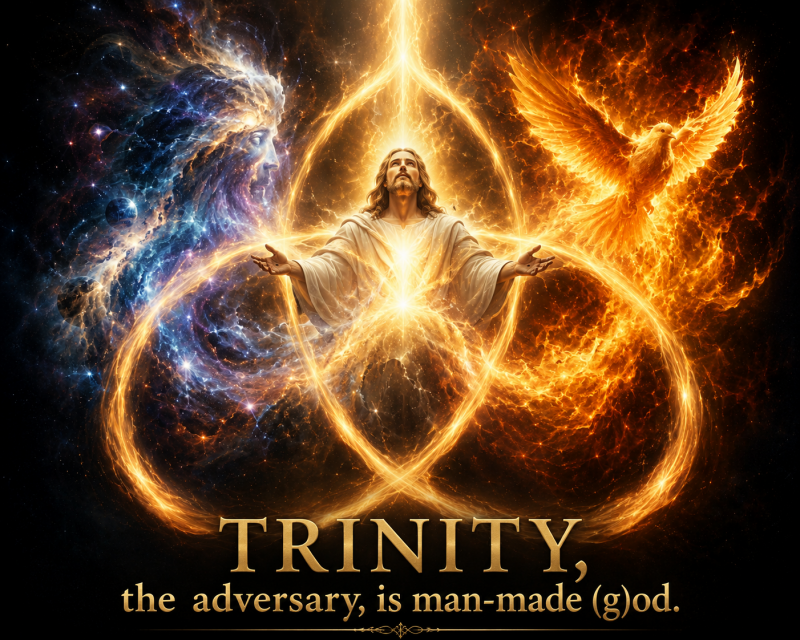
Presentation / Debate: Opening Remarks
"Thank you for being here today. We are gathered to confront a critical crossroad in Christian theology: the choice between the raw, physical reality witnessed by the prophets or the complex, abstract riddles born of fourth-century Greek philosophy. Mainstream orthodoxy asks you to look through a lens that completely vaporizes the distinct, individual reality of the Father and the Son, replacing them with a formless, invisible cloud of divine energy. Today, we will look directly under the hood of these systematic manuals. We will prove using the plain Hebrew and Greek text of your own Bibles that the creeds have traded the living, breathing, sitting, and seeing Creator for an unfeeling, non-physical phantom. I challenge you today to set aside imperial Roman compromises and face the literal testimony of the men who saw and spoke with the living God."
Introduction
- The Dilemma: Mainstream Christian orthodoxy relies heavily on ancient, formal creeds.
- The Conflict: These philosophical frameworks openly clash with the literal text of scripture.
- The Premise: Human logic and Greek metaphysics have systematically erased the physical reality of the Godhead.
The Nicene Trap: Escaping the Logic of the Fourth Century
Mainstream trinitarianism hides behind the Nicene Creed. A fourth-century political compromise. They claim it protects scripture. It destroys it. They argue the Father, the Son, and the Holy Ghost are "one God in three persons." One divine substance. Homoousios. That is the philosophy mainstream theology worships. They say the Father is not the Son. The Son is not the Spirit. The Spirit is not the Father. Yet they claim all three are the exact same numerical being. A logical knot. A man-made (g)od.
Look closely at their machinery. They claim the Father is the unbegotten fountain. They claim the Son is "eternally begotten." Not made. Generated from eternity past. They claim the Holy Ghost "proceeds" from the Father and the Son. This is not scripture. This is Greek metaphysics. It turns the Godhead into an abstract cloud of divine essence. It strips away the individual reality of the Three. It leaves a faceless, formless mystery. A monster of human logic.
The Philosophical Roots of the Creed
Mainstream theologians built this machine by forcing the words of the Bible into the mold of Greek philosophy. They took simple scriptural descriptions of family relationships—Father and Son—and twisted them into complex metaphysical puzzles to fit the theories of Plato and Aristotle.
They started with the word begotten in John 3:16. In the plain language of the text, to be begotten means to be physically generated, having a literal beginning. But Greek philosophy taught that a supreme being must be totally unchangeable, outside of time, and without any physical origin. To solve this contradiction, fourth-century writers like Origen and Athanasius invented the concept of "eternal generation." They argued that God the Son Jesus Christ is generated by God the Father, but that this generation happens outside of time, from all eternity, with no beginning and no end.
They applied the same philosophical twisting to God the Comforter, the Holy Ghost. They took John 15:26, where Christ says the Spirit of truth "proceedeth from the Father," and turned it into an eternal, metaphysical relationship. This led to the creation of the Nicene Creed, which declared that the Father is the unoriginated source, the Son is eternally begotten, and the Spirit eternally proceeds.
This entire framework was invented to protect the philosophical idea of a single divine essence, known in Greek as homoousios. Mainstream theologians were terrified of the plain scriptural truth that the Godhead consists of separate, distinct, physical individuals. They believed that if the Father and the Son were truly separate beings, it would mean there are multiple Gods.
To avoid this, they claimed that the terms "Father," "Son," and "Holy Spirit" do not describe separate individuals, but rather internal relationships within one single cosmic substance. They argue that the Father is the fountainhead, the Son is the eternal expression of that fountainhead, and the Holy Ghost is the eternal bond of love flowing between them.
The mechanical engineering of mainstream theology traces its ancestry back to a desperate, ancient defense mechanism called modalism and its closely related replacement, relational ontology. These are the actual machinery designs hidden inside systematic theology textbooks.
When fourth-century philosophers introduced the unscriptural word homoousios, they created a massive logical trap. If the Father, the Son, and the Holy Ghost are the exact same numerical piece of divine substance, then they cannot be distinct individuals. To escape this, the Cappadocian Fathers—Basil of Caesarea, Gregory of Nyssa, and Gregory of Nazianzus—invented the concept of hypostasis defined purely by "relations of origin." They taught that the only things distinguishing the three are how they relate to one another. The Father is the father only because He begets; the Son is the son only because He is begotten. They stripped the Godhead of true personhood. They reduced three glorious, independent, physical Individuals into mere mathematical relative points inside one single, locked divine container.
The Influence of Systematic Theology Textbooks
Standard systematic theology textbooks are full of poison. Students study Wayne Grudem and read Louis Berkhof. These books do not start with the prophets. They start with Aristotle. They use the word immutability. They use impassibility. Look at what those words actually mean. They mean a (g)od who cannot feel. A (g)od who cannot change. A (g)od who has no physical location.
Wayne Grudem and Louis Berkhof did not invent these ideas from their own imaginations. They inherited them from a centuries-old pipeline of human tradition that directly plagiarized Greek pagan philosophy. They found their "facts" not in the plain text of the Hebrew prophets, but in the writings of medieval Catholic theologians who had synthesized Christian doctrine with the secular metaphysics of Aristotle and Plato.
The primary source for Louis Berkhof was John Calvin and the 17th-century post-Reformation scholastic theologians, such as Francis Turretin. Wayne Grudem draws heavily from these same Reformed traditions and earlier Latin fathers like Augustine of Hippo and Thomas Aquinas. In the 13th century, Thomas Aquinas explicitly set out to reconcile Christian theology with the newly rediscovered works of Aristotle. Aristotle had argued that the supreme ultimate reality must be the "Unmoved Mover"—a being of pure intellect that is completely unchangeable, unaffected by anything outside itself, and entirely without physical form or location.
Aquinas took Aristotle's pagan definition of perfection and stamped it onto Christian theology. He argued that if a (g)od could change, or if he could feel new emotions, it would mean he was imperfect. Augustine had previously done the exact same thing using the philosophy of Plato, arguing that the supreme being must be completely timeless and immaterial. Grudem and Berkhof simply copied these medieval textbooks, packaged them into modern English systematic theology manuals, and passed them off to modern students as biblical truth.
This is why Wayne Grudem and Louis Berkhof teach students to look at the Bible through a lens that completely vaporizes the distinct physical reality of the Father and the Son. Their books rely heavily on the writings of Augustine of Hippo, specifically his work De Trinitate. Augustine could not handle the plain text of the scriptures, so he compared the Trinity to a single human mind. He argued that the Father is Memory, the Son is Understanding, and the Holy Ghost is Will.
Think about the psychological damage of this teaching. It claims that when God the Father speaks from heaven at the baptism of Jesus Christ, it is not a literal Father speaking to His literal Son. Instead, it is just one part of a cosmic mind communicating with another part of itself. It turns the entire New Testament into a theatrical illusion. It means the prayers of Jesus Christ in the Garden of Gethsemane were not a real, physical Son pleading with a real, physical Father. It reduces those agonizing prayers to an internal, psychological monologue within a single, formless essence.
They invented this complex, multi-layered deception because they were utterly terrified of the Hebrew reality of the Godhead. The prophets never taught that the Father, the Son, and the Holy Ghost were trapped inside a single substance. The scriptures reveal an absolute unity of purpose, covenant, and testimony, executed by separate, independent, perfect Individuals. By replacing the literal family of the Godhead with an intellectualized web of internal relations, these systematic textbooks force readers to bow before an unfeeling, non-physical phantom. They trade the living, breathing, sitting, and seeing Creator for a complex riddle of human logic designed to protect an imperial Roman creed.
Deconstructing the Creedal Deceptions
Look at the index of mainstream theological libraries. You will find the Westminster Confession. You will find the Belgic Confession. What is the very first thing they declare about their (g)od? They say He is "without body, parts, or passions."
The books taught in these seminaries claim that God cannot change or have passions. They call this immutability and impassibility. The Bible reveals a Father with profound, real expressions of emotion. Genesis 6:6 states that it repented the Lord that he had made man on the earth, and it grieved him at his heart. Zephaniah 3:17 declares that God the Father will joy over His people with singing. These are not the cold, unfeeling traits of a formless Aristotelian primary mover. They are the traits of a living, physical, divine Father.
These textbooks talk about circumincession. They talk about perichoresis. Mutual indwelling. They claim the Father, the Son, and the Holy Ghost leak into each other to form one single being. This erasure gets even more desperate when they try to explain how three separate Persons can be only one single entity.
The word perichoresis literally means "interpenetration" or "co-inherence." It was popularized by eighth-century writer John of Damascus. It teaches that the Father, the Son, and the Holy Ghost endlessly flow, penetrate, and leak into one another so completely that they occupy the exact same spiritual space. Seminary professors teach this as a beautiful, mystical "divine dance." In reality, it is a desperate philosophical patch designed to glue three distinct Persons into one formless cosmic soup. It forces them to argue that where the Father is, the Son and the Spirit are also numerically present, destroying any real individuality within the Godhead.
This human logic completely destroys the physical reality revealed by the prophets. It reduces the three distinct Persons of the Godhead into mere functions or relations inside a formless, invisible cloud of divine energy. It leaves mainstream peers worshipping a faceless abstraction born of intellectual pride rather than the living, physical Creator.
Confronting the Scriptural and Eyewitness Evidence
Now open the Bible. Genesis 1:26. God the Father says, "Let us make man in our image, after our likeness." Mainstream books say that image is just "moral capability" or "spiritual capacity." The plain Hebrew text says tselem. It means a physical, concrete duplicate. A shadow cast by a real object. Modern textbooks actively lie about the Hebrew language to protect their Greek philosophy.
Look at how professors handle the secondary Hebrew word used in Genesis 1:26, which is demut. While tselem means a physical, carved image, demut translates directly to a concrete structural likeness or physical resemblance. It is the exact same word used in Genesis 5:3 when Adam begat a son "in his own likeness, after his image" and called his name Seth. No professor alive would argue that Seth was just a "moral metaphor" of Adam without a physical body. Yet systematic textbooks force a double standard onto the exact same vocabulary in Genesis 1 to protect the pagan Greek concept of aseity—the idea that a supreme being cannot share any physical attributes with creation. They twist the language to hide the physical reality of the Creator.
The Bible repeatedly details the physical features of God the Father. Exodus 24:9-11 declares that Moses, Aaron, Nadab, Abihu, and seventy elders saw the God of Israel, and there was under His feet a paved work of sapphire stone. They saw Him, and they did eat and drink. Exodus 33:22-23 states that God the Father covered Moses with His hand and allowed Moses to see His back parts, though His face was not to be seen. Academic books flatly contradict this and call the words of Moses "anthropomorphisms." That is a ten-dollar word for a lie. It means they think Moses was just making things up so human beings could understand an invisible vapor, telling students that the prophets were hallucinating or using poetic exaggerations. They choose Greek metaphysics over eyewitness prophetic testimony.
In Matthew 3:16-17, during the baptism of Jesus Christ, all three Persons are physically separate at the exact same moment. God the Son Jesus Christ is standing physically in the Jordan River. God the Comforter, the Holy Ghost, descends visibly like a dove. God the Father speaks with an audible voice out of the physical heavens. One is in the water, one is in the air, and one is speaking from above. They are not one single cosmic puddle of essence. They are three distinct individuals with three separate positions in space.
Mainstream defenders argue that the Trinity is "one God in three persons." Yet Jesus Christ completely refutes this in John 8:17-18. Christ invokes the Mosaic law of witnesses, stating that the testimony of two men is true, and then declares, "I am one that bear witness of myself, and the Father that sent me beareth witness of me." Christ uses the legal requirement for two distinct individuals to prove His point. If the Father and the Son are the same numerical being or substance, Christ’s legal argument fails completely. He would be a single witness testifying twice.
Acts chapter 7 destroys this entire philosophical framework with a single eyewitness report. When Stephen is being stoned to death, the heavens open to his sight. He does not see a blurry, interpenetrating cloud of perichoresis. He does not see three entities dissolved into a single mathematical point or one cosmic soup. He sees Jesus Christ standing on the right hand of God the Father.
This description requires two distinct physical positions. If the Son is standing on the right hand of the Father, they cannot be leaking into each other as one single substance. They occupy separate, defined spaces in the heavens. Defenders boast about Hebrew and drop the Tetragrammaton, writing that Jesus is incarnate, but they ignore the text. Two thrones. Two bodies. Two distinct realities.
Mainstream theology calls this "anthropomorphic language" or a "symbolic vision" rather than actual reality. They twist the plain text to save their Greek philosophy, serving a man-made (g)od born in Nicea, hammered out by imperial decree, and signed by politicians. They are forced to argue that the Holy Ghost gave a dying martyr a false visual impression, adapting it to his human mind. They literally call the eyewitness testimony of a dying martyr a visual metaphor. They choose the ink of their professors over the blood of the saints, launching a direct assault on the text of the Holy Bible.
The Theological Escape Hatches Exposed
Because Wayne Grudem and Louis Berkhof committed themselves to defending this inherited Greek framework, they ran into a massive problem when reading the Old Testament. The prophets explicitly describe God the Father as a personal being with physical features, a specific location in heaven, and deep emotional responses. To save their pagan-derived system, these textbook writers had to invent a theological escape hatch. They pulled the word anthropomorphism out of Greek grammar books—combining anthropos (human) and morphe (form).
They teach that when Moses wrote in Genesis 6:6 that the Lord grieved in His heart, or when Exodus says the Lord spoke face-to-face, the Bible was simply using a literary device. They claim the Holy Ghost inspired the prophets to use false physical and emotional descriptions because the human mind is too small to understand a formless, unfeeling cosmic vapor. They literally argue that the words of the prophets are holy misrepresentations. They choose the philosophical calculations of Aristotle, Augustine, and Aquinas over the direct, literal testimony of the men who saw and spoke with the living Creator.
The major problem that completely shatters this theology is that their "anthropomorphism" escape hatch destroys the absolute truthfulness of the Holy Bible. If textbooks are correct, it means the Holy Ghost deliberately inspired the prophets to write down physical and emotional descriptions of God the Father that are factually false.
This creates a massive crisis of authority. If the plain text of Exodus 33:11 states that "the Lord spake unto Moses face to face, as a man speaketh unto his friend," then no text in scripture can be trusted literally if it is labeled a lie. These textbooks force students to believe that the word of God uses deception to teach truth. They claim that because a formless (g)od cannot actually have a face, hands, or feet, the Bible must use false physical imagery to accommodate human weakness. This turns the prophets into writers of fiction and myth. It makes the text completely dependent on seminary professors to decode what it "actually" means.
The machinery behind this education operates on a specific, dangerous principle: the doctrine of divine accommodation. This is the exact technical term John Calvin and modern systematic theologians use to dismiss Stephen’s literal testimony in Acts 7.
In their textbooks, they teach that a formless, infinite (g)od must "lisp" or speak in baby talk to human beings. They argue that because heaven is a non-physical dimension outside of time and space, it is impossible for anyone to literally stand to the right hand of another. Therefore, Wayne Grudem and Louis Berkhof explicitly write that the Holy Ghost projected a fake, simplified corporate slide show into Stephen's mind. They claim the vision was merely a psychological metaphor to comfort a dying man by showing him that Christ had authority. They strip Stephen of his actual eyesight. They turn the open heavens into an internal hallucination to save their creedal definitions.
This systematic gaslighting is mandatory for them because the alternative destroys their entire theological empire. If Stephen literally saw two distinct, physical Personages occupying two separate positions in space, then the Westminster Confession of Faith is completely fraudulent.
To maintain this lie, they must completely neutralize the historical events of the Exodus. When Exodus 24 states that seventy-four men ascended Mount Sinai and literally saw the feet of God the Father on a paved work of sapphire stone, Berkhof's theology calls this a "theophany." That is their second escape hatch. They claim it was a temporary, manifested angel or a visual illusion because John 4:24 says "God is a Spirit."
The Physicality of the Incarnated and Resurrected Lord
This creates an even deeper problem when you look at the incarnation of God the Son Jesus Christ. If every physical description of God the Father in the Old Testament is just a fake literary device, then the physical body of Jesus Christ loses its entire theological foundation.
Mainstream apologists claim historic Christianity does not strip the Savior of His physical reality. A desperate defense. They scream about the incarnation, the bodily resurrection, and the bodily ascension. But look under the hood of mainstream theology. What does it actually teach? It teaches the Council of Chalcedon from AD 451. Two natures in one person. They claim the divine nature of Jesus Christ has no body. It is incorporeal, universal, and formless. They believe only the human nature has a body.
This means the mainstream (g)od is a spirit that fills the universe without a center. A being without parts and without passions. They claim the Son took on flesh, but the divine nature itself remained completely non-physical. That is a phantom. It is a mathematical equation. It is not the resurrected Lord who told His apostles to handle Him and see. Their creedal system forces them to dualize Christ. It deletes the physical image of the Father entirely. It reduces the true, individual glory of the Godhead into an invisible essence.
Luke 24:39 destroys this seminary philosophy completely. The resurrected Jesus Christ stands before His terrified disciples and demands, "Behold my hands and my feet, that it is I myself: handle me, and see; for a spirit hath not flesh and bones, as ye see me have." Christ explicitly denies being a formless spirit. He possesses a permanent, glorified body of flesh and bones. He ascended into heaven with that physical body. Acts 1:11 guarantees He will return in the exact same manner.
Furthermore, Hebrews 1:3 flatly states that Jesus Christ is the brightness of the Father's glory and the "express image of his person." The Greek word is charakter, which means a precise engraving or an identical physical copy of a mold. If the Father is a formless, non-physical cosmic vapor without parts, then Jesus Christ cannot be the physical copy of His person. A physical, tangible body of flesh and bones cannot be the exact physical copy of an invisible, formless nothing. By labeling the Father's physical form as a metaphor, textbooks logically destroy the very meaning of Christ being the image of the invisible Creator. They strip the Son of His true inheritance, reduce the Godhead to a philosophical abstraction, and force mainstream creeds to worship a phantom.
The absolute reality that the world must confront is that the only Christians that are true Christians are the Godhead followers; Stop trying to erase the physical image of your Creator and face the plain text of the Bible.
Presentation / Debate: Closing Remarks
"As we close, the absolute reality we must confront is that we cannot serve two masters. You cannot claim to follow the text of the Holy Bible while simultaneously clinging to a philosophical system that calls the eyewitness testimony of a dying martyr a visual metaphor and labels the words of Moses as holy misrepresentations. When Stephen looked into heaven, he did not see a blurry, interpenetrating cloud of essence; he saw two separate individuals. When the resurrected Christ stood before His disciples, He explicitly denied being a formless spirit, showing His physical flesh and bones. Stop trying to erase the physical image of your Creator to protect an imperial tradition of men. Toss out the philosophical calculations of Aristotle and Aquinas, return to the plain text of the scriptures, and stand with the prophets."
.
Summary
- The Core Argument: The Father, Son, and Holy Ghost are separate, physical, independent Individuals.
- The Philosophy Error: Words like homoousios and perichoresis reduce God to a formless cosmic soup.
- The Textbook Trap: Modern theologians use "anthropomorphism" to explain away literal prophetic encounters.
- The Ultimate Proof: Stephen’s vision and the resurrected body of Jesus demand a physically defined Godhead.
Appendix 1: Historical Timeline of Creedal Formulations
To trace exactly how and when Greek philosophical terms were voted into early Christian doctrine, review this chronology of systemic shifts:
- AD 200–230 (The Rise of Abstract Speculation): Origen of Alexandria introduces Neo-Platonic constructs into early Christian writing. He coins the precursor ideas to "eternal generation," arguing that God must be completely immutable and outside of time, laying the groundwork to re-interpret biblical family relationships as abstract puzzles.
- AD 325 (The Council of Nicaea): Convened by Emperor Constantine to resolve the Arian controversy. Under political pressure, church leaders adopt the unscriptural Greek philosophical term Homoousios ("of one substance"). This represents the formal turning point where abstract metaphysics are legally codified as mandatory orthodoxy.
- AD 360–380 (The Cappadocian Formulation): Basil of Caesarea, Gregory of Nyssa, and Gregory of Nazianzus formalize the phrase "one God in three persons" (mian ousian, treis hypostaseis). They explicitly redefine hypostasis to mean purely a "relation of origin" rather than a separate individual, freezing the three Persons into a singular numerical container.
- AD 381 (The Council of Constantinople): The Nicene Creed is expanded to declare that the Holy Ghost eternally "proceeds" from the Father. This updates the creedal machinery, officializing a multi-layered metaphysical network within a formless divine cloud.
- AD 415–420 (Augustine’s Psychological Shift): Augustine of Hippo writes De Trinitate, comparing the Godhead to a single human mind consisting of Memory, Understanding, and Will. This effectively vaporizes the physical reality of the Father and Son, turning the literal New Testament interactions into an internal, cosmic psychological monologue.
- AD 451 (The Council of Chalcedon): The council issues the Chalcedonian Definition: Christ possesses "two natures in one person." It codifies that His divine nature remains entirely formless, incorporeal, and universal, while only His human nature has physical limits. This forces a strict theological dualism that deletes the physical identity of the Divine.
- AD 730–750 (The Formalization of Perichoresis): John of Damascus popularizes the term Perichoresis ("co-inherence" or "interpenetration"). This philosophical patch teaches that the three Persons endlessly leak into one another, providing a mechanism to deny their independent spatial realities.
- AD 1260–1274 (The Thomistic Synthesis): Thomas Aquinas synthesizes Christian dogma with the secular metaphysics of Aristotle. He stamps Aristotle's "Unmoved Mover"—a being completely devoid of parts, passions, or physical location—onto Christian theology, finalizing the medieval manuals copied by modern reformers.
.
Appendix 2: Key Linguistic Analysis
Hebrew Vocabulary
Greek Vocabulary
- Homoousios (ὁμοούσιος)
- Creedal Framework: "Of one substance"—meaning the Father, Son, and Holy Ghost share the exact same numeric, singular divine essence.
-
- Literal Definition: Same being or identical substance. A metaphysical concept imported from Greek philosophy to protect absolute mathematical monotheism at the Council of Nicaea.
- Charakter (χαρακτήρ)
-
- Systematic Theology Claim: A metaphorical reflection of divine attributes or character.
-
- Literal/Visual Definition: A precise engraving, an instrument for marking, or the exact physical copy left by a die or a mold. It demands a tangible, structural form from which the copy was cast.
- Perichoresis (περιχώρησις)
-
- Systematic Theology Claim: A beautiful, mystical "divine dance" describing the mutual indwelling of the Trinity.
.
-
- Literal/Visual Definition: "Interpenetration" or "co-inherence." The concept that the three persons endlessly flow or leak into one another so completely that they occupy the exact same spiritual and physical space simultaneously.
Appendix 3: Scriptural Cross-Reference Study Outline
This outline follows the logical path of the document. Keep your Bible open to these key passages to verify the textual claims against mainstream creedal interpretations:
- The Physical Image of God the Father
- Genesis 1:26–27: God forms man in His own tselem (carved image) and demut (structural likeness). Compare with Genesis 5:3 to establish that demut requires a physical body.
- Exodus 24:9–11: Seventy-four distinct eyewitnesses ascend Mount Sinai, physically see the feet of God on a paved work of sapphire stone, and safely eat and drink in His presence.
.
- Exodus 33:11 / 33:22–23: Moses speaks with the Lord "face to face, as a man speaketh unto his friend." Moses is later protected by God’s hand to literally view His "back parts" while His face remains hidden.
.
- The Spatial Separateness of the Godhead
.
- Matthew 3:16–17: The baptism of Jesus Christ demonstrates three distinct Persons occupying three entirely different spaces at the exact same moment. The Son stands in the water, the Spirit descends through the air, and the Father speaks audibly from the heavens.
.
- John 8:17–18: Jesus Christ explicitly uses the Mosaic legal requirement for two independent witnesses to validate His testimony. If the Father and the Son are the same numerical being, Christ’s legal argument fails.
.
- Acts 7:55–56: The dying martyr Stephen sees the heavens open. He witnesses two separate individual Personages occupying distinct spatial locations: Jesus Christ standing on the right hand of God the Father.
.
- The Physicality of the Divine Nature
.
- Luke 24:39: The resurrected Lord explicitly denies being an incorporeal, formless spirit, declaring to His disciples: "Handle me, and see; for a spirit hath not flesh and bones, as ye see me have."
.
- Hebrews 1:3: Declares the Son to be the charakter (the exact physical engraving/imprint) of the Father's person (hypostasis). Because the Son possesses a glorified body of flesh and bones, the Father must possess a tangible form for the Son to be an exact imprint of Him.
.
Appendix 4: Counterarguments Guide: Anticipating and Answering Systematic Theologians
.
When presenting these points, mainstream theologians will typically deploy standard academic objections. Below is a breakdown of their arguments and how this text directly refutes them.
.
Counterargument 1: "John 4:24 explicitly states that 'God is a Spirit,' which proves He cannot have a physical body."
.
- The Theological Claim: Because the text says God is a spirit, any description of Him having a body must be a metaphor.
.
- The Scriptural Refutation: Look closely at the raw Greek text: Pneuma ho Theos. It lacks the indefinite article "a." It translates literally to "Spirit is God," which describes His divine nature, character, and essence, not His physical anatomy.
.
- The Textual Parallel: 1 John 4:8 states that "God is love." No theologian argues that God is a formless, literal emotion floating in space. To isolate John 4:24 to strip God of His form while ignoring Christ's physical body is a double standard. Furthermore, Luke 24:39 explicitly states that a spirit does not have flesh and bones, yet the resurrected Christ does.
.
Counterargument 2: "The Old Testament descriptions of God's face, hands, and feet are just 'anthropomorphisms'—poetic language used to help finite human minds understand an infinite God."
.
- The Theological Claim: God doesn't actually have a face or feet; the prophets were using human terms to describe an invisible, unfeeling vapor.
.
- The Scriptural Refutation: This escape hatch destroys the absolute truthfulness of the Bible. If Exodus 33:11 says God spoke to Moses "face to face, as a man speaketh unto his friend," but God has no face, then the text is factually false.
.
- The Textual Parallel: In Genesis 1:26, God uses the word tselem (carved, three-dimensional image) and demut (structural likeness). Genesis 5:3 uses the exact same word, demut, to describe how Adam begat Seth. If Seth is a literal, physical copy of Adam, then man is a literal, physical copy of God. Changing concrete nouns into abstract moral concepts is a deliberate distortion of the Hebrew language.
.
Counterargument 3: "Stephen's vision in Acts 7 was just a 'symbolic vision' or 'divine accommodation.' Heaven isn't physical, so Christ wasn't literally standing next to the Father."
.
- The Theological Claim: God "lisps" in baby talk to us. The Holy Ghost just projected a psychological metaphor into Stephen's mind to comfort him.
.
- The Scriptural Refutation: This is systematic gaslighting that chooses the ink of professors over the blood of martyrs. Stephen was an eyewitness under the inspiration of the Holy Ghost.
.
- The Spatial Argument: Stephen explicitly details two separate positions in space: Jesus Christ standing on the right hand of God. If the Father and the Son are dissolved into one single cosmic puddle of essence (perichoresis), they cannot occupy separate, defined spatial positions. Turning an eyewitness report into an internal hallucination completely undermines scriptural authority.
.
Counterargument 4: "The Council of Chalcedon establishes that Christ has two natures. His human nature has a body, but His divine nature remains incorporeal and formless."
.
- The Theological Claim: Christ's physical body belongs only to His human side; His true divine essence is completely non-physical.
.
- The Scriptural Refutation: This framework forces a dangerous dualism onto Christ and turns Him into a phantom. Hebrews 1:3 flatly states that Jesus Christ is the charakter—the precise engraving or perfect physical copy—of the Father’s person (hypostasis).
.
- The Logical Finality: A physical, tangible body of flesh and bones cannot be the exact physical copy of an invisible, formless nothing. Because the resurrected Son possesses a permanent, glorified body of flesh and bones (Luke 24:39), the Father must possess a physical form for the Son to be His exact physical imprint.
Add comment
Comments