Chapter 1
What We Learn from Moses 1
The opening chapter of the Book of Moses is a divine introduction that sets the stage for the entire Restoration narrative. In a theophanic vision, God speaks directly to Moses, revealing the premortal existence of humanity, the creation of the world, and the purpose of our mortal probation. We learn that before arriving on earth, all souls dwelt with God, where they were taught the principles of agency, love, and eternal progression. When God created the earth, He placed Adam and Eve there not as victims of a tragedy but as willing participants in a Plan of Happiness that would enable them to exercise agency, experience growth, and ultimately return to Him.

Moses 1 also clarifies the character of God’s commandments. The “law” given to Adam and Eve was not a burden but a gift of guidance, designed to help them become more like their Creator. Their transgression—choosing to eat the forbidden fruit—was a purposeful “step forward” in the plan, allowing them and their posterity to learn the consequences of choices, to develop compassion, and to qualify for the Atonement of Jesus Christ, which would later make redemption possible.
Finally, the chapter establishes the centrality of prophecy and revelation in the Restoration. The very fact that God chose to speak to Moses—more than two thousand years after the original dispensation—underscores that divine communication is ongoing. It teaches Christians that the scriptures are not static records but living witnesses of God’s eternal purposes, inviting us to study, pray, and receive personal insight.
In sum, Moses 1 teaches that we are children of a loving Heavenly Father who prepared a plan that respects our agency, provides a path back to Him through Christ’s Atonement, and continues to unfold through modern revelation. Understanding these foundational truths equips us to view the rest of the Book of Moses—and all of scripture—with greater clarity and reverence.


Imagine a long, long time ago, a special person named Moses was in a quiet place, talking to God. Suddenly, God showed Moses an amazing vision! It was like looking up at the night sky but seeing so many stars and planets, more than anyone could ever count. God told Moses, "I made all of these! And each one is special to me." This vision helped Moses understand how incredibly powerful God is and how vast His creations are, reminding him that God knows and loves every single thing He’s made, including us.
The Book of Moses holds profound theological meaning for Christians, serving as a foundational text that dramatically expands upon the Genesis account and restores "plain and precious truths" lost from the traditional biblical record. Preserved within the Pearl of Great Price, this work originated from Joseph Smith’s inspired clarification of the Bible and elucidates doctrines crucial to the understanding of the Plan of Salvation. Its significance begins with a detailed, expansive vision granted to Moses, clarifying the nature of God the Father, confirming the premortal divinity of Jesus Christ (Jehovah), and emphasizing that God’s work is to bring to pass the "immortality and eternal life of man." Crucially, the Book of Moses reframes the Fall of Adam and Eve, portraying it not merely as a catastrophe but as a necessary and glorious step—a deliberate choice that enabled procreation, mortal experience, and the eventual need for a Savior. Moreover, it restores the majestic narrative of the prophet Enoch, detailing his powerful ministry, his expansive vision of the cosmos, and the eventual removal of his righteous people (the City of Zion) due to their unparalleled holiness. Thus, the meaning of the Book of Moses is rooted in restoration: it provides a broader cosmic view of creation, the purpose of mortality, the centrality of the Atonement, and the eternal pattern of building Zion through covenants and righteousness.
1. The words of God, which he spake unto Moses at a time when Moses was caught up into an exceedingly high mountain,
Moses 1:1 provides a striking prelude to the lawgiver's insights. The opening verse states, "The words of God, which he spake unto Moses at the time when Moses was caught up in an exceedingly high mountain." Significantly, Moses beheld God "face to face." These intimate surroundings reflect the prophet's elevated rank and protection. The vision was only viable because "the glory of God was upon Moses; therefore Moses could endure his presence," laying the foundation for the deep truths about creation and salvation that follow.
2. And he saw God face-to-face, and he talked with him, and the glory of God was upon Moses; therefore, Moses could endure his presence.
Moses 1:2 gives Moses a striking glimpse of God's majesty. Says, "And he saw God face to face, and he talked with him, and the glory of God was upon Moses; therefore Moses could endure his presence." This conversation illustrates how grace can allow mankind to enter God's presence. The magnificence of God supports Moses in this vision, unlike later ones (Exodus 33:20–23). Scripture emphasizes connection to heaven and God's transformative power. It also previews Moses' mission, emphasizing that God's power, not human talent, supplies spiritual strength. This brief yet profound verse sets the foundation for Moses' prophethood and insights.
3. And God spake unto Moses, saying, "Behold, I am the Lord God Almighty, and Endless is my name, for I am without beginning of days or end of years; and is not this endless?"
Moses 1:3 announces divine identity, laying the stage for Moses' panoramic vision. God says "Lord God Almighty" before affirming "Endless is my name." His eternality explains his name: "for I am without beginning, and I am without end."
This verse describes the being speaking to Moses as eternal and self-existent. "Endless" validates God's actions, might, and glory, underpinning truths about creation and man's eternal potential.
4. And, behold, thou art my son; wherefore look, and I will show thee the workmanship of mine hands, but not all, for my works are without end, and also my words, for they never cease.
Moses Chapter 1, Verse 4, reveals God's identity and ontology and Moses's tremendous understanding. After awe, the Lord says, “And behold, I am the Lord God Almighty, and Man is my name, and I am mighty and without end.” Two reasons make this verse important. First, proclaiming oneself “The Lord God Almighty” shows Moses' strength. More stunning, “Man is my name.” These profound anthropomorphic names portray God as a glorified, perfected person, decreasing the gap between Him and His mortal children and underlining that mankind is fashioned in His likeness. God's final statement, “and I am mighty and without end,” promises Moses instruction and strength for his prophetic mission.
5. Wherefore, no man can behold all my works, except he behold all my glory; and no man can behold all my glory and afterwards remain in the flesh on the earth.
Moses Chapter 1, verse 5, of the Pearl of Great Price shaped Moses' faith. Moses is transfigured after seeing God's immense creations and purposes. Adds, "And it ultimately came to pass that I saw God face to face, and he spoke unto me, and the glory of God was upon me; wherefore I could endure his presence." The confession implies an undetermined God-relationship. The phrase "the glory of God was upon me; wherefore I could endure his presence" shows divine power. This means God's majesty and purity would overwhelm us. Moses' transfiguration allowed him to instantly talk with God and get the deep revelations and instructions that would launch his prophetic mission and change his people's history. God wishes to instantly show Himself to His chosen servants in Moses 1:5, but holy contact requires grace.
6. And I have work for thee, Moses, my son; and thou art in the similitude of my Only Begotten; and my Only Begotten is and shall be the Savior, for he is full of grace and truth; but there is no God beside me, and all things are present with me, for I know them all.
Moses 1:6 offers a profound and foundational revelation within Moses's grand vision of eternity. In this pivotal moment, Moses beholds the Spirit of God acting as the divine witness, "bearing record of the Father and the Son." This confirms the distinct yet unified nature of the Godhead, testifying to the existence and inherent relationship between these two divine personages. Crucially, the Son is described as "full of grace and truth," a powerful foreshadowing and confirmation of Jesus Christ's divine character and mission long before His mortal advent. The verse thus serves as a cornerstone of divine doctrine, revealing not only the Spirit's role in conveying heavenly truths but also the eternal identity and attributes of the Savior, preparing Moses for his prophetic calling and offering mankind a clear glimpse into the very nature of God.
7. And now, behold, this one thing I show unto thee, Moses, my son, for thou art in the world, and now I show it unto thee.
"And now, behold, this one thing I show unto thee, Moses, my son, for thou art in the world, and now I show it unto thee." Moses 1:8's Pearl of Great Price revelation from God the Father is noteworthy. Moses, astonished by God's beauty, is called “my son” in this close contact to emphasize the covenant between God and His faithful servant. Divine truth is revealed to spiritually qualified mortals by God's will and time (“thou art in the world”). The “one thing” God shows Moses is a broad view of God's creations and salvation, extending his knowledge of humanity's divine potential. Moses is told to study his identity, mission, and God's vast creation for prophethood.
8. And it came to pass that Moses looked and beheld the world upon which he was created; and Moses beheld the world and the ends thereof, and all the children of men who are and who were created; of the same he greatly marveled and wondered.
In a great supernatural revelation, Moses saw the entire world. His view of the world included all of human history—past, present, and future. He could see all the children of men, from the first to the last, including the unborn, from this spectacular view. Moses was awestruck by God's creation's vastness and complexity. The majesty and beauty of the earth and the intricate fabric of human lives made him marvel at God's wisdom and power. This transcendent encounter helped Moses understand the broad narrative of human history and the divine plan that governed it. Moses' awe for the planet and its inhabitants reminded him of God's infinite and eternal creation and his responsibility as a humble servant and leader among His people.
9. And the presence of God withdrew from Moses, so that his glory was not upon Moses, and Moses was left unto himself. And as he was left unto himself, he fell unto the earth.
Scripture records God's withdrawal from Moses, a turning point. Moses came to terms with his humanity as his extraordinary powers vanished. "So that his glory was not upon Moses" means that the divine presence left Moses without the magnificent force and understanding that directed him. Moses "fell unto the earth," symbolizing his spiritual and emotional collapse as his humanity weighed on him. This tragedy highlights human leaders' dependency on heavenly guidance and spiritual leadership's enormous responsibilities. Moses' solitude revealed his vulnerability, reminding him that even the most righteous and courageous are human. When God disappeared, Moses wondered: what remains when the celestial glory is gone and we are alone?
10. And it came to pass that it was for the space of many hours before Moses did again receive his natural strength like unto man; and he said unto himself, "Now, for this cause I know that man is nothing, which thing I never had supposed."
Moses' self-realization is remarkable. After a supernatural encounter, “it was for the space of many hours before Moses did again receive his natural strength like unto man”—a deliberate weakness. The prophet can contemplate his weakness and calling in silence. Moses thinks, “Now, for this cause I know that man is nothing, which thing I never had supposed.” Old theology says "man is nothing" compared to God's vastness. This verse humbles us by saying true strength comes from outside the flesh, not nihilism. The weakness shows Moses overestimates his strength. Divine gifts include humility and “natural strength.” The building symbolizes loss, revelation, and renewal. The passage says true power comes from accepting human limits and relying on a higher, sustaining presence rather than self-assertion. Divine communion begins with introspection, and Moses' rebirth proves “nothingness” is not human grandeur.
11. But now my own eyes have beheld God, but not my natural eyes, but my spiritual eyes, for my natural eyes could not have beheld, for I should have withered and died in his presence, but his glory was upon me, and I beheld his face, for I was transfigured before him.
In deep spiritual awakening, the soul may transcend the physical world and enter the transcendent. An encounter with the Divine through a purified, "spiritual eye" awakened beyond natural perception is described in the passage. God's glory is so great that flesh and blood cannot endure it. To see Him directly would dissolve mortals in holiness. Transformation lies in this paradox. The speaker is transfigured—not dimmed, but reshaped to reflect the divine. This metamorphosis, like Christ's transfiguration, reveals mystical faith's mystery: that gazing at God sanctifies, not destroys. Former radiance becomes a refining fire, a love that illuminates without destruction. This luminous exchange transforms the holy into an intimate encounter where the human spirit, momentarily conformed to the divine image, experiences awe and peace—a glimpse of the eternal in the fragile vessel of the soul.
12. And it came to pass that when Moses had said these words, behold, Satan came tempting him, saying, "Moses, son of man, worship me."
"And it ultimately came to pass that when Moses had said these words, behold, Satan came tempting him, saying, 'Moses, son of man, worship me.'" This striking moment occurs after Moses sees God's glory and receives the Holy Spirit. Satan tries to steal his divine truth-based spiritual certainty. Satan calls Moses "son of man," emphasizing his mortality and inferiority to God. His worship demand contradicts divine order, echoing his premortal rebellion. Moses, strengthened by God, orders Satan to leave: “Depart from me, Satan, for I know that thou art out of the presence of God.” This episode shows a timeless spiritual principle: the enemy targets people at their greatest revelation to distort identity, allegiance, and truth. Moses' defiance of deception shows faith, discernment, and divine power.
13. And it came to pass that Moses looked upon Satan and said, "Who art thou?" For behold, I am a son of God, in the similitude of his Only Begotten; and where is thy glory, that I should worship thee?
Moses met Satan emotionally. "Who art thou?" Moses asked Satan, per the Bible. His deep understanding of his identity and purpose drove this inquiry, not fear or intimidation. "For behold, I am a son of God, in the similitude of his Only Begotten," Moses said, confirming his divine heritage and relationship to God. Moses declared that he was a child of God made in the image of Jesus Christ, the Only Begotten Son, distinguishing him from Satan. Moses' "Where is thy glory, that I should worship thee?" contrasted Satan's power grab with God's. Moses implied Satan's glory was nonexistent, disqualifying him from worship. Moses' faith, understanding of his divinity, and defiance of Satan show spiritual courage and discernment. Moses' encounter encourages generations to boldly declare their sonship and daughtership with God and stand firm against darkness.
14. For behold, I could not look upon God, except his glory should come upon me, and I were transfigured before him. However, I am able to look upon you as a natural man. Is it not so?
The complexity of seeing God in His glory has fascinated theologians and spiritual seekers for centuries. "For behold, I could not look upon God, except his glory should come upon me, and I were transfigured before him" implies a transformation to see God. This implies that God's overwhelming, radiant, and powerful glory transforms mortal eyes. Thus, to see God in His glory requires a spiritual transformation from natural man to one who can withstand divine light and energy. Persons perceive and understand divine presence differently. Relationships and understanding make it easier to see another imperfect and finite human. The question "Is it not so?" emphasizes the vast difference between human and divine realms and the need for spiritual transformation to see God's glory.
15. Blessed be the name of my God, for his Spirit hath not altogether withdrawn from me, or else where is thy glory, for it is darkness unto me? And I can judge between thee and God, for God said unto me, "Worship God, for him only shalt thou serve."
The eternal cry, "Blessed be my God, for his Spirit has not entirely withdrawn from me, or else where is thy glory, for it is darkness to me?" I can judge between thee and God, for God said, ‘Worship God, for him only shalt thou serve,’” which shows humility, faith, and divine calling. This verse shows that hard times require sacredness. Speaker thanks God for mercy and the Holy Spirit for guidance and light. The world would be meaningless without that Spirit. This imagery recalls Psalms' themes of spiritual desolation without God.
As mediator, the speaker claims divine authority to “judge between thee and God.” Moses and Isaiah preached one God. “Him only shalt thou serve” demands exclusive worship and recalls the first commandment to reject idolatry and affirm God's sovereignty. Spirituality demands Holy Spirit obedience and creation respect. Faith transforms, and we must guide others through doubt and distraction.
16. Take thee hence, Satan; deceive me not, for God said unto me, "Thou art after the similitude of mine Only Begotten."
In this powerful declaration, "Take thee hence, Satan; deceive me not, for God said unto me, 'Thou art after the similitude of mine Only Begotten,'" we find a profound expression of faith, identity, and spiritual authority. The speaker, with unwavering confidence, addresses Satan directly, commanding him to depart and cease his attempts at deception. This bold assertion is rooted in a more profound understanding of the speaker's divine nature, as expressed in the words of God: "Thou art after the similitude of mine Only Begotten." This phrase suggests that the individual has been created in the likeness of God's Only Begotten Son, implying a profound connection to the divine and a shared nature with the sacred. By invoking this divine affirmation, the speaker is able to resist Satan's temptations and deceptions, standing firm in their knowledge of their true identity and purpose. This declaration serves as a testament to the transforming power of faith and the importance of understanding one's divine heritage, enabling individuals to overcome adversity and remain steadfast in the face of spiritual challenge. Through this statement, we are reminded of the enduring truth that our identities are rooted in our relationship with the divine and that this knowledge can empower us to overcome even the most formidable spiritual foes.
17. And he also gave me commandments when he called unto me out of the burning bush, saying, "Call upon God in the name of my Only Begotten, and worship me."
Bible imagery and theological doubt mix. He said, “Call upon God in the name of my Only Begotten, and worship me,” as he called me from the burning bush. Moses receives the Ten Commandments and the Israel-God covenant through a burning shrub in Exodus 3-4. Two crucial aspects distinguish a lesson from a tale. John 3:16, “only begotten Son,” implies Old Testament revelation. Second, “worship me” reverses reverence: in the traditional tale, Yahweh is adored alone, while Moses is the humble servant who accepts but does not demand devotion.
Comparing the burning bush's cry to "Only Begotten," it deconstructs religion. Orthodox Christianity and Judaism reject the non-trinitarian God-human mediator. Power can mimic heavenly guidance. The “burning bush” symbolizes heavenly law and a corrupt authority justifying worship with holy rhetoric.
The burning bush distorts Exodus to warn against misrepresenting God and demanding worship. Self-righteousness and stealing divine power are not revelation.
18. And again Moses said, "I will not cease to call upon God; I have other things to inquire of him, for his glory has been upon me, wherefore I can judge between him and thee." Depart hence, Satan.
In a profound display of faith and defiance, Moses boldly declared his permanent dedication to seeking guidance from God, unrelenting in his pursuit of divine wisdom. As he stood firm against the adversary, he proclaimed, "I will not cease to call upon God; I have other things to inquire of him, for his glory has been upon me, wherefore I can judge between him and thee." These words, imbued with conviction and spiritual authority, underscored Moses' recognition of the divine presence that had been bestowed upon him. With the glory of God shining upon him, Moses was empowered to discern between the will of God and the cunning deceptions of Satan. Unwavering in his devotion, Moses issued a resolute command: "Depart hence, Satan." This declaration was not merely a rebuke but a testament to the transformative power of faith, as Moses, filled with the glory of God, was able to distinguish between light and darkness and to boldly reject the evil influences that sought to lead him astray. Through his unwavering faith and his unshakeable commitment to seeking God's guidance, Moses exemplified the spiritual resilience and courage that defines the faithful, and his words continue to inspire and uplift generations, offering a powerful reminder of the importance of seeking divine wisdom and rejecting the forces of darkness that seek to undermine our spiritual lives.
19. And now, when Moses had said these words, Satan cried with a loud voice and ranted upon the earth and commanded, saying, "I am the Only Begotten; worship me."
Moses, the famous leader and prophet, closes his speech with a stirring confrontation. Satan, the epitome of evil and hostility, rants on earth at this moment. Satan boldly declares, "I am the Only Begotten; worship me." This strong statement shows Satan's attempt to take Jesus Christ, the genuine Only Begotten Son of God's, authority and majesty. Satan uses this claim to deceive and manipulate anyone who would believe him and accept his false promise of power and control. This important moment shows the ongoing fight between righteousness and evil as Satan tries to replace God's worship with his own false divinity. This episode shows the persistence of spiritual strife and the significance of discernment, faith, and commitment to the one true God.
20. And it came to pass that Moses began to fear exceedingly; and as he began to fear, he saw the bitterness of hell. Nevertheless, calling upon God, he received strength, and he commanded, saying, "Depart from me, Satan, for this one God only will I worship, who is the God of glory."
Moses, a spiritually resilient man, was overtaken with horror when he saw hell's torment. Satan tried to use Moses' fear and weaken his loyalty to God at this vulnerable period. Moses instinctively sought comfort and strength from the Divine, refusing to give in to despair. Moses was empowered to fight the evil that threatened to consume him by his impassioned call to God. He boldly declared, "Depart from me, Satan, for this one God only will I worship, who is the God of glory." This triumphant declaration demonstrated Moses' unwavering devotion to God and the transformational power of faith and prayer in overcoming the greatest spiritual problems. Moses's struggle against darkness became a timeless example for believers that in the face of overwhelming fear and adversity, invoking God's name and committing to unwavering devotion can overcome hell's bitter influences.
21. And now Satan began to tremble, and the earth shook; and Moses received strength and called upon God, saying, "In the name of the Only Begotten, depart hence, Satan."
Moses' struggle with vision and Satan illustrates spiritual strife and heavenly enablement. After viewing God's grandeur and handiwork, Moses is alone and scared, trembling. Satan exploits this vulnerability to rule and deceive. Moses faces the enemy with authority, strengthened by God's Spirit. His words, "In the name of the Only Begotten, depart hence, Satan," invoke Jesus Christ's divine power to punish wickedness. Spiritual victory shakes the ground, and Satan flees. This religious symbol stresses that Jesus Christ rules all darkness and that divine might empowers positive action against evil. Spiritual opposition can be overcome with humility, faith, and God's power.

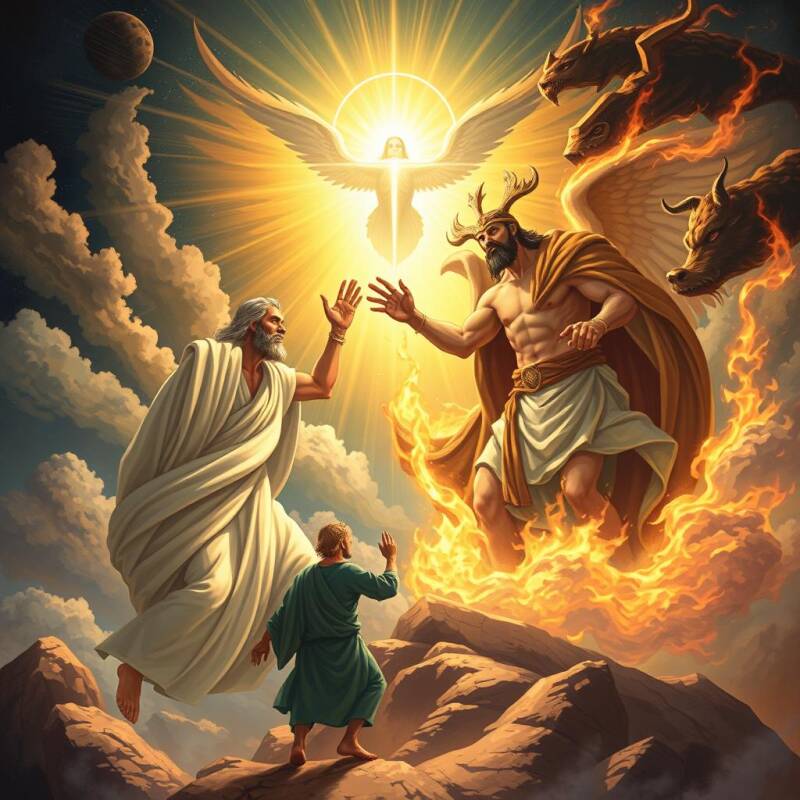
22. And it came to pass that Satan cried with a loud voice, with weeping, and wailing, and gnashing of teeth; and he departed hence, even from the presence of Moses, that he beheld him not.
Satan cries “with a loud voice, with weeping, and wailing, and gnashing of teeth” as he leaves the prophet. The lesson is twofold. First, Satan's grief shows how much he hates truth; his tragedy is the loss of an opportunity to corrupt someone so pure. Second, the text reminds Christians that divine protection is instantaneous and forceful; when we stand firm in righteousness, evil is thrown out before it can approach. Personal obedience and humility make a Satan-proof shelter.
23. And now of this thing Moses bore record; but because of wickedness it is not had among the children of men.
We learn about God, man, and spiritual conflict. Moses fights Satan, who wants worship, after being transfigured and speaking to God. Moses confronts him in Christ's name, praising his divinity and strength. This remarkable experience reveals divine identity and mission. “Moses bore record, but because of wickedness it is not had among the children of men.” This tragedy reveals how sin and disbelief corrupt sacred truths. The lack of such profound revelation in scripture reminds us that spiritual understanding is delicate and requires humility, holiness, and faith. Moses 1 encourages us to find forgotten knowledge, understand our divinity, and fight Christ's deception.
24. And it came to pass that when Satan had departed from the presence of Moses, that Moses lifted up his eyes unto heaven, being filled with the Holy Ghost, which beareth record of the Father and the Son;
Spiritual strength and heavenly identity lessons are gained. Moses looks up to heaven, filled with the Holy Spirit, after Satan leaves him fatigued and terrified. In humility and faith, he sees God's magnificence and hears the Father proclaim, “This is my Beloved Son.” This example reveals how the Spirit renews us after temptation and trial. Faith in God calms and validates us throughout spiritual attacks. Moses' vision says Jesus knows, loves, and grants us divine potential. This chapter urges us to rise with the Holy Spirit and our God-given identity after every failure.
25. And calling upon the name of God, he beheld his glory again, for it was upon him; and he heard a voice, saying, "Blessed art thou, Moses, for I, the Almighty, have chosen thee, and thou shalt be made stronger than many waters, for they shall obey thy command as if thou wert God."
Moses is given immense ability to govern His people. He calls on the Lord and sees God's magnificence and hears Him say, “thou shalt be made stronger than many waters, for they shall obey thy command as if thou wert God.” This moment underscores a fundamental lesson: obedience and trust in God empower heavenly callings. Moses found authority and power through humility and faith in God. He relies on God despite heavy responsibilities. This story teaches that when we accept the Lord's plan and act in trust, we can channel His power and discover courage to serve Him.
26. And lo, I am with thee, even unto the end of thy days; for thou shalt deliver my people from bondage, even Israel, my chosen.
The Prophet emphasizes that heavenly connection is inseparable from liberating God's children. True discipleship is never alone; the Lord promises His presence when we suffer personal or cultural “bondage.” When we realize we are chosen to participate in His redeeming work, our obstacles become learning opportunities, and our actions—small or large—reflect the Savior's enduring support. We are urged to trust, act, and witness that the promised companionship lasts.
27. And it came to pass, as the voice was still speaking, Moses cast his eyes and beheld the earth, yea, even all of it; and there was not a particle of it which he did not behold, discerning it by the Spirit of God.
Moses saw the earth while the voice was still speaking. He saw every atom of it, comprehending it by the Spirit of God.” The scripture explains that heavenly revelation expands real perception beyond bodily sight. Aligning our hearts with the Spirit helps us understand God's seemingly boundless creation and “see” the purpose behind every hardship, covenant, and blessing. Thus, the message for Latter-day Saints is simple but profound: use a Spirit-guided perspective to see the whole earth—its beauty, suffering, and destiny—and respond with greater faith, humility, and love.
28. And he beheld also the inhabitants thereof, and there was not a soul that he beheld not; and he discerned them by the Spirit of God; and their numbers were great, even numberless as the sand upon the seashore.
According to the scripture, the prophet saw all residents but no souls beyond them. They were as abundant as beach sand.” This striking picture reminds Christians God sees more than us. By identifying people “by the Spirit of God,” Moses learns to trust spiritual revelation over statistics and prejudice. The concept of countless souls highlights the Lord's infinite value in everyone. This chapter urges us to have a compassionate, Spirit-led view of every soul as precious, worthy of love, and crucial to God's plan.
29. And he beheld many lands, and each land was called earth, and there were inhabitants on the face thereof.
The Lord “beheld many lands, and each land was called earth, and there were inhabitants on the face thereof.” This broad vision shows that God cares for every nation and people in the globe He created. The scripture reminds Christians that every region, culture, and person is a thread in the plan of redemption. It urges us to approach missionary work, service, and fellowship globally, seeing every soul as a valued child of God worthy of the gospel's love and truth.
30. And it came to pass that Moses called upon God, saying, "Tell me, I pray thee, why these things are so, and by what thou madest them?"
After a vision, Moses asks God, “Tell me, I pray thee, why these things are so, and by what thou madest them?” Trust and divine communication are shown beautifully here. Moses 1:30. This modest investigation seeks truth to understand God's actions and intentions. In response, the Lord reveals great truths about Creation, His glory, and souls. This moment reveals that honest, faith-filled questions can reveal heaven. Moses' experience reveals that prayer and divine contact strengthen our relationship with God and demonstrate His love and plan for His children.
31. And behold, the glory of the Lord was upon Moses, so that Moses stood in the presence of God and talked with him face to face. And the Lord God said unto Moses, "For mine own purpose have I made these things." Here is wisdom, and it remains in me.
The Lord's light allowed Moses to face Him and say, "For mine own purpose have I made these things." This quick, gorgeous scene inspires Latter-day Saints to seek God. Moses's story indicates that choosing righteousness can open heaven's veil and reveal divine intent. The phrase “wisdom… remains in me” highlights the availability of revelation for those who seek, listen, and align with God’s eternal plan.
32. And by the word of my power, have I created them, which is mine Only Begotten Son, who is full of grace and truth.
God declares, “By the word of my power, have I created them, which is my Only Begotten Son, full of grace and truth.” Moses believed Jesus, the only Son, created everything. Creatorship shows His Fatherhood, immeasurable grace, and truth, enriching existence. This teaches Christians. Christ rescues. Grace saves, and truth guides forever. Christians should become closer to Christ and recognize His sovereign authority and loving purpose in creation. His teachings enable us to live with grace and truth that touch the universe and spirit.
33. I made planets for my family. God said Moses, He created "worlds without number" through Jesus Christ for a purpose.
This text emphasizes creation's limitless creativity and purpose, showing that all existence is for love and salvation. These visions demonstrate Christ's role in creation, salvation, and eternal unity to Moses. Mormons believe humans and the universe are interrelated and part of God's purpose to glorify His children. The Atonement inspires awe because the Son who created all things would redeem it.
34. And the first man of all men have I called Adam, which is many.
God says, “And the first man of all men have I called Adam, which is many,” revealing a major truth. First, flesh Adam. “Adam” represents our divine birthright and purpose as children of God. Adam's story is about human experience—creation, testing, fall, and redemption—not history. Being “many,” Adam shows we all choose spirituality. This passage reminds us that we are God's eternal family with divine potential and the chance to return to Him through obedience and trust, encouraging humility and unity.
35. But only an account of this earth, and the inhabitants thereof, do I give unto you. For behold, there are many worlds that have passed away by the word of my power. And there are many that now stand, and innumerable are they unto man, but all things are numbered unto me, for they are mine, and I know them.
The Lord's vast creation humbles us. He calls Earth one of His divinely shaped worlds—some past, some flourishing. God emphasizes that He counts every world and soul, even though humans cannot comprehend them. The greatness of God and our smallness are highlighted. The lesson encourages us to honor His eternal plan beyond human limits. Accepting that all creation is by His will and part of a greater plan requires humility, faith, and awe in His wisdom beyond our understanding. After Moses' vision, we reconsider our role in God's infinite work.
36. And it came to pass that Moses spake unto the Lord, saying, "Be merciful unto thy servant, O God, and tell me concerning this earth and the inhabitants thereof, and also the heavens, and then thy servant will be content."
humility and honest prayer are learned. Rather than demanding answers, Moses asks the Lord to be merciful to him and tell him about the earth and its inhabitants. Faith in God's grace is acknowledged. Christians learn that true learning requires contrition and God's help. Moses' prayer and sincere desire for understanding model the spiritual posture that opens the heavens to reveal divine truth and invites us to revere and seek understanding from the Lord.
37. And the Lord God spake unto Moses, saying, "The heavens, they are many, and they cannot be numbered unto man; but they are numbered unto me, for they are mine."
The Savior says, “The heavens are many, and they cannot be numbered unto man; but they are numbered unto Me, for they are Mine.” This simple but profound statement teaches Mormons two things. Since humans cannot catalog God's infinite creations, intellectual pride must give way to humility. Second, it assures us that the Almighty knows every star and sphere and every child. The Lord's intimate, numbered relationship with every soul can comfort us when we feel lost in the universe.
38. And as one earth shall pass away, and the heavens thereof, even so shall another come; and there is no end to my works, neither to my words.
God's purpose is eternal, but creation is temporary—“as one earth shall pass away, and the heavens thereof.” This teaches Christians two interrelated truths. First, our brief lives encourage humility, faith, service, and divine commandments. Second, God's “works” and “words” never end, so every sincere effort we make helps an ever-expanding divine plan. We can trust that while nations rise and fall, the Savior's infinite handiwork continues, inviting us to join that eternal legacy.
39. For behold, this is my work and my glory—to bring to pass the immortality and eternal life of man.
Moses 1:39 states, “For behold, this is my work and my glory—to bring to pass the immortality and eternal life of man”—a key Latter-day Saint belief. This powerful declaration shows God's ultimate goal—His children's eternal welfare. The Atonement of Jesus Christ gives everyone eternal life. Faith, repentance, and righteousness bring God-like eternal life. Moses saw God's boundless love and humanity's divinity. The verse emphasizes our worth, purpose, and God's plan. It encourages gratitude, discipleship, and focusing on what matters—returning to Him with eternal joy.
40. And now, Moses, my son, I will speak unto thee concerning this earth upon which thou standest, and thou shalt write the things which I shall speak.
God tells Moses, “And now, Moses, my son, I will speak unto thee concerning this earth…” and instructs him to record His words. The passage reminds Mormons that revelation is a divine invitation and sacred duty. We must record, protect, and share God's truth. Our paternal relationship with the Savior is symbolized by calling Moses a "son" in the text, but privilege without obedience leads to loss. This simple but profound lesson is to honor the Lord's word by studying, writing, and living it.
41. And in a day when the children of men shall esteem my words as naught and take many of them from the book which thou shalt write, behold, I will raise up another like unto thee; and they shall be had again among the children of men—among as many as shall believe.
When people ignore God's words and erase them from history, God will raise up another Moses to restore truths. This revelation proves divine truth can endure human rejection or change. As Moses saw God's glory and received sacred writings, modern prophets must minister to believers. Late scriptures like the Book of Mormon show God is still speaking. All believers “had again” these restored scriptures, not just the proud or skeptical. This lesson emphasizes God's covenant and His ongoing efforts to gather and guide His children.
42. (These words were spoken unto Moses in the mount, the name of which shall not be known among the children of men. And now they are spoken unto you. Show them not unto any except them that believe. Even so. Amen.)
Some rare, solemn advice echoes the gospel's covenant-keeping spirit: "These words were spoken to Moses in the mount, whose name is unknown. Now you hear them. Display them only to believers. Even so. Amen.” Christians learn that spiritual knowledge is a privilege, not a show. We should only share holy revelations with true believers. We keep divine instruction and ensure the word's purity and efficacy by doing so.
Book of Moses Chapter 1: The Divine Preface to Your Purpose
As you delve into the first chapter of the Book of Moses, you are immediately transported to a mountaintop where Moses experiences a profound, transfiguring vision of the Almighty. This account serves as a divine preface, not just to the creation story that follows, but to your understanding of your own place in the cosmos. What is happening is nothing less than a complete elevation of Moses’s status: you see him commune with God "face to face," a glorious encounter so intense that his natural strength leaves him, requiring divine aid to withstand the glory. God then reveals to him—and thus to you—the sheer infinity of creation, showing you "worlds without number." The meaning here is threefold: first, it establishes God’s incomprehensible majesty as the orchestrator of galaxies, and second, it humbles Moses, forcing him to acknowledge that “man is nothing.” However, the third and crucial meaning is the affirmation of purpose, as God calls Moses His “son” and ordains him for a mighty work, confirming that your individual identity is known and valued despite the vastness of creation. Finally, this chapter immediately arms you for spiritual combat, detailing the immediate confrontation with Satan. Having just seen the true glory of God, you watch Moses resist the adversary’s demand for worship by declaring, "I will not cease to call upon God," illustrating a timeless principle: the moment you gain a clear, personal witness of the Father, you must prepare yourself for the fiercest test of your obedience. This chapter is your blueprint for discipleship, teaching you that transformation, vision, and conflict are inseparable parts of your divine calling.
What knowledge we receive from Abraham Chapter 3
Using the amazing Urim and Thummim, Abraham received a deep vision, not just of the sun, moon, and stars in their arrangement, but of the important, lasting truths they represented. The Lord revealed to him that just as these celestial bodies exist in an ordered cosmos, so too do spirits exist eternally, uncreated intelligences without beginning or end. Abraham learned of a grand, premortal council where countless spirit children of God resided and where a divine plan for their progression was presented. He witnessed the principles of foreordination, seeing how certain noble and great ones were chosen and prepared for specific missions on earth long before their mortal advent. The very Creation of this earth, Abraham understood, was a meticulously ordered stage for these spirits to gain bodies, experience mortality, and prove their faithfulness. Crucially, he learned of the divine foreordination of a Redeemer, even Jesus Christ, whose atoning sacrifice was planned from the foundation of the world. This mortal sojourn, the "second estate," became clear as a vital period of testing, learning, and growth, culminating in judgment and eternal consequence. Thus, through divine revelation, Abraham transcended mere astronomical observation, grasping the vast, eternal scope of God's plan for His children, all unveiled through the sacred instrument of the Urim and Thummim.
As I reflect on the profound experience of Abraham, I am filled with a sense of awe and reverence for the vast, eternal scope of God's plan for His children. Through the sacred instrument of the Urim and Thummim, Abraham received a deep and abiding vision, one that transcended the mere observation of the sun, moon, and stars in their celestial arrangement. He was given to see the underlying, lasting truths that these heavenly bodies represented—the eternal existence of spirits, uncreated intelligences without beginning or end, living in an ordered cosmos. I am humbled by the realization that Abraham was privileged to witness a grand, premortal council, where countless spirit children of God resided and a divine plan for their progression was presented. He saw the principles of foreordination in action, where certain noble and great ones were chosen and prepared for specific missions on earth long before their mortal advent. The Creation of this earth, Abraham understood, was a meticulously ordered stage for these spirits to gain bodies, experience mortality, and prove their faithfulness. And at the heart of this plan, he learned of the divine foreordination of a Redeemer, even Jesus Christ, whose atoning sacrifice was planned from the foundation of the world. As I think about this vision, I am struck by how important our time on Earth, this "second estate," is as a time of testing, learning, and growth that ends in judgment and eternal consequences. Through the Urim and Thummim, Abraham was given a glimpse of the eternal expanse of God's plan, and I am grateful for the opportunity to reflect on the profound implications of this vision and to catch a glimpse of the divine love and purpose that underlies all of existence.
The profound teachings that emerge from this sacred text are remarkable. From my perspective, this chapter is teaching me about the importance of faith and obedience in the face of uncertainty and adversity. Abraham's willingness to sacrifice his son Isaac at God's command powerfully illustrates the unwavering trust and devotion required of us as followers of God. What resonates deeply with me is the way Abraham's faith is tested and refined through this experience, revealing a more profound understanding of God's character and promises. As I reflect on this chapter, I am reminded that my faith is not about having all the answers or avoiding challenges, but about trusting in God's sovereignty and goodness, even when the road ahead is unclear. Abraham's example encourages me to surrender my own will and desires to God's purposes and to trust that He will provide and guide me, just as He did for Abraham and Isaac. Ultimately, Abraham Chapter 3 is teaching me that true faith is not just about believing in God but about living a life of radical obedience and trust, one that is rooted in a deep and abiding relationship with Him.
ABRAHAM Chapter 3
1 And I, Abraham, had the Urim and Thummim, which the Lord my God had given unto me, in Ur of the Chaldees;
2 And I saw the stars, that they were very great, and that one of them was nearest unto the throne of God; and there were many great ones which were near unto it;
3 And the Lord said unto me: These are the governing ones; and the name of the great one is Kolob, because it is near unto me, for I am the Lord thy God: I have set this one to govern all those which belong to the same order as that upon which thou standest.
4 And the Lord said unto me, by the Urim and Thummim, that Kolob was after the manner of the Lord, according to its times and seasons in the revolutions thereof; that one revolution was a day unto the Lord, after his manner of reckoning, it being one thousand years according to the time appointed unto that whereon thou standest. This is the reckoning of the Lord’s time, according to the reckoning of Kolob.
5 And the Lord said unto me: The planet which is the lesser light, lesser than that which is to rule the day, even the night, is above or greater than that upon which thou standest in point of reckoning, for it moveth in order more slow; this is in order because it standeth above the earth upon which thou standest, therefore the reckoning of its time is not so many as to its number of days, and of months, and of years.
6 And the Lord said unto me: Now, Abraham, these two facts exist, behold thine eyes see it; it is given unto thee to know the times of reckoning, and the set time, yea, the set time of the earth upon which thou standest, and the set time of the greater light which is set to rule the day, and the set time of the lesser light which is set to rule the night.
7 Now the set time of the lesser light is a longer time as to its reckoning than the reckoning of the time of the earth upon which thou standest.
8 And where these two facts exist, there shall be another fact above them, that is, there shall be another planet whose reckoning of time shall be longer still;
9 And thus there shall be the reckoning of the time of one planet above another, until thou come nigh unto Kolob, which Kolob is after the reckoning of the Lord’s time; which Kolob is set nigh unto the throne of God, to govern all those planets which belong to the same order as that upon which thou standest.
10 And it is given unto thee to know the set time of all the stars that are set to give light, until thou come near unto the throne of God.
11 Thus I, Abraham, talked with the Lord, face to face, as one man talketh with another; and he told me of the works which his hands had made;
12 And he said unto me: My son, my son (and his hand was stretched out), behold I will show you all these. And he put his hand upon mine eyes, and I saw those things which his hands had made, which were many; and they multiplied before mine eyes, and I could not see the end thereof.
13 And he said unto me: This is Shinehah, which is the sun. And he said unto me: Kokob, which is star. And he said unto me: Olea, which is the moon. And he said unto me: Kokaubeam, which signifies stars, or all the great lights, which were in the firmament of heaven.
14 And it was in the night time when the Lord spake these words unto me: I will multiply thee, and thy seed after thee, like unto these; and if thou canst count the number of sands, so shall be the number of thy seeds.
15 And the Lord said unto me: Abraham, I show these things unto thee before ye go into Egypt, that ye may declare all these words.
16 If two things exist, and there be one above the other, there shall be greater things above them; therefore Kolob is the greatest of all the Kokaubeam that thou hast seen, because it is nearest unto me.
17 Now, if there be two things, one above the other, and the moon be above the earth, then it may be that a planet or a star may exist above it; and there is nothing that the Lord thy God shall take in his heart to do but what he will do it.
18 Howbeit that he made the greater star; as, also, if there be two spirits, and one shall be more intelligent than the other, yet these two spirits, notwithstanding one is more intelligent than the other, have no beginning; they existed before, they shall have no end, they shall exist after, for they are gnolaum, or eternal.
19 And the Lord said unto me: These two facts do exist, that there are two spirits, one being more intelligent than the other; there shall be another more intelligent than they; I am the Lord thy God, I am more intelligent than they all.
20 The Lord thy God sent his angel to deliver thee from the hands of the priest of Elkenah.
21 I dwell in the midst of them all; I now, therefore, have come down unto thee to declare unto thee the works which my hands have made, wherein my wisdom excelleth them all, for I rule in the heavens above, and in the earth beneath, in all wisdom and prudence, over all the intelligences thine eyes have seen from the beginning; I came down in the beginning in the midst of all the intelligences thou hast seen.
22 Now the Lord had shown unto me, Abraham, the intelligences that were organized before the world was; and among all these there were many of the noble and great ones;
23 And God saw these souls that they were good, and he stood in the midst of them, and he said: These I will make my rulers; for he stood among those that were spirits, and he saw that they were good; and he said unto me: Abraham, thou art one of them; thou wast chosen before thou wast born.
24 And there stood one among them that was like unto God, and he said unto those who were with him: We will go down, for there is space there, and we will take of these materials, and we will make an earth whereon these may dwell;
25 And we will prove them herewith, to see if they will do all things whatsoever the Lord their God shall command them;
26 And they who keep their first estate shall be added upon; and they who keep not their first estate shall not have glory in the same kingdom with those who keep their first estate; and they who keep their second estate shall have glory added upon their heads for ever and ever.
27 And the Lord said: Whom shall I send? And one answered like unto the Son of Man: Here am I, send me. And another answered and said: Here am I, send me. And the Lord said: I will send the first.
28 And the second was angry, and kept not his first estate; and, at that day, many followed after him.
QUESTIONS ANSWERS
- Why is Chapter 3 of Genesis not about Abraham, and where do Abraham’s stories begin?
2. What was the covenant God made with Abraham, and why was it significant?
3. How did Isaa
1. Actually, Abraham’s story doesn’t appear in Genesis Chapter 3. That chapter tells the tale of Adam and Eve in the Garden of Eden. Abraham’s journey starts in Genesis Chapter 12, where God calls him to leave his homeland and promises to make him the father of a mighty nation. The Book of Genesis is divided into sections, and Abraham’s key events (like the covenant with God and the birth of Isaac) are found in Chapters 12 through 25.
2. God made a covenant (a special promise) with Abraham in Genesis 15, promising that his descendants would be as countless as the stars and that they would inherit the land of Canaan. Abraham trusted God’s promise even when he and his wife, Sarah, were old and childless. This covenant was significant because it established Abraham as the spiritual father of the Israelites and showed God’s faithfulness to fulfill His plans.
3. God promised Abraham and Sarah a son, but they laughed in doubt because they were old (Genesis 17 and 21). Despite this, God kept His word, and Sarah gave birth to Isaac when she was 90! Isaac was Abraham’s promised child, symbolizing God’s power to bring life where there seemed to be no hope. His birth taught that God’s timing and promises are always trustworthy.
4. In Genesis 22, God tested Abraham’s faith by asking him to sacrifice his son Isaac. Abraham obeyed, even though it was heartbreaking. Just before the sacrifice, an angel stopped him and provided a ram to take Isaac’s place. This story shows Abraham’s deep trust in God and foreshadows how God later provided a sacrifice to save humanity—Jesus Christ.
5. Abraham demonstrated respect and fairness when dealing with others. For example, in Genesis 20, he lied about Sarah being his sister to protect himself in a foreign land. Later, he repented and asked Abimelech to return Sarah. Abraham also made peace with Abimelech (Genesis 21:22-34), showing he prioritized reconciliation and clear relationships. This teaches us to own up to our mistakes and value harmony.
Let's talk; leave your questions in the comment area, and leave a reply in the comment area.
Replies
Add comment
Comments