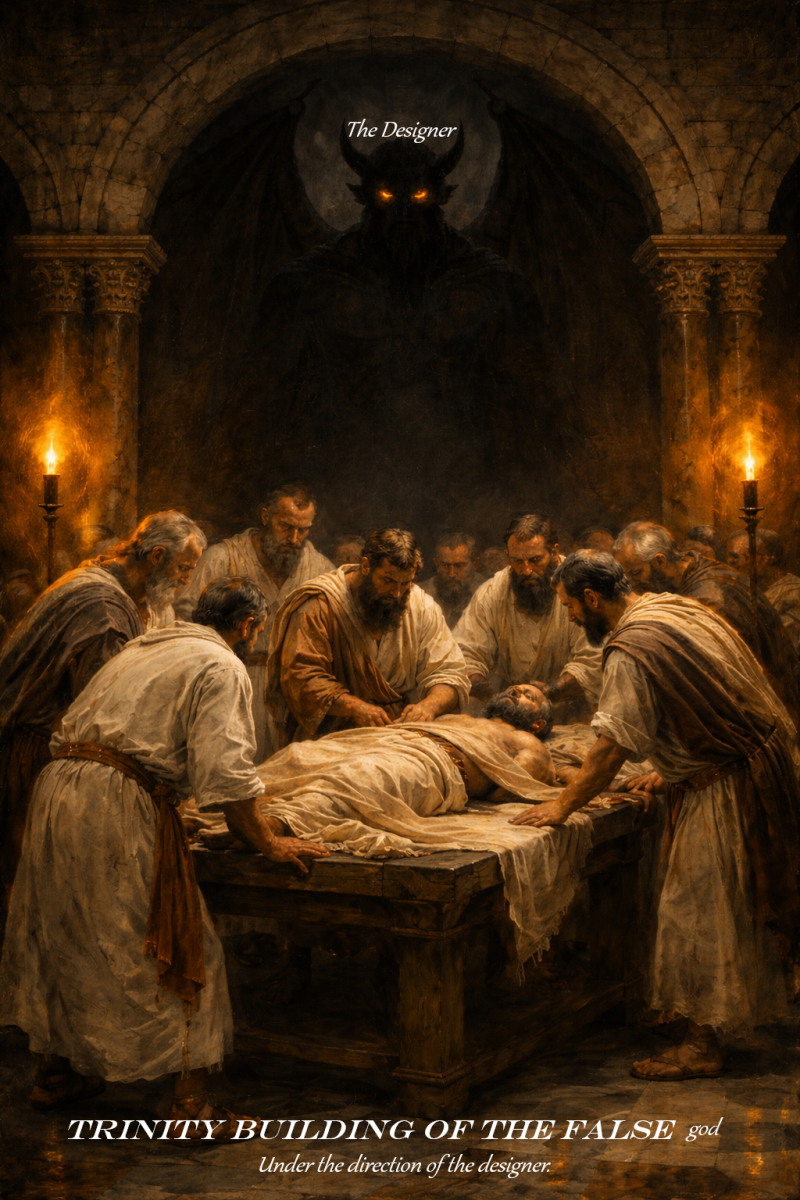
The 318 leaders who built the false god Trinity under the watchful eyes of Satan.
How Satan took that knowledge away from the simple minded.
Do you know the Heavenly Father, Jesus Christ, or the Holy Ghost?
The requirement to be a true Christian is to be a child of the Heavenly Father.
You do NOT qualify to be a Christian: If you believe that Jesus Christ was simply Heavenly Father in disguise—fooling the world by claiming to be born of a Virgin just to obtain a body—then you miss the true power of the Atonement. If they are the same person, then the Father’s sacrifice of His Only Begotten Son becomes an illusion. The pain He endured watching the torture of His Son wasn't real, and the shaking of the earth at Christ’s death meant nothing. That 'one-person' god is a product of the Council of Nicaea’s 318 men, a doctrine that has been used to manipulate the simple-minded for over 1,600 years. We believe in the truth as it was before it was changed: the Godhead consists of three distinct individuals—Heavenly Father, Jesus Christ, and the Holy Ghost—unified in one purpose. Titles like 'God' do not erase their individuality any more than your titles change who you are.
The idea that the Father and Son are one and the same person actually strips the Gospel of its meaning. If Jesus is just a title for the Father, then there was no 'Only Begotten Son' to give. The Father’s grief during the Crucifixion would be a performance, and the Savior’s pleas in Gethsemane would be hollow. This confusion is the legacy of the 318 men at the Council of Nicaea, who replaced the clear truth of the Godhead with a 'forced' doctrine that has clouded human minds for 1,645 years. Satan thrives on this confusion because it makes the Father’s literal sacrifice seem 'nothing special.' The truth is simpler and more glorious: three separate, divine Beings working in perfect unity for our exaltation. Don't let a man-made creed hide the reality of a Father who truly gave His Son for you.
You have been tricked, so many have been lied to , Satan knew the simple minded, the easily manipulated human mind and stole the very requirement to be saved.
Internet Archive: Athanasius_Letters_to Serapion... The introduction to the false god "godhead" takes away three identities and makes them one.
- Coining the Term (Early 3rd Century): The Latin theologian Tertullian was the first to use the word Trinitas (Trinity). He introduced the formula "one substance, three persons" (una substantia, tres personae) to explain that while they are distinct in role or "form," they are one in "spiritual matter".
- The "Same Substance" (325 AD): At the Council of Nicaea, the Church adopted the term homoousios ("of the same substance") to declare that Jesus was not a separate created being but was equal to the Father.
- The Final Definition (381 AD): The Cappadocian Fathers (Basil the Great, Gregory of Nyssa, and Gregory of Nazianzus) resolved the remaining confusion by distinguishing between Essence (ousia) and Person (hypostasis). They argued:
- Essence: What God is (one divine nature).
- Person: Who the Father, Son, and Spirit are (three distinct ways of being that one nature).
The transition from debate to state-enforced punishment—including excommunication, exile, and eventually execution—occurred in stages between 325 AD and 385 AD. While the Council of Nicaea introduced excommunication and exile as tools for unity, it was not until the late 4th century that the Roman state began using capital punishment for theological dissent.
The creed was amended by the First Council of Constantinople in 381.
- Jesus Christ is described as "Light from Light, true God from true God," proclaiming his divinity.
- Jesus Christ is said to be "begotten, not made," asserting that he was not a mere creature, brought into being out of nothing, but the true Son of God, brought into being "from the substance of the Father."
- He is said to be "of one substance with the Father," proclaiming that although Jesus Christ is "true God" and God the Father is also "true God," they are "of one substance." The Greek term homoousios, consubstantial (i.e., of the same substance), is ascribed by Eusebius of Caesarea to Constantine, who, on this particular point, may have chosen to exercise his authority. The significance of this clause, however, is ambiguous as to the extent in which Jesus Christ and God the Father are "of one substance," and the issues it raised would be seriously controverted in the future.
Exiled & Murder
-
- The First Council of Nicaea concluded by excommunicating Arius and two Libyan bishops who refused to sign the Creed.
- Emperor Constantine enforced the Nicene Creed by banishing them and ordering Arius's writings to be burned. He even threatened death for anyone caught hiding Arius's books, though there are no verified records of executions for this specific offense at that time.
- 335–380 AD: Political Volatility and Banishments
- For several decades, the "official" view shifted depending on the sitting Emperor. Athanasius, the champion of the Trinity, was himself excommunicated and exiled five separate times as Arian-leaning emperors gained power.
- During this period, violence was often localized and physical, involving riots or the forceful removal of bishops from their cathedrals rather than formal state executions.
The emperor carried out his earlier statement: everybody who refused to endorse the creed would be exiled. Arius, Theonas, and Secundus refused to adhere to the creed and were thus exiled to Illyria, in addition to being excommunicated. The works of Arius were ordered to be confiscated and consigned to the flames,[66] while his supporters were considered "enemies of the new Christianity."[67] Nevertheless, the controversy continued in various parts of the empire.
EMPERORS GRATIAN, VALENTINIAN, AND THEODOSIUS AUGUSTI. EDICT TO THE PEOPLE OF CONSTANTINOPLE.
It is our desire that all the various nations that are subject to our Clemency and Moderation, should continue to profess that religion which was delivered to the Romans by the divine Apostle Peter, as it has been preserved by faithful tradition and as it is now professed by the Pontiff Damasus and by Peter, Bishop of Alexandria, a man of apostolic holiness. According to the apostolic teaching and the doctrine of the Gospel,
Let us believe in the one deity of the Father, the Son, and the Holy Spirit, in equal majesty and in a holy Trinity.
We order the followers of this law to embrace the name of Catholic Christians; but as for the others, since, in our judgment, they are foolish madmen, we decree that they shall be branded with the ignominious name of heretics and shall not presume to give to their conventicles the name of churches. They will first suffer divine condemnation and then the punishment of our authority, which we shall inflict according to our will.
Add comment
Comments