By Karma McConahay
A loving Godhead that allows us to choose our comfort for eternity.
Ultimately, the Three Degrees of Glory are seen as a mercy from God, providing a place where every person can be "comfortable" according to the desires of their own hearts.

The knowledge of the Celestial Kingdom is the highest degree of glory, but it is governed by specific laws and a way of life that not everyone may desire or feel comfortable with. According to God the Father, people who would not want to be in the Celestial Kingdom generally fall into these categories:
1 Corinthians 15:40–42, where the Apostle Paul distinguishes between different types of resurrected bodies and their respective splendors:
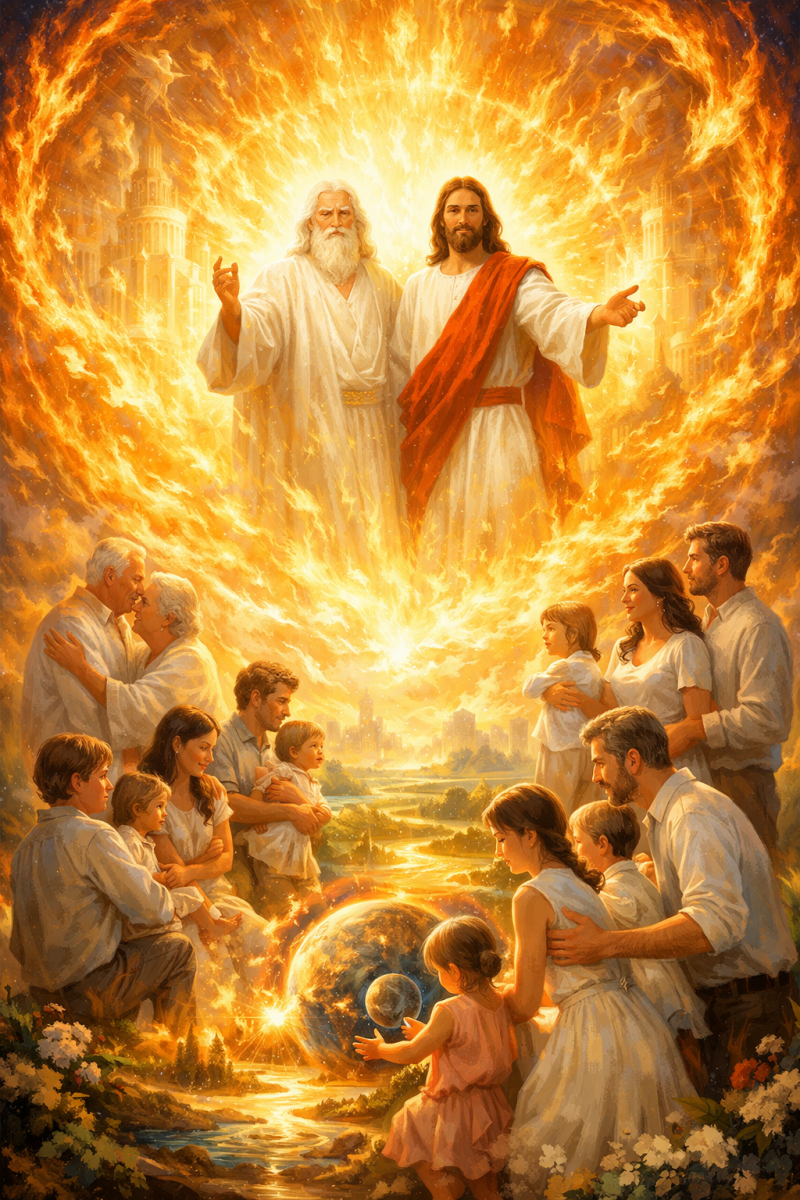
Celestial Kingdom (Glory of the Sun): Paul explicitly uses the term "celestial" and likens its glory to the sun. This is also associated with the "third heaven" Paul mentions in 2 Corinthians 12:2.
- Those who cannot "abide" by its law: Every kingdom of glory has a specific law. Individuals will inherit a kingdom based on the laws they are willing to obey. Those who find the requirements of celestial law—such as complete obedience, sacrifice, and total devotion to God the Father—unappealing or too restrictive would not feel at home there.
- Those who do not want to be in Heavenly Father's presence: The Celestial Kingdom is where God the Father and Jesus Christ dwell. Some people may feel uncomfortable or even miserable in the presence of such perfect holiness if they have not developed a love for God the Father or a desire to be like Him during their lives.
- Those who lack interest in "Eternal Increase": The highest degree of the Celestial Kingdom involves exaltation, which includes the responsibility of "eternal increase" and participating in God’s ongoing work of creation. People who prefer a life of rest without the weight of eternal responsibility or family growth might prefer a different state of glory.
- Those who were "not valiant" in their testimony: The Terrestrial Kingdom is described as a place for "honorable men [and women] of the earth" who were not "valiant in the testimony of Jesus." These individuals may prefer a kingdom of glory that is still wonderful but does not require the same level of spiritual intensity and covenant-keeping as the Celestial Kingdom.
- Those who choose other priorities: Agency is a core principle of the Plan of Salvation. Joseph Smith taught that some people might even be worthy of the Celestial Kingdom but choose a lower kingdom because they simply prefer the laws and lifestyle found there.
Celestial law refers to the eternal, unchanging principles and laws by which God the Father lives and governs His kingdom. To inherit the Celestial Kingdom, an individual must be willing and able to "abide" or live by these laws while on earth.
- The Five Laws of the Temple: These are core spiritual laws often detailed in the Temple through voluntary covenants:
- Law of Obedience: Striving to keep all of God the Father’s commandments. This law is lived through both large-scale scriptural examples and everyday personal actions:
- Daily Life Application:
- Financial & Health Laws: Choosing to pay tithing or follow the Word of Wisdom even when it requires personal sacrifice.
- Spiritual Habits: Praying daily when tired or acting promptly on spiritual promptings from the Holy Ghost.
- Following Leaders: Heeding the counsel of living prophets, even when their advice is personally challenging or not fully understood.
- Law of Sacrifice: Willingness to sacrifice anything required for Jesus Christ’s work. In the context of the temple endowment, the Law of the Gospel refers to the higher law that Jesus Christ taught during His earthly ministry. While the word "gospel" often broadly encompasses all Church doctrines, this specific covenant focuses on a lifelong commitment to the fundamental principles and ordinances of salvation.
-
- Law of the Gospel: Living the higher moral and spiritual teachings taught by Jesus Christ.
- Exercising faith in Jesus Christ.
- Repenting daily to stay on the covenant path.
- Making and keeping covenants by receiving essential ordinances.
- Enduring to the end through continued faithfulness.
- Striving to live the two most important commandments: loving God and loving your neighbor.
- Law of Chastity: Strict adherence to the Lord's law of sexual purity (purity in both action and thought). In the context of the temple endowment, the Law of Chastity is a sacred covenant between an individual and God to live a life of sexual purity.
- The specific requirements of this law include:
- Complete abstinence from sexual relations before marriage.
- Total fidelity to one's spouse within a legal marriage between a man and a woman.
- Purity of thought, word, and action, which includes avoiding pornography, inappropriate media, or anything that intentionally arouses sexual feelings outside of marriage
- The specific requirements of this law include:
- Law of Consecration: Dedicating one’s time, talents, and means to building the Kingdom of the Heavenly Father and establishing Zion.
- The law is based on the doctrine that everything belongs to the Lord; therefore, members act as "stewards" over the resources He has entrusted to them.
- Time and Talents: Offering your specific skills—such as teaching, music, or administration—to help others and strengthen the local congregation.
- Material Resources: Using your financial means to care for the poor and needy.
- The Ultimate Consecration: Leaders often teach that the highest form of this law is the "yielding up of oneself to God," making His will the most powerful influence in your life.
- The law is based on the doctrine that everything belongs to the Lord; therefore, members act as "stewards" over the resources He has entrusted to them.
- The Law of the New and Everlasting Covenant: This refers specifically to Celestial Marriage—being sealed for time and all eternity in the temple—which is required to obtain the highest degree within the Celestial Kingdom, known as exaltation.
- While the term refers to the entire gospel, the scriptures often highlight specific ordinances as parts of this covenant:
- The Fulness of the Gospel: It encompasses all ordinances necessary for salvation and exaltation, including baptism, priesthood ordination, and the temple endowment.
- The Covenant of Marriage: In Doctrine and Covenants 132:4, the Lord refers specifically to eternal marriage as "a new and everlasting covenant." This sealing of a man and woman for eternity is the "gate" to the highest degree of the celestial kingdom.
- The Abrahamic Covenant: Modern prophets have taught that the New and Everlasting Covenant is essentially the same as the Abrahamic Covenant. Through it, faithful members become "heirs to all the blessings of Abraham, Isaac, and Jacob."
- While the term refers to the entire gospel, the scriptures often highlight specific ordinances as parts of this covenant:
The "Higher and Holier" Way
Celestial law is often compared to a "higher way" of living. For example:
- Terrestrial Law might focus on outward behavior (e.g., not committing adultery).
- Celestial Law focuses on the heart and thoughts (e.g., not lusting), as taught in the Sermon on the Mount.
The Role of Grace
The Lord Jesus Christ teaches that no one can live celestial law perfectly in mortality. Instead, the goal is to be "valiant in the testimony of Jesus" and consistently repent. Through the Atonement of Jesus Christ, those who strive to live these laws are "made perfect" and sanctified, eventually becoming like God the Father.

Celestial and terrestrial bodies exist, but their glory is different. "In my Father’s house are many mansions: if it were not so, I would have told you. I go to prepare a place for you."
The knowledge of the Terrestrial Kingdom is a place of peace and "glory of the moon," but it lacks the full presence of God the Father and the opportunity for "eternal increase" found in the Celestial Kingdom. People who would not want to be in the Terrestrial Kingdom generally fall into two categories: those who desire something "higher" and those who prefer a lifestyle "lower" than what it offers.
- These individuals would consider the Terrestrial Kingdom a place of regret rather than rest because they seek the fullness of the Father:
- Those who desire Eternal Family: In the Terrestrial Kingdom, individuals live "separately and singly." Those who deeply value the doctrine of "eternal marriage" and being sealed to their families forever would find this kingdom a state of "damnation" (meaning a limitation of progress) because family units do not persist there.
- Those who seek God’s full presence: This kingdom receives the presence of Jesus Christ but not the fullness of Heavenly Father. A person who has a strong desire to return to the Father's presence would not find satisfaction in this kingdom.
- The "Valiant": Those who have prepared themselves to live Celestial Law—characterized by total consecration and keeping all covenants—would feel they have "fallen short" of their potential if they inherited a Terrestrial glory.
This kingdom is primarily for individuals who lived respectably but did not meet the requirements for the Celestial Kingdom:
- The Honorable: People who were honorable men and women of the earth but were "blinded by the craftiness of men" and did not receive the fullness of the gospel while in mortality.
- The Not Valiant: Members of the Church who received a testimony of Jesus Christ but were not valiant in living it.
- Delayed Believers: Those who rejected the testimony of Jesus while on earth but later received it in the postmortal spirit world.
- Those Without Law: People who died without the law and later accepted the gospel in the spirit world.
Life in the Terrestrial Kingdom is described as a state of happiness, though it is not the highest form of salvation (exaltation):
- Presence of the Son: Inhabitants receive the presence and ministration of Jesus Christ, but they do not receive the "fullness of the Father."
- Service and Ministration: Those in this kingdom minister to the inhabitants of the lower Telestial Kingdom.
- Resurrection Timing: These individuals come forth in the afternoon of the First Resurrection.
While glorious, the Terrestrial Kingdom has significant eternal limitations compared to the Celestial Kingdom:
- No Eternal Increase: Inhabitants live "separately and singly" and cannot have children or eternal increase.
- No Eternal Family: Family units and marital bonds do not continue in this kingdom; those relationships are reserved only for those who reach the highest degree of the Celestial Kingdom.
- Restricted Presence: They cannot dwell where God the Father resides.
Telestial Kingdom (Glory of the Stars): While Paul refers to the "glory of the stars," the specific word "telestial" does not appear in the Bible. It was revealed later to Joseph Smith as the name for this third degree.

Celestial Kingdom (Glory of the Sun): Paul explicitly uses the term "celestial" and likens its glory to the sun. This is also associated with the "third heaven" Paul mentions in 2 Corinthians 12:2.
The telestial kingdom is the lowest of the three degrees of glory in The Church of Jesus Christ of Latter-day Saints, characterized by full knowledge and a state of salvation, along with a resurrected, "star-like" glory that surpasses human understanding. It is inhabited by those who did not receive the gospel or testimony of Jesus, including the wicked, murderers, and liars, who are redeemed only after suffering for their sins in spirit prison.
- Key details about the telestial kingdom include
- Inhabitants: It will be populated by individuals who were unrepentant at death, including "liars, sorcerers, adulterers, and whoremongers," or those who rejected the testimony of Jesus and the gospel. They are considered to be as "innumerable as the stars."
- Glory and Condition: Although the lowest kingdom, its glory is said to surpass all human understanding, and inhabitants receive a resurrected body, making it superior to life on earth.
- Role of Christ/God: Those in the telestial kingdom will receive the ministering of the Holy Ghost and beings from the terrestrial kingdom, but they cannot dwell where God and Christ are, "worlds without end."
- Afterlife Experience: Individuals will be "cast down to hell" (spirit prison) to suffer for their sins until the last resurrection, when they are redeemed and assigned to this kingdom.
- Origin: The term was revealed to Joseph Smith and Oliver Cowdery in 1832, as described in Doctrine and Covenants 76.
The telestial kingdom is emphasized in mainstream teachings as a final, permanent resting place for those who rejected the gospel, despite some interpretations suggesting it is a place of perpetual advancement.
- Matthew 8:12: "But the children of the kingdom shall be cast out into outer darkness..."
- Matthew 22:13: "Bind him hand and foot... and cast him into outer darkness..."
- Matthew 25:30: "And cast ye the unprofitable servant into outer darkness..."
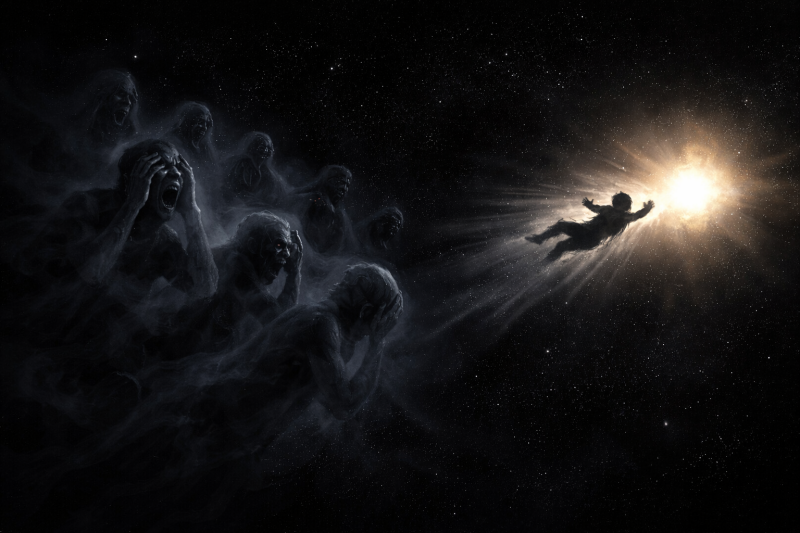
Revelation 21:8 describes the "second death" as a lake that burns with fire and brimstone, which, with true knowledge, helps interpret as the spiritual torment found in outer darkness.
Outer Darkness (Permanent): This is the final state for the "sons of perdition"—those who willfully rebelled against God after receiving a perfect knowledge of Him. For these few, the "fire and brimstone" (spiritual torment) is described as never-ending.
In Latter-day Saint theology, Outer Darkness (in its permanent form) is a kingdom without glory reserved for those who have placed themselves entirely beyond the reach of the Atonement. It is distinct from "spirit prison," which is sometimes also called outer darkness but is a temporary state of waiting and learning before the resurrection.
- Defining "Perfect Knowledge"
To qualify for this final state, a person must reach a spiritual height from which a fall is catastrophic.
- A "Sure" Witness: It requires more than just belief or faith. It is described as having the heavens opened, knowing God personally, and then denying Him—essentially saying the "sun does not shine while seeing it."
- The Unpardonable Sin: This crime is the act of "denying the Holy Ghost" after having received a full, undeniable witness of the Savior.
- Rarity: Church leaders like Spencer W. Kimball taught that it is "manifestly impossible for the rank and file" of the Church to commit this sin because most people never attain the required level of absolute knowledge.
- The Nature of "Sons of Perdition"
The term "Perdition" refers to Lucifer, meaning "ruined" or "lost." There are two main groups:
- Premortal Rebels: Lucifer and the one-third of the hosts of heaven who followed him. They never received physical bodies and will never be resurrected.
- Mortal Rebels: Individuals who gained a body but willfully chose to follow Satan after receiving perfect knowledge of Christ. These individuals will be resurrected with a physical body, but it will be a body without glory.
- Spiritual Torment as "Fire and Brimstone"
The LDS doctrine interprets "fire and brimstone" as a metaphor for the profound mental and spiritual suffering experienced by those who have fully rejected God's love and light.
- Complete Separation: It is the only state entirely devoid of the influence of the Spirit of God.
- Eternal Regret: The "weeping and gnashing of teeth" represents the profound realization of what has been lost and the refusal to repent even when the truth is fully known.
- The Second Death: This is the final spiritual death—a permanent separation from God's presence.
- Mystery of the Final End
Scripture in the Doctrine and Covenants (76:45–46) states that "the end thereof, neither the place thereof, nor their torment" is revealed to anyone except those who are made partakers of it. While some early leaders like Brigham Young speculated about the "dissolution" or "disorganization" of these souls into their original elements, this remains a matter of private speculation rather than official, revealed doctrine.
Add comment
Comments