By Karma McConahay
The Pathfinders: Jesus's First Apostles and the Way Forward
Jesus's twelve closest followers, the disciples, laid the foundation of his ministry, ultimately receiving a commission to preach the Kingdom of God. This critical inner circle consisted of Simon Peter, Andrew, James (son of Zebedee), John, Philip, Bartholomew, Thomas, Matthew, James (son of Alphaeus), Thaddaeus, Simon the Zealot, and Judas Iscariot. Despite their singular mission, alternative nomenclature sometimes complicates the historical record of these pivotal figures. For instance, the tax collector Matthew was also known as Levi, and Bartholomew is widely recognized in some accounts as Nathanael. Additionally, Thaddaeus possessed two other identifying names, being referred to interchangeably as Jude or Lebbaeus. Despite these varying names, these twelve individuals’ dedication to quality landed them the task of serving as Jesus’s first apostles, laying the conceptual groundwork for the nascent church.
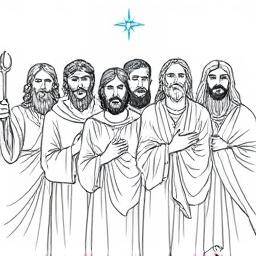
The book of Mormon provides a detailed account of the apostles in the days following Jesus Christ's death, with a specific focus on the Nephite civilization in the ancient Americas. It describes how, after Jesus' personal ministry to them, he ordained twelve disciples, whom he called apostles, with the authority to preach the gospel, baptize, and lead the church. These Nephite apostles were instrumental in establishing and guiding the early Christian community in that land. The book emphasizes their divine calling, their role as special witnesses of Jesus Christ, and their ongoing ministry of teaching, healing, and administering church ordinances. Their lives and ministries, as chronicled in the Book of Mormon, highlight a continuation of Christ's work through divinely appointed leaders, mirroring the apostolic model found in the New Testament.

The restoration of the Church of Jesus Christ through Joseph Smith, following the translation and publication of the Book of Mormon—or the "gold plates"—was immediately accompanied by the vital re-establishment of apostolic authority. While Joseph Smith himself acted as the initial prophet, seer, and revelator, the true organizational backbone of the restored Church required the ancient order of twelve special witnesses. On February 14, 1835, and again on February 21, the first group of men were called by revelation and chosen by the three witnesses to the Book of Mormon to form the Quorum of the Twelve Apostles, thereby completing the ecclesiastical framework necessary for global expansion. These twelve men, including revered figures like Brigham Young and Heber C. Kimball, were charged with carrying the gospel to the world, organizing the Saints, and holding the keys of the kingdom—a revival of the same priesthood authority held by Peter, James, and John—signaling that the institution established by Christ in the meridian of time had indeed returned to the earth.
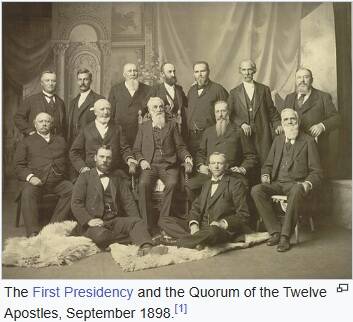
The presiding body of the restored church of Jesus Christ, known as the Quorum of the Twelve Apostles, serves a function analogous to the ancient apostles: they are designated as special witnesses of the divinity and resurrection of Jesus Christ to the entire world. These fifteen men, known as prophets, seers, and revelators, have the highest priesthood authority along with the First Presidency. They are in charge of the Church's global administration, declaring doctrine, and giving spiritual guidance to Christians all over the world. Emulating the biblical mandate to preach the gospel in "all the world," modern apostles spend their lives traveling across continents, ministering to local congregations, strengthening leadership, and testifying of the Savior's reality. Their collective counsel, delivered globally through semi-annual general conferences, guides the temporal and spiritual affairs of the Church, emphasizing continuous revelation and ensuring the cohesion and growth of the worldwide faith.

Carma McConahay If a prophet today said he had a revelation that another man’s spouse is to be sealed to him in an eternal marriage, do we comply because he is the prophet?
Carma McConahay Because of ALL the 66 books of the Bible, God spoke DIRECTLY to a long line of Prophets and later Apostles DIRECTLY by the moving of the Holy Spirit to write. God does not NEED “help” from “magic stones”, which in the Bible are condemned as “peeping” by wizards! This is something it seems, since you guys lack the Discernment gift of the Holy Spirit, is beyond your ability to comprehend. Joseph used those SAME stones back in his days as a “treasure hunter”
Replies
John Wigglesworth In the Church of Jesus Christ of Latter‑day Saints we are taught to “receive the word of the Lord with meekness and soberness” (Doctrine and Covenants 58:20) and to give honor to the President of the Church as the living prophet, seer, and revelator only insofar as his counsel is presented as a revelation from the Lord. A prophet does not, however, have unlimited authority to command the sealing of a living person to another without the explicit, personal revelation that the Lord has given that individual. The sealing ordinance is an Eternal Marriage covenant between two consenting souls; it cannot be imposed by a third party, even a prophet, without the mutual consent of those involved and without a direct revelation to each participant. Therefore, when someone asks, “If a prophet today said he had a revelation that another man’s spouse is to be sealed to him, do we comply because he is the prophet?” the faithful answer is: No. We must first confirm that the revelation was personally received by the parties concerned, that they freely consent, and that the priesthood authority is properly exercised. The Savior taught that any command that “contradicts the commandments of God” is not of God (Matt. 22:21). Thus the proper response is to affirm the prophet’s role, but also to remind the questioner that the Lord’s will is always expressed through personal revelation, love, and agency.
Laurence Ardito Your statement contains several inaccuracies and misunderstandings about Latter-day Saint (LDS) beliefs. As a member of The Church of Jesus Christ of Latter-day Saints, I appreciate the opportunity to clarify. We affirm the Bible as scripture and revere the 66 books of the Protestant canon as the word of God, “as far as it is translated correctly.” However, we also believe that God continues to speak to His children through modern prophets and revelation, just as He did in ancient times. The Holy Spirit does indeed guide prophets and apostles, but this does not negate the use of instruments in divine communication—scripture itself records instances where God used physical means, such as the Urim and Thummim given to the high priest (Exodus 28:30), or Ezekiel's use of symbolic actions (Ezekiel 4). Joseph Smith’s early use of a seer stone in a treasure-seeking context was part of his personal journey before his prophetic calling; however, the sacred translation of the Book of Mormon was undertaken under divine direction, using the same instrument God prepared for that purpose. To equate this with “peeping” by wizards misrepresents both scripture and our doctrine. We believe Joseph was called of God, not as a magician, but as a prophet like Moses, to restore Christ’s true church and receive further revelation. Discernment is indeed a gift of the Spirit, and we encourage all to seek truth with prayerful hearts.
Add comment
Comments